


Introduction
At Softjourn, we believe there's a real difference between recommending a technology and actually building with it. Our R&D practice exists to close that gap by setting aside real time for experiments with tools we want to understand deeply before bringing them to a client engagement.
In February 2026, we turned that curiosity toward our own website: could we make it smarter about answering the questions prospects ask us most?
The answer, it turned out, was yes! Here's how we pulled it off in a week.
The Challenge
Picture this: you're evaluating software development partners and land on Softjourn's website. You want to know whether we've done cloud consulting work, handled a specific payment flow, or built mobile ticketing apps before.
You could search our case studies or reach out directly, but we wanted to make that first moment of discovery faster and easier, so prospects could get a confident answer to "have you done this before?" without any friction at all.
The content was already there: years of work across fintech, ticketing, and software development, documented across hundreds of case studies. The question was whether we could put it to work in a smarter way.
We wanted to make that first moment of discovery even easier, so a prospective client could get a direct, confident answer to "have you done this before?" without any friction at all.— Softjourn Team
The Solution
Our R&D team scoped the project for one week and got to work. The objective was clear: build a proof-of-concept chatbot that could answer capability and expertise questions using only Softjourn's actual content, including our hundreds of case studies, blog posts, and other documentation.
One constraint was non-negotiable from the start: zero tolerance for invented answers. The chatbot had to be strictly grounded in Softjourn's own documentation. If the answer wasn't in our materials, it should say so rather than guess or hallucinate.
Working within Google Cloud's Vertex AI ecosystem, the team explored multiple tools and data approaches before landing on the right combination.
Evaluating the Options
The team tested how the platform handled two distinct types of data. Structured datasets, which use defined fields and schemas, offered more control and predictability. Unstructured datasets, like Markdown and plain text documents, were more flexible and suited to open-ended, conversational queries. Understanding how each behaved was essential to choosing the right agent architecture.
Three agent types were evaluated side by side:
- A Conversational Agent worked well for guided chat interactions but could not handle structured datasets with defined schemas, which ruled it out when the chatbot needed to return direct links to specific pages on our website.
- A Search UI showed strong document retrieval capabilities, understood related topics, and worked well across multiple languages. Its customization options were limited, however, and it was better suited to search-style discovery than a conversational interface.
- Customer Experience Agent Studio, also part of the Vertex AI platform, was the clear winner. It handled structured data correctly, returned direct links to the right pages on the Softjourn site, and supported the kind of multi-scenario architecture the project required.

How the Chatbot Works
Customer Experience Agent Studio supports "sub-agents," meaning different types of tasks can be handled by specialized components within the same system. The chatbot connects to backend platforms via APIs and MCP servers (a protocol that allows AI tools to communicate with external services like project management or CRM systems). It also includes built-in guardrails that control how it behaves and what it will and won't respond to.
Two design decisions shaped the final build:
The first was the no-hallucination rule. The chatbot is restricted to answering only from Softjourn's uploaded documents. Anything outside that scope triggers a scripted fallback response. Questions about competitors or pricing are handled the same way, with predefined, controlled replies rather than improvised answers.
The second was a deliberate three-question flow. After three exchanges, the chatbot prompts the visitor to reach out to our sales team directly. This keeps conversations focused, prevents meandering sessions, and creates a clear, repeatable path from initial inquiry to qualified lead.
The team resolved a technical issue that caused the tool to crash on our internal testing environment, confirmed the chatbot correctly pulled information from uploaded PDFs and spreadsheets, and successfully ran the full setup on a staging version of our website.
"By testing and implementing Google's foundation models, we've seen that we can maintain a high bar for accuracy while significantly lowering the time-to-resolution for our users. That's the value." - Iryna Branovska, Softjourn PM
The Benefits
Within a single week, our team validated that a grounded, hallucination-resistant chatbot could be built on Google Cloud's Vertex AI platform and deployed to a live website environment. What started as an exploratory R&D sprint delivered a tool that is ready for production.
The outcomes from the proof-of-concept include:
- The chatbot retrieves information accurately from both structured (JSON, CSV, JSONL) and unstructured (Markdown, text) document formats
- Direct links to relevant pages on the Softjourn website are served correctly, replacing the manual effort of search navigation
- The three-question-to-contact-us flow creates a consistent, measurable path from visitor inquiry to sales engagement
- Built-in guardrails prevent off-topic, competitor, and pricing questions from generating unreliable answers
- Responses are delivered in under half a second, keeping the experience fast enough to hold a visitor's attention at the exact moment they're evaluating whether to reach out.
- The sub-agent architecture means additional scenarios can be layered in without rebuilding from scratch
- Hundreds of existing case studies and blog posts are now fully searchable through a conversational interface, putting years of expertise to work for every site visitor
And the team's own takeaway after building it? "It is easy to use, set up, and can be used in different cases."

What This Looks Like in Other Contexts
The architecture behind this chatbot is not specific to Softjourn's use case. The same approach, a grounded chatbot built on structured and unstructured documentation, can be adapted for a wide range of industries and scenarios:
- Ticketing and live events: A chatbot embedded on an event or venue website that answers questions about accessibility, ticket categories, bag policies, or seating sections, drawing from the event's own documentation rather than generic responses.
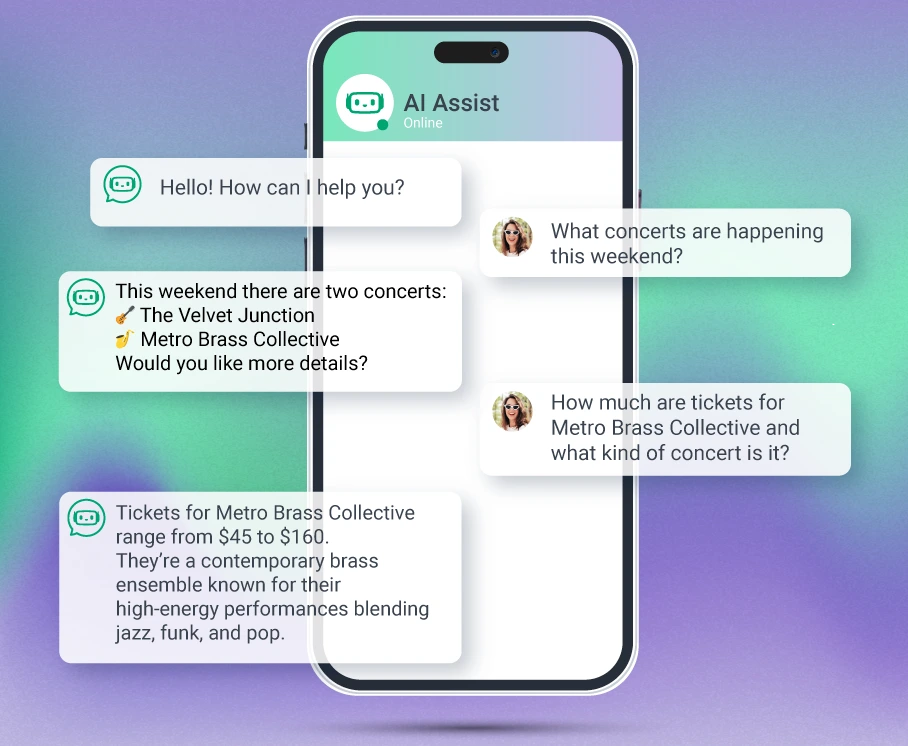
In fact, our R&D team has already taken this further: our AI Event Discovery Assistant lets ticket buyers search for events using natural language — asking things like "family-friendly events this Saturday under $100" — and delivers real-time, personalized results. Same principle of grounding the AI in your own data, applied to a full discovery and purchase experience.
- Fintech and payments: A support chatbot grounded in product documentation that handles questions like "how do I dispute a transaction" or "what fees apply to international transfers" without routing every query to a human agent. The guardrails feature is especially relevant here, where accuracy and compliance matter.
- E-commerce and ordering: The sub-agent feature means the system can be configured to guide users through a multi-step ordering process, capture preferences, and hand off to a backend fulfillment system, reducing manual effort on both sides.
- Internal knowledge management: Large enterprises with extensive policy libraries, onboarding documentation, or standard operating procedures can use the same setup to help employees find answers without searching through shared drives or escalating to HR and legal.
- SaaS and software products: For companies with complex product feature sets, a grounded chatbot can deflect common support tickets by surfacing answers directly from release notes, help documentation, and FAQs.
In each of these cases, the core advantage is the same: the chatbot draws strictly from verified, curated content, which means the answers it gives are consistent, auditable, and accurate to what the organization actually wants users to know.
Conclusion
What started as curiosity-driven exploration became a deployment-ready product and a practical foundation for building grounded AI chatbots on top of existing documentation. The team proved the concept, worked through the technical edges, and came away with hands-on experience on a platform we can now recommend to clients with confidence.
The chatbot is ready to go live, helping prospects get the answers they need faster and helping our sales team focus on the conversations that matter most. Contact Softjourn to learn how a grounded AI chatbot could work for your platform.