


The Need: Affordable QA Without Cutting Corners
When project budgets get tight, QA is usually the first thing to shrink. Teams cut test coverage, defer framework upgrades, and accept more risk in production because thorough testing takes time, and time costs money.
Even on projects where QA is fully staffed, the work is heavily mechanical. Writing test cases from user stories, generating test data, debugging routine failures, creating pull requests: each step requires a skilled engineer's attention, but most of the effort is repetitive rather than strategic. A mid-sized framework migration can take four to five hours. A single broken test can take 30 minutes to diagnose and fix. Test plans that should cover edge cases get trimmed to meet sprint deadlines.
The result is a familiar tradeoff. Teams either invest the hours and slow delivery, or they cut corners and accept gaps in coverage. Our R&D team wanted to know whether AI tooling could break that tradeoff, and what it would actually cost to try.

The Solution: The $40 Stack That Runs a Full QA Pipeline
The Cost of Entry
The entire AI tooling stack runs on two subscriptions: a leading large language model for reasoning and test generation, and an AI code completion tool for inline assistance in the IDE. Total monthly cost: roughly $40, which is comparable to about one hour of a senior QA engineer's time.
For context, the median salary for a senior automated QA engineer in the United States is approximately $118,000 per year, according to ZipRecruiter. That works out to about $57 an hour. A single framework migration, which this pipeline reduced from four to five hours down to roughly 15 minutes, represents over $225 in senior AQA time. Just completing one task, one time, already pays for more than five months of the tooling.
What that $40 buys is not a single feature or a shortcut on one step. It powers an end-to-end pipeline that covers seven distinct stages of the QA workflow, each of which used to require the engineer's full manual effort.

How the Pipeline Works
The pipeline starts when a QA engineer receives a user story and the associated code changes. From there, it moves through seven stages, with one critical human checkpoint built in by design.
1. Test planning: The engineer provides the user story and the developer's code changes to the LLM. It generates a structured test plan listing every scenario to cover, including edge cases, and flags any requirements that seem ambiguous or incomplete.
2. Human review: This is the deliberate checkpoint in the pipeline. The engineer reviews the test plan, discusses any flagged items, and approves or adjusts before anything gets implemented. No tests are written until the plan is signed off. This step exists specifically to prevent the AI from making assumptions about what should be tested.
3. Test implementation: Once approved, the LLM writes the actual test code in the project's framework. The engineer reviews the output but doesn't write it from scratch.
4. Test data generation: The LLM suggests test data sets for the approved scenarios. The engineer validates anything domain-specific, such as edge-case values or user-specific data, where business context matters more than pattern recognition.
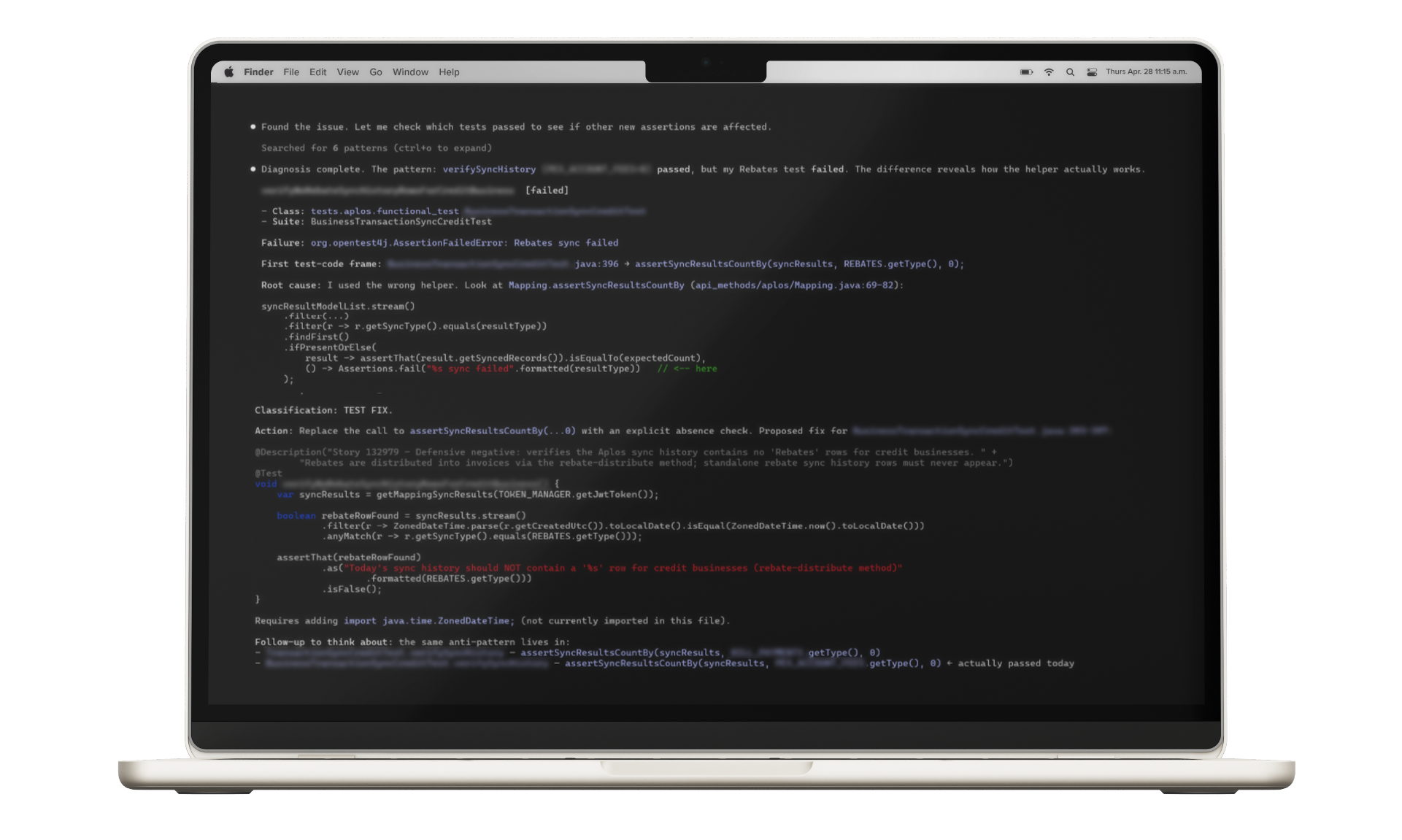
5. Failure analysis: When tests fail, the engineer shares the test report output with the LLM. A custom skill investigates the failure automatically: it traces what went wrong, reads the actual versus expected values, and classifies the outcome as a test issue, a backend bug, an environmental problem (such as an infrastructure outage), or a flaky result that needs a retry. Instead of the engineer combing through logs to find the failure point, the AI does the initial investigation and proposes a diagnosis.
6. Self-correction: If the diagnosis is a routine fix, the LLM applies the correction and re-runs the tests. For anything that looks off, the engineer and AI work through it together to find the root cause. The loop closes faster, but the engineer always has the final word.
7. Pull request creation: A custom skill file (a simple Markdown document encoding the project's conventions for branch naming, commit messages, and review checklists) triggers the final step: the AI creates the pull request following all project standards.
Putting It to the Test
A recent project put this pipeline to the test. The engagement involved end-to-end test automation for a marketplace platform with multiple third-party integrations, where each integration connects to an external API the QA engineer doesn't own. The field mappings between the platform and each partner system are non-obvious and easy to get wrong, making test coverage particularly time-consuming to build from scratch.
Previously, writing a new test for one of these integrations meant manually digging through the partner's API documentation, the developer's pull request, and existing mapping code just to figure out which field maps to which. For an unfamiliar API, that discovery alone took a significant chunk of time before a single line of test code was written. And when assertions failed, the engineer had to retrace the same path through logs to determine whether the mapping was wrong in the test or wrong in the code.
With the pipeline, the AI reads the user story, reviews the developer's pull request end to end, and surfaces the mapping logic without the engineer having to trace it manually. When a test failed on an incorrect field mapping, the failure analysis skill identified the wrong assertion and proposed the fix. What used to be a slow, manual investigation became a short conversation between the engineer and the AI.
"A framework migration that used to take me 4-5 hours now takes about 15 minutes. The AI does the mechanical rewriting; I validate the output." – Oleksandr Kisil, QA Engineer, Softjourn
Custom Skill Files: Making the Pipeline Repeatable
One of the details that makes this workflow sustainable across sessions is the use of custom skill files. These are plain Markdown documents that encode project-specific conventions, such as how branches should be named, what format commit messages follow, or what items belong on a review checklist.
Instead of re-explaining these conventions in every session, the engineer loads the relevant skill file and the AI follows the encoded rules. The PR creation step, for example, runs entirely from a skill file. The result is consistency: every pull request follows the same format regardless of when or how it was generated.
These skill files are shareable. Other team members have used them as templates for building their own workflows on different projects, adapting the conventions to their specific needs without starting from scratch.
“Since introducing the AI pipeline, we've seen a clear improvement in sprint throughput and test coverage — especially across our third-party integrations. What used to be a multi-day manual effort is now resolved in hours, without sacrificing quality.”— Oleksandr Chubatyi, Project Manager at Softjourn
The Benefits
The most visible change is in how the engineer spends their time. Before the pipeline, the majority of QA work was routine: writing test cases line by line, reading failure logs, formatting pull requests. The strategic work, deciding what to test, evaluating edge cases, applying domain judgment, was sandwiched between hours of repetitive writing.

With the pipeline handling those stages, that ratio flips. The engineer's attention goes almost entirely to oversight, planning, and domain-specific decisions. Test coverage per sprint increases because the bottleneck is no longer how fast someone can type test cases. It's how well they can evaluate what needs testing and whether the AI's output meets the bar.
For teams that have historically treated QA as a cost to minimize, this changes the math. A single QA engineer with this pipeline produces test coverage that would previously have required significantly more manual hours. Projects that might have shipped with abbreviated testing because the budget didn't allow for thorough QA can now get fuller coverage within the same timeline and team size.
Results
Task | Before | After |
Framework / test migration | 4-5 hours | ~15 minutes |
Single broken test repair | ~30 minutes | ~5 minutes |
Test plan drafting | 30-60 minutes | Minutes (with review) |
Monthly AI tooling cost | N/A | ~$40/month |
What We Learned
- The human checkpoint is the whole point: The pipeline is deliberately not autonomous. AI will confidently generate tests for the wrong scenarios if left unchecked, so the plan gets approved before any code is written.
- Break the pipeline into discrete steps, not one long session: Running everything as one continuous conversation can hit context limits mid-task. Splitting into defined stages keeps things reliable and makes any single step easy to restart.
- Domain knowledge still belongs to the engineer: AI-generated test data is a useful starting point, but edge cases that depend on business context require human input. The pipeline doesn't replace product expertise.
- Reusable skill files save more time than you'd expect: Writing project conventions into simple files means the AI doesn't need to be re-taught at the start of every session, and other engineers can adopt the workflow by adapting those files to their own projects.
Conclusion: More Coverage With a Smaller Tooling Cost
This pipeline didn't start as a formal initiative. It grew from a QA engineer asking a practical question: which parts of my daily workflow are routine enough for AI to handle, and which ones genuinely need my judgment? The answer turned into a repeatable, seven-step process that runs on $40 a month in tooling, is now in active use on live client projects, and can be adapted by any QA team to their own framework, conventions, and project needs.
For organizations weighing the cost of thorough QA against delivery timelines, the takeaway is simple: the investment required to dramatically expand what one engineer can accomplish is smaller than you might think.
Our R&D team tests AI-powered workflows on real projects before we ever recommend them to clients. Contact Softjourn to learn how our QA engineering team can bring that same approach to yours.