
Choosing an Outsourced QA Partner? Ask These 7 Questions First
Finding the right QA outsourcing partner has less to do with vendor demos and far more to do with asking the right questions before you sign.

Finding the right QA outsourcing partner has less to do with vendor demos and far more to do with asking the right questions before you sign.
If you're considering outsourcing QA or software testing to speed up release cycles and reduce costs, you're in good company. Research suggests that over 70% of businesses outsource at least some portion of their QA or software testing, with more than half of Fortune 500 companies outsourcing critical QA functions entirely.
The question most of them wish they had spent more time on is not whether to outsource, but how to choose the right partner.
Choosing outsourced QA services is not a simple vendor comparison. You are making a decision that affects your release confidence, your team's capacity, your security posture, and — depending on your industry — your regulatory standing.
The cost of choosing poorly is not just wasted budget. It is production incidents, missed deadlines, and QA processes that your own engineers end up having to rescue.
The questions below will help you dig deeper and envision what a QA outsourcing company actually looks like as a working partner.

Question 1: "What does your QA process look like from kickoff to release?"
This is intentionally open-ended. A confident QA partner will walk you through their process in detail: how they gather requirements, how they scope coverage, how they prioritize test cases, and how they report findings throughout a sprint. A hesitant or generic answer here is worth noting.
What you want to hear is a process that moves in parallel with development rather than piling up at the end of a release cycle. As Softjourn's CTO, Jeff Kreuser, puts it: "The sooner you catch a flaw, the cheaper it is."
That's not just an intuition. According to research by IBM's Systems Sciences Institute, fixing a bug after release can cost up to 100x more than catching it during development.
A QA partner whose process only activates at the end of a sprint is, in effect, more expensive.
Follow-up Questions to ask:
"How do you handle testing when requirements change mid-sprint?" and "How early in development does your team get involved?"
Question 2: "How much experience do you have in our industry?"

A QA team that has only tested consumer apps will approach a fintech platform or a high-volume ticketing system very differently than a team that has operated in those spaces before. Domain knowledge shortens ramp-up time, reduces the number of questions your team has to answer, and leads to more relevant test coverage from the start.
Ask for specific examples, related case studies in your industry, and about the regulatory environment in your sector to see whether the response reflects real familiarity or surface-level awareness.
For instance, QA in financial services means navigating PCI DSS requirements, transaction edge cases, and data accuracy at a level of scrutiny that is categorically different from testing a marketing website. The same is true for healthcare, regulated SaaS, and enterprise platforms with strict SLAs.
Case Study: Tribal Credit
When fintech company Tribal Credit needed to build out QA processes for both their 1.0 and 2.0 systems simultaneously, Softjourn's team came in with a clear strategy. They established manual and automated testing workflows, implemented CI/CD tooling, and created a regression process the client still uses today.
Question 3: "How do you decide what to automate and what to test manually?"
This question reveals a lot about a QA partner's maturity. Teams that automate everything, or teams that avoid automation entirely, are both telling you something worth hearing.
The real answer is that the decision depends on the type of test, the stability of the feature, and the cost-benefit of maintaining automated scripts over time. Regression testing is a strong candidate for automation, while exploratory testing and usability validation generally are not.
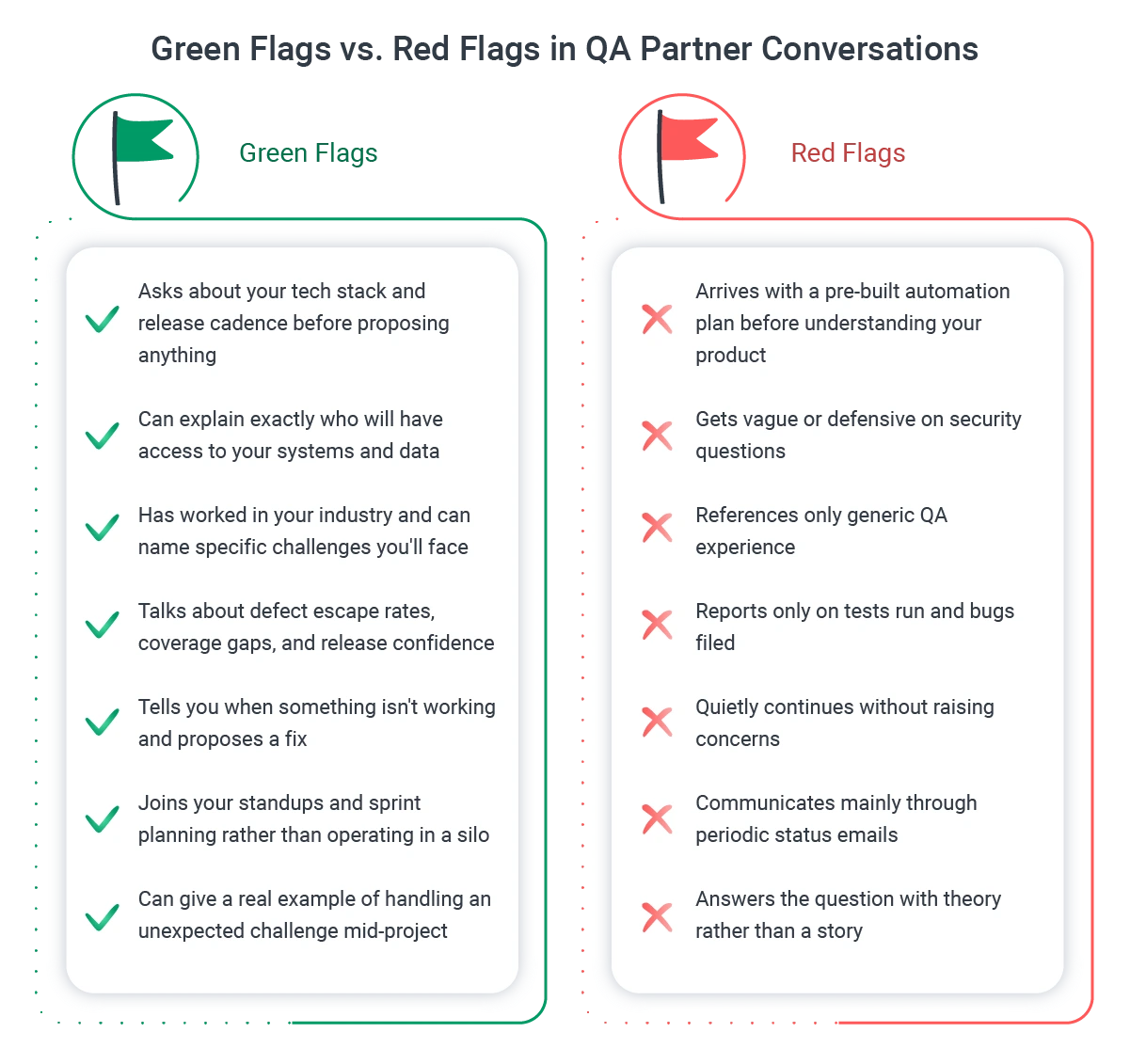
A good QA outsourcing company will ask about your current test coverage before making any recommendations. If they arrive with a predetermined automation plan before understanding your product, that is a red flag.
What good looks like:
A QA lead who asks about your tech stack, your release cadence, and your highest-risk user flows before proposing any test automation strategy.
Case Study: Performance Testing for a Global Expense Management Leader
When a global expense management platform needed to identify and remove performance bottlenecks across their system, they didn't need more bug hunters. They needed a specialized team focused entirely on load, speed, and stability. Softjourn provided a dedicated performance testing team that worked through API endpoints, created test scripts, and surfaced bottlenecks that standard QA would have missed.
Question 4: "How will your team actually work alongside ours day-to-day?"

Collaboration structure matters more than most teams realize before a partnership starts. A QA team that operates in a silo, only sending defect reports over the wall, creates overhead rather than value. What you are looking for is a team that joins your standups, participates in sprint planning, and flags risks early rather than surfacing them at release time.
Ask specifically about: which communication tools they use, whether they join meetings or only communicate asynchronously, how they handle overlapping time zones, and who your main point of contact will be week to week.
If real-time collaboration matters to your team, that answer should shape which engagement model you choose. For instance, nearshore QA partners may offer better working hours overlap than offshore teams operating in distant time zones, but may cost more, so it's important to weigh the pros and cons.
Question 5: "How do you protect our data and stay compliant with our security requirements?"

QA environments frequently touch staging data, user records, and system configurations that could be sensitive. For companies operating in fintech, healthcare, or any regulated sector, this question is non-negotiable.
Ask who specifically will have access to your systems, whether testers sign NDAs and what access controls are in place. Additionally, ask whether they have experience with specific frameworks that apply to you: PCI DSS, GDPR, HIPAA, SOC 2, and what happens to test data after the engagement ends.
A partner that is accustomed to operating in regulated environments will not hesitate on any of these questions. Hesitation or vagueness here is a meaningful signal to not pursue a partnership if you are in a data-sensitive industry.
Minimum expectations:
Documented access control policies, NDA standard practice, experience with relevant compliance frameworks for your industry, and a clear policy on test data handling and disposal.
Case Study: Engineering Process Maturity for a US Financial Institution
When a Texas-based bank was preparing for regulatory audits and modernizing its infrastructure across a multi-vendor environment, Softjourn came in to formalize their entire development and QA process from the ground up. That meant structured SDLC practices, manual and automated testing protocols, disaster recovery plans, and a hybrid AWS/Azure cloud architecture built to banking security standards. The bank passed its FDIC audit and the practices Softjourn introduced remain in use as internal standards today.
Question 6: "What does success look like, and how will you report on it?"

A QA partner should be measuring the same things your business cares about. That means defects caught before production, escape rate from releases, test coverage across critical paths, and cycle time impact. If their reporting focuses only on tests run and bugs filed without connecting to business outcomes, you have misaligned incentives.
We recommend that you request a sample report and ask how often they review metrics with clients and whether they adjust their strategy based on what the data shows. The difference between a vendor and a real partner often comes down to whether they are willing to say: "This is not working, and here is what we want to try instead."
Question 7: "What happens when something goes wrong mid-engagement?"
Things go wrong. Requirements change, an environment breaks, or a critical release date moves up. How a QA partner responds under pressure tells you more about them than any proposal document.
When you ask this question, listen for specifics. Good answers include immediate escalation protocols, transparent communication during incidents, and flexibility to reallocate resources when priorities shift. Vague answers like "we handle problems as they come up" without further detail should prompt a follow-up.
Ask about a specific example from a past project to see if they have real experience with unexpected challenges, and not just theories about what they might do.
A Note on Pricing Conversations
Cost is part of every partnership decision, but the companies that optimize purely on hourly rate tend to pay for it later in production incidents, shallow test coverage, and the overhead of managing a team that was never truly embedded in their delivery process.
A more useful question than "What is your rate?" is "What does a typical engagement look like for a team of our size, and what does that cost over three months?" That framing usually produces a much more honest and useful conversation.
Starting the Search

Before reaching out to any QA outsourcing company, get specific about what you actually need. Not "more testing," but:
- Where your current coverage is weakest
- What your highest-risk user flows are
- Whether you need automated testing services built from scratch or an extension of what you already have
- How quickly you need capacity added
The more specific your requirements are going into the conversation, the easier it becomes to evaluate whether a partner is genuinely suited to your situation or just capable of fitting your brief on paper.
Ready to Build a Stronger QA Process?
Contact Softjourn to get started on building or extending your QA team with experienced engineers who have worked across fintech, ticketing, expense management, and enterprise software. Our QA team is happy to walk through your current setup, propose a practical starting point, and answer all of your questions. Contact us to get started.