










 RAG System in Production
Softjourn's AI development team builds retrieval-augmented generation (RAG) systems that answer questions from your documents, databases, and project records, with a source behind every answer. We prepare your data, design the retrieval pipeline, and test answers on your real questions before launch. Our own RAG system runs on 25+ years of Softjourn project history.
Software teams in fintech, ticketing, and expense management:
RAG development services cover the path from raw content to an answer a person can trust: collecting and cleaning sources, splitting and indexing them, retrieving the right passages for each question, and generating an answer that cites them. The RAG system is the knowledge layer of an AI product; a chatbot is one way people reach it, with conversation design, channels, and handoff built on top through AI chatbot development by Softjourn engineers on top of the retrieval pipeline. AI integration connects models to the products you already run. We build the knowledge layer to serve a chatbot, an internal search tool, a Slack assistant, or a feature in your product.

Assistants that search internal documentation, policies, and project history and return an answer with links to its sources. New hires find answers without knowing where a document lives, and experienced staff stop answering the same questions in chat. We deliver them in tools your team already uses, such as Slack or an internal portal.

The retrieval layer behind a customer chatbot or a search feature inside your product. We connect it to your content and live records and expose it through an API, so product teams build on answers that stay grounded as content changes.

Retrieval across documents, help center articles, and structured records such as JSON or CSV exports from your systems. Our website chatbot proof of concept answers from both types of data and links each answer to the page it came from.

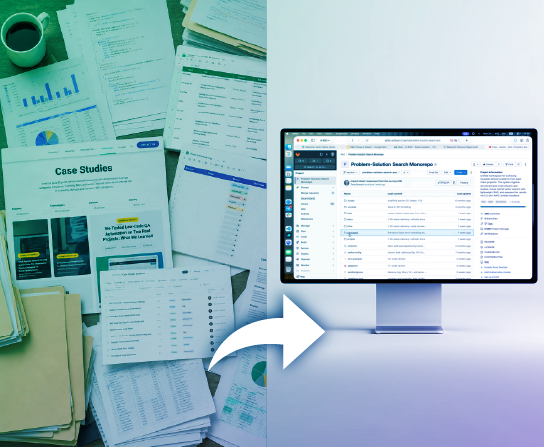
One knowledge base built from sources that were never designed to work together. For our own knowledge base, three separate ingestion pipelines turned case studies, engineer surveys, and project feature logs into one searchable index.

Retrieval as a step in a multi-step AI workflow, where an agent looks up facts before it scores, drafts, or decides. Our lead intelligence pipeline retrieves past project experience before it scores a prospect. AI agent development covers the actions agents take after retrieval.

Test sets built from your real questions, accuracy checks for each step of the pipeline, and monitoring after launch. When content, prompts, or models change, the same tests run again, so a drop in answer quality shows up before your users notice it.
RAG gives a model access to your current data at the moment of the question. Fine-tuning trains a model on examples to change how it writes or classifies. Prompting puts instructions and reference text into the request itself. Questions about internal knowledge usually need RAG, because the answers depend on documents that change every week. We check which option fits at the start of every project and recommend the simpler one when it does the job.
Your answers live in documents, records, or tickets that change often. Users need to see where an answer came from, and access to content differs between users. The knowledge base is larger than a single prompt can hold, from hundreds of pages to millions of records. Retrieval keeps answers current in all of these cases without retraining a model.
Each source gets its own ingestion step, because content arrives in different shapes: a case study is a long narrative, and a feature log lists what was built without saying why. Ingestion extracts the text, removes duplicates, and adds missing context, such as the client problem behind each feature log in our own knowledge base. Answers are only as good as the content behind them.
We split long documents into short passages that each make sense on their own, such as one section of a policy or one answer in a help article. We tag each passage with details such as its source, date, product, or region. These tags let the system narrow the search before it starts, so a question about one product only searches that product's documentation.
We convert each passage into an embedding, a numeric representation of its meaning, so the system matches passages to a question by meaning rather than exact wording. Embeddings live in a vector database or a search engine such as Elasticsearch, chosen by data volume, your current systems, and whether users also search by exact terms like order numbers. Our own knowledge base keeps them on AWS.
Semantic search finds passages that match the meaning of a question even when the wording differs. Structured filters narrow results by fields such as price, date, or availability. Reranking then puts the most relevant passages in front of the model. A question like “which plans under $25 a month include API access” runs through all three steps.
Content changes after launch, so the pipeline updates the index on a schedule or whenever a source document changes. Data that changes by the minute, such as prices, stock levels, or account balances, never goes into the index. Each answer pulls it live from the source system at the moment of the question.


Each answer links to the document, record, or page it came from, so users can check it in one click. Our website chatbot proof of concept returns a direct link to the relevant page with every answer. Reviewers and compliance teams use the same links to see what the system said and why.

When retrieval finds nothing relevant, the system says so and offers a next step instead of guessing. We set this rule before the first prompt is written. For instance, our own website chatbot proof of concept answers only from Softjourn’s documentation and gives a fixed reply to questions outside it.

Before launch, we collect the questions your users ask most often, agree on the expected answers, and measure how often the system gets them right. The same test set runs again after every change to content, prompts, or models.

Retrieval and generation fail for different reasons, so we measure them apart. In our own knowledge base, each step scored 70–90% accuracy on its own, but chained together the errors added up and the end-to-end results were noticeably weaker. Measuring each step separately showed us where the chain needed work.
Access rules belong inside retrieval.
Our 25+ years of work on secure financial software give our engineers practical experience with PCI DSS constraints on payment data.
Softjourn's R&D team turned case studies, engineer surveys, and project feature logs into one AI-searchable knowledge base.
We plan client projects around that split.
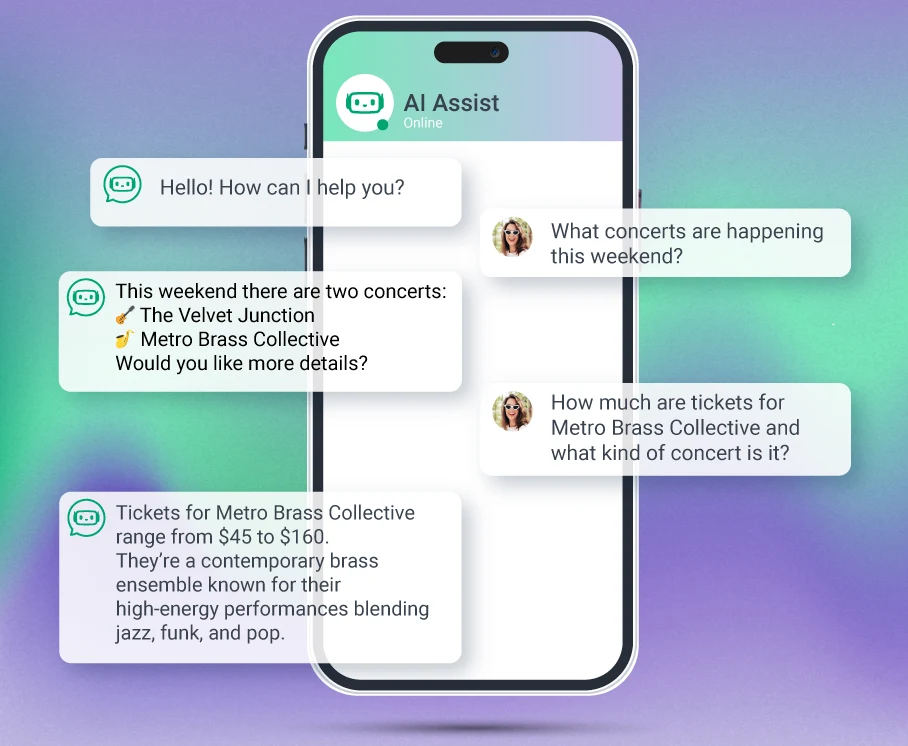
A proof of concept for ticketing platforms that runs a request such as “find a family-friendly event this Saturday under $100” through semantic search, live price and availability filters, and reranking. Routing each query to a model that fits its complexity through OpenRouter and Cohere cut model costs by up to 60%. The assistant connects to an existing ticketing platform with no changes to that platform.

Built on Google Cloud Vertex AI, this proof of concept answers prospect questions from Softjourn case studies and documentation stored as JSON, CSV, Markdown, and plain text. Every answer links to the relevant page, responses arrive in under half a second, and questions outside the approved content get a fixed reply.
Every RAG project starts with the data, because the sources set the ceiling for answer quality. In the data assessment, we review a sample of your content, the systems it lives in, and the access rules around it, and agree on the questions the system must answer. A proof of concept then tests retrieval on a few of your real sources. Once results hold up against your test questions, we build the full pipeline, run evaluation, and launch to a first group of users. After launch, we keep the index current and track answer quality as your content grows.
RAG System in ProductionSoftjourn has built software for event ticketing, fintech, and expense management companies for 25+ years. That work shapes how we plan RAG systems in these industries: which data changes by the minute, which records carry payment or personal data, and which documents arrive as scans or exports. We build RAG systems for other industries too when the technical fit is right.
In a data assessment, most of the time goes to learning where records live, how fresh they must be, and who is allowed to see them. For ticketing, fintech, and expense platforms, our engineers know this context from past projects. This means the assessment can move straight to your specific sources, and we can say early which data belongs in the index and which should come from live queries.
Event catalogs, venue policies, and help content go into the index, while prices and availability come from live queries because they change by the minute. Our event discovery proof of concept combines both in a single answer.
Product documentation, fee schedules, and dispute policies make strong RAG sources. Transaction and card data needs masking before indexing and filtering by user permissions, and every answer needs a record for audit.
Expense policies, travel rules, and approval guidelines answer most employee questions. Receipts often arrive as photos or PDFs and need text extraction before search, and each answer has to follow the company's current policy version.
Four things drive the build cost for RAG development: the number and condition of your data sources, the cleaning and structuring they need, the access rules the system has to respect, and the depth of evaluation before launch. Running cost depends on query volume and the models you use, and routing simple requests to lighter models keeps it predictable. Teams that want RAG as a service can hand us the system after launch, including index updates, quality monitoring, and model changes. We can provide an estimated cost after the data assessment.
A fixed-scope build that tests retrieval on a sample of your real data. You get a working prototype, accuracy results on your own questions, and a recommendation on whether and how to move to production.
RAG application development services build software that answers questions from your own data by retrieving relevant passages first and generating an answer from them. The work covers data preparation, the retrieval pipeline, answer generation with sources, evaluation, and integration into the apps your users already work in. Softjourn builds RAG systems as part of its AI development services, alongside chatbots, agents, and AI integration.
ChatGPT is an application built on a language model. By default, it answers from what the model learned in training, and features such as web search or file uploads add a form of retrieval. A RAG system built for your company connects a model to your private, current data under your access rules, so each answer comes from your documents with a link to its source.
Yes. Larger context windows let a model read more text at once, but sending a full knowledge base with every question is slow and expensive, and it still needs access control. Agents and newer methods such as graph RAG use retrieval as a core step. The change is in how retrieval runs, moving from a single search to multi-step lookups inside agent workflows.
The common types are basic RAG, with one search and one generation step; advanced RAG, which adds query rewriting, filters, and reranking; agentic RAG, where an agent decides when and where to search across several steps; and graph RAG, which retrieves through relationships between entities. The advanced pattern covers most business use cases, where answers depend on filters such as product, date, or region. We choose the type after testing on your data.
Yes. We run open-source models and the vector database inside your own cloud account, so documents and questions stay in your infrastructure. When you use hosted models, we mask personal and payment data before it reaches the model and log each request for audit. We define the setup during the data assessment, based on your compliance requirements.

We were encouraged because Softjourn asked the right questions, involved people with the right experience in to the conversations. Showed good leadership in managing the process of walking them through the sales process, keeping them on track, and has a lot of strong knowledge in the financial area, as they are a small software developer company and there are always so many other things that are pulling us in multiple directions. As well Softjourn shows a lot of experience in multiple programming languages and in combining them in to one product.

The CTO left the company after about eight years, and I needed to replace him. I didn't want to replace him with a single CTO because that created a single point of failure, so I went back to Softjourn. You just can't run an SaaS company without development work. Nearly every time I meet someone, and they're having problems with developers, I tell them "you need to call Softjourn". Softjourn just gives me tremendous peace of mind, and I can't emphasize that enough.


Softjourn really helped us grow to the next phase, and provided the stability for the transition to 2.0. I really enjoyed working with Softjourn, and am excited to keep on working with them.


I felt like Softjourn offered a much more professional approach, distance never became an issue, and the team really understood the goals of our project. There was a lot more collaboration rather than a one-way push saying this is what you need to do.