
Is Blockchain Dead? What Survived the Hype, and What We Got Wrong in 2018
Blockchain isn't dead, but the 2018 hype is. We checked our 2018 predictions against 2026: what failed, what banks absorbed, and when you still need it.

Blockchain is not dead, but the version sold in 2018 is: the use cases moved into banks and market infrastructure, and much of the technology built for them did not survive. We watched this from the inside. Softjourn has built custom software for fintech and ticketing companies for 25+ years, and we built our first blockchain projects in 2017. In June 2018, two of our engineers spent two days at the European Investment Bank's Blockchain Challenge building a "smart commercial paper" on Quorum, the permissioned version of Ethereum that J.P. Morgan had open-sourced.
Eight years later, the idea reached the market. In June 2026, the EIB issued its first DLT-native commercial paper, an instrument that exists only on a distributed ledger (DLT, the wider family of technology that blockchain belongs to). Two of its investors then used the €77.5 million paper as collateral for financing from the Bundesbank. That same month, Consensys ended support for GoQuorum, the platform our prototype ran on, archived its repository, and said it does not recommend GoQuorum for new projects.
The use case survived, and the technology under it was replaced. In this article, we hold the predictions we published and quoted in 2018 up against what actually happened, look at where blockchain earns its place in 2026, and give fintech and ticketing leaders a 5-question test for deciding whether their product needs it.
TL;DR
- Blockchain is alive in 2026, but the 2018 hype is over, and most of the big consortium projects from that era closed because too few companies joined and paid for them.
- What works today is settlement infrastructure: stablecoins on public chains, plus tokenized bonds and bank deposit tokens run by banks and market operators.
- Blockchain is worth considering only when you settle money or assets with parties outside your own ledger, and even then, a regulated provider is usually the better route.
Is Blockchain Dead in 2026?
Blockchain is still alive, but it now runs in the back office of the financial institutions it was supposed to replace, and the excitement around it is gone.
In its 2024 Hype Cycle for Web3 and Blockchain, Gartner placed smart contracts and NFTs at the entrance to the "Trough of Disillusionment". In March 2025, Gartner VP Adrian Leow summed up the mood for CIO.com: "Blockchain has a lot of promise, but it's tactical." In the same article, Nationwide CTO Jim Fowler called it "a bright and shiny object that has zero to no use". By then, board attention and budgets had moved to AI.
Much of the confusion comes from treating crypto prices and ledger technology as one thing. When an NFT collection crashes or a token loses 90% of its value, that tells you about speculation. The technology itself now runs at firms such as DTCC, which operates the main US securities settlement system, and at JPMorgan, Visa, and HSBC, which is a very different crowd from the ICO startups of 2017.
Our reading, after building on blockchain and then watching most of the big projects close, is that it lasted as shared settlement infrastructure between institutions that don't share a ledger. It faded as a product feature wherever one company already controls the whole process.
What We Predicted in 2018, What the Market Predicted, and What Happened
Both sides missed the big adoption numbers. The calls that held up were narrow ones: a bank's own dollar token, a single instrument moved onto a ledger, and payments that hide the blockchain from the user.
In 2018, we interviewed two blockchain experts for our Expert Talk series, Dr. Neil Wasserman of George Washington University and Dr. Andreas Freund of Tata Consultancy Services, published a white paper on smart contracts, and repeated the industry forecasts of the day in our articles and sales emails. Banks, consultancies, and governments were making their own calls at the same time. We went back through both sets and checked them against where things stood in October 2026.
Theme | What we said | What the market said | What happened by 2026 |
|---|---|---|---|
Adoption | We cited PwC's 2017 finding that 77% of financial institutions expected blockchain in production by 2020. Did not happen | The World Economic Forum (2015) expected "10% of global gross domestic product (GDP) stored on blockchain technology" by 2027. Off track | Deloitte's 2020 survey found 39% of respondents with blockchain in production. In Gartner's 2019 survey of CIOs, only 11% had deployed blockchain or were in short-term planning with it. Tokenized real-world assets on public blockchains totaled about $39 billion in October 2026 (rwa.xyz), well under 0.1% of world GDP |
Business value | Our 2019 sales emails quoted Gartner: blockchain would add $176 billion of business value by 2025. Can't verify | The same Gartner forecast cycle warned that "as much as 90% of current enterprise blockchain implementations will fail by 2021" (The Block, 2019). Partly | Nobody has published a measurement comparable to the $176 billion. The failure call held a year or two late, with TradeLens, ASX's CHESS project, we.trade, Marco Polo, and Contour all closed by 2023 |
Payments | Dr. Neil Wasserman, blockchain instructor at George Washington University, in our 2018 interview: blockchain will become "useful but invisible". Came true | Facebook's Libra "is expected to launch in 2020" (NPR, June 2019). Did not happen | Libra, renamed Diem, never launched, and its assets went to Silvergate in January 2022 for about $182 million. Visa, Stripe, and PayPal now run stablecoin payments that merchants receive in local currency |
Bank money | Our 2019 prototype: banks will let customers buy and sell crypto inside regular accounts. Partly | JPMorgan announced JPM Coin, "a digital coin representing United States dollars" (UPI, February 2019). Came true | JPM Coin became Kinexys, which averaged about $7 billion a day by August 2026. US banks and brokers such as Schwab, E*Trade, and PNC added crypto trading in 2025 and 2026, while UK banks still restrict it |
Capital markets | We bet on it in 2018: two of our engineers took the EIB's challenge to put commercial paper on a blockchain and built a proof of concept on Quorum. Came true | ASX said its blockchain settlement system "will put Australia at the forefront of innovation in financial markets" (ASX, December 2017). Did not happen | ASX scrapped the project in 2022 and wrote off A$245–255 million. The EIB issued €77.5 million of DLT-native commercial paper in June 2026, and DTCC launched its tokenization service on October 28, 2026 |
Trade | Dr. Wasserman (2018) named IBM and Maersk's shipping platform as a case where blockchain is clearly better. Did not happen | At the TradeLens launch, with 94 organizations signed up, a partner said it "will generate tremendous savings for our industry over time" (Marine Log, August 2018). Did not happen | Maersk shut TradeLens down in 2022 because "the need for full global industry collaboration has not been achieved" |
Costs | Dr. Andreas Freund, head of technology at Tata Consultancy Services' blockchain practice, in our 2018 interview: fees and speed would be fixed so fast that, looking back from 2020 or 2022, we would wonder why we had worried. Partly | Accenture (January 2017) put blockchain's potential savings for investment banks at 30% of infrastructure costs, or "$8 billion to $12 billion in annual cost savings". Can't verify | Ethereum fees peaked around $60 in May 2021 and fell to about four cents per swap after the 2024 and 2025 upgrades. No bank has published savings on the scale Accenture described |
Identity and government | Dr. Freund (2018): identity use cases would be the first step to mass adoption. Did not happen | Dubai planned to conduct "the entirety of its transactions using Blockchain by 2020" (Dubai Future Foundation, 2016). Partly | Trading and stablecoins drove adoption instead. Dubai reports 24 blockchain use cases, 15 of them fully implemented, and gives no share of transactions |
Scorecard: our side has two calls that came true, two partly, three misses, and one we can't check. The market's side has one that came true, two partly, three misses, one off track for 2027, and one we can't check.
Gartner managed to get both outcomes into one forecast cycle: a $176 billion value forecast nobody has measured since, and a 90% failure warning that held up, a year or two late. Dr. Wasserman came closest in 2018: "Blockchain is going to stay in the background in a lot of ways, so it will become useful but invisible."
Why Did the Blockchain Hype Fade?
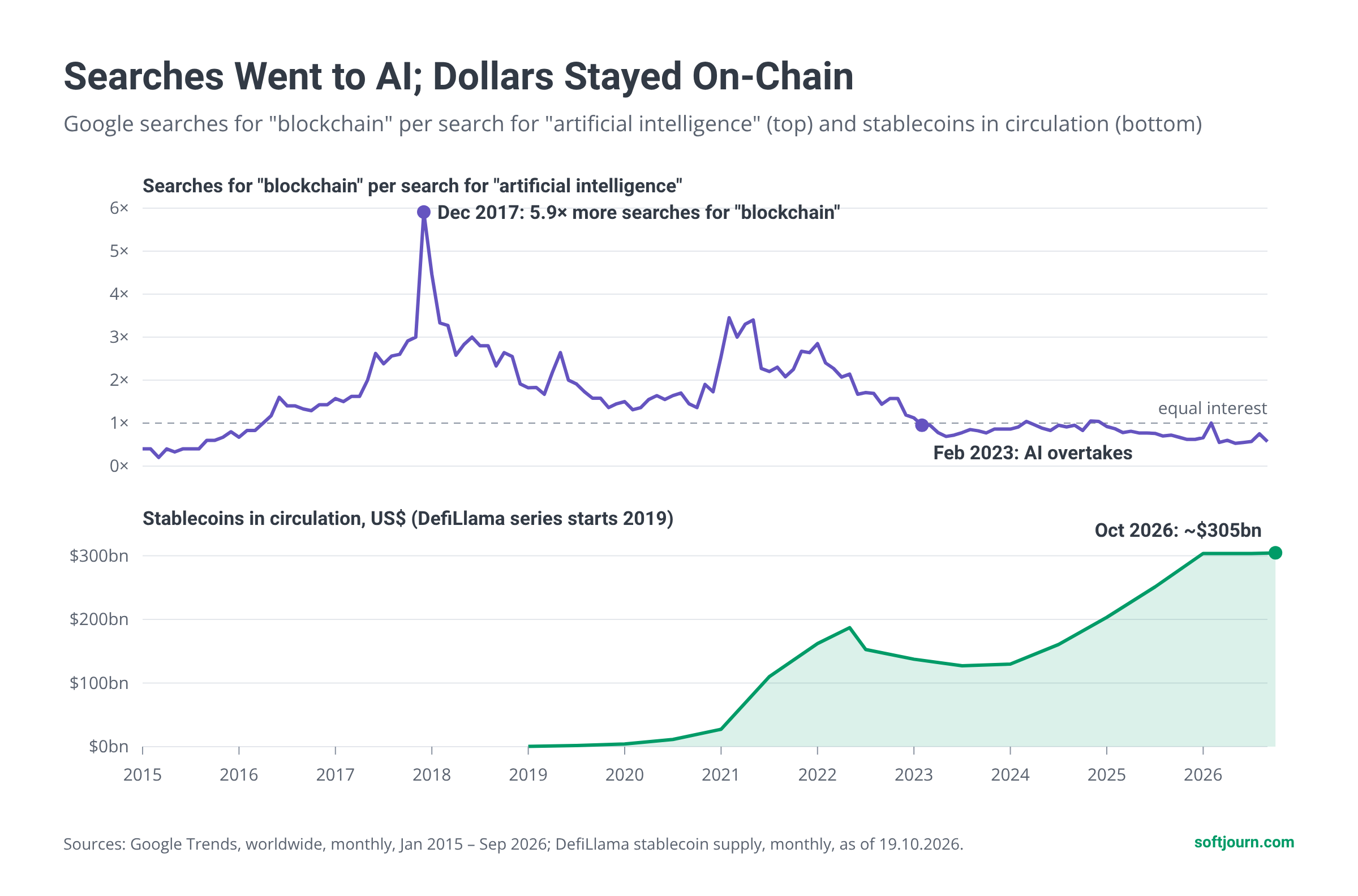
At the peak, the word alone moved markets. In December 2017, people googled "blockchain" almost six times as often as "artificial intelligence", according to Google Trends worldwide web search data. That month, Long Island Iced Tea renamed itself Long Blockchain, and its stock jumped more than 380% intraday. In January 2018, Kodak's shares more than doubled after it announced KodakCoin. KodakCoin never launched publicly, and the SEC revoked Long Blockchain's registration in 2021.
By early 2023, AI had overtaken blockchain in search interest. The money moved the other way, and stablecoin supply kept growing long after the searches fell off.
Looking back at our own projects and the industry's, four things took the air out of the hype.
Nobody Wanted to Fund the Shared Network
The flagship enterprise projects of 2017–2020 closed one after another:
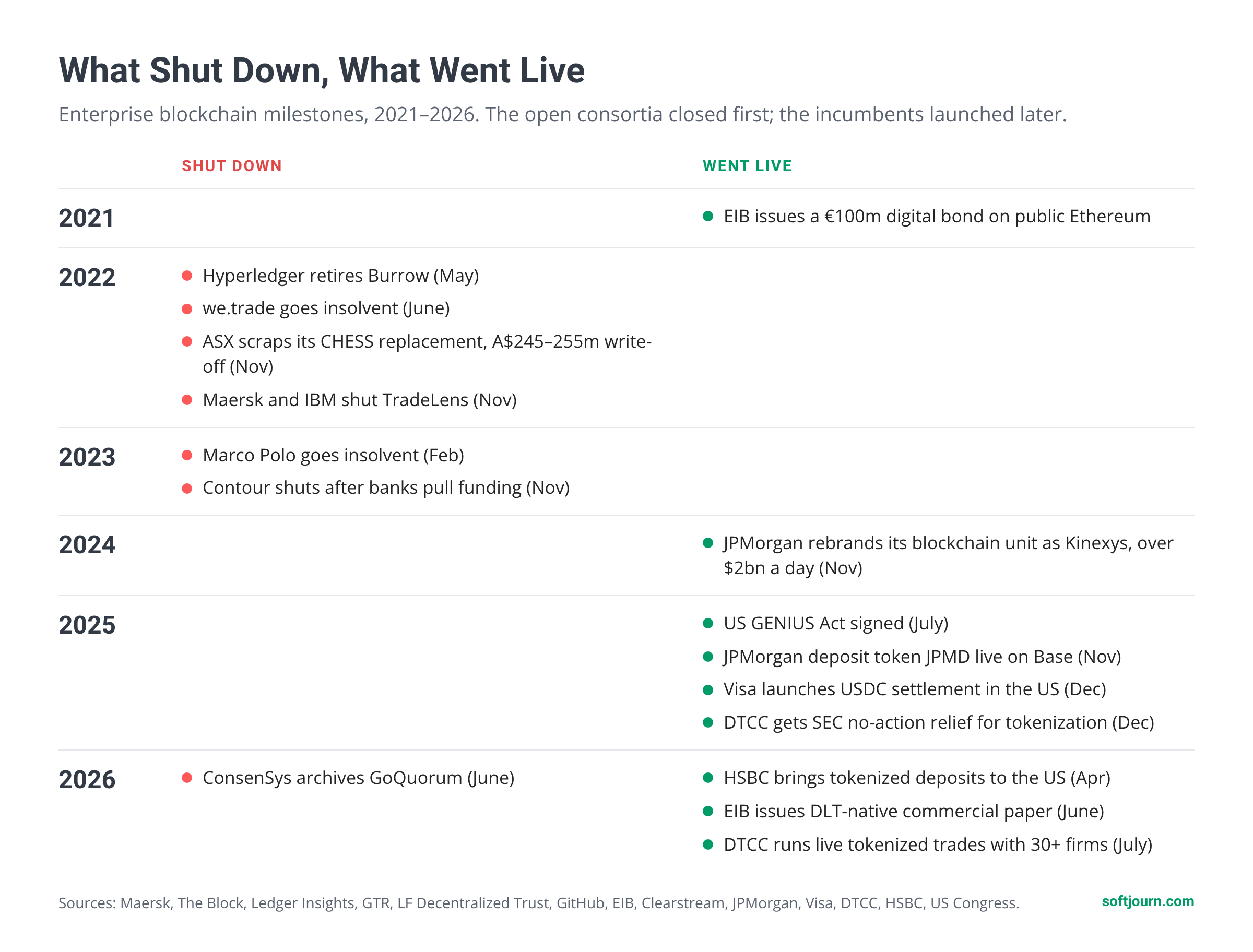
- Maersk and IBM discontinued TradeLens in November 2022.
- The Australian Securities Exchange scrapped its blockchain-based CHESS replacement the same month and wrote off A$245–255 million; its chairman cited "significant technology, governance and delivery challenges" after an independent review.
- The bank-backed trade finance networks we.trade, Marco Polo, and Contour shut down in 2022 and 2023. Contour closed after its bank shareholders pulled funding.
The consortium projects failed on participation. A shared ledger only pays off when a whole industry joins it, pays for it, and agrees on the rules, and that turned out to be a much harder sell than the technology itself. The ASX system, run by a single operator, failed on delivery.
In 2019, we wrote that regulation, trust, and getting a network together were the biggest barriers to adoption. Regulation is the one that moved. Getting a network together never got easier, and it is what ended most of the big consortium projects.
Fees and Speed Got Fixed, Too Late for the Hype
In 2018, an Ethereum transaction could cost dollars and take minutes to confirm. Dr. Freund told us he expected those problems to be history by 2020 or 2022. Fees went the other way first, peaking at an average of around $60 in May 2021.
The fixes came later. The Merge moved Ethereum to proof of stake in September 2022, but by Ethereum's own account, it was never meant to lower fees. Costs fell with the upgrades that followed: Dencun made layer-2 networks, which batch transactions on top of Ethereum, cheaper in March 2024, and Fusaka followed in December 2025. A token swap on Ethereum costs about four cents as of October 2026, but by the time costs came down, most enterprise buyers had stopped asking.
AI Took the Budget and the Developers
Gartner's Adrian Leow told CIO.com that executive interest in blockchain dropped as boards asked CIOs to invest in AI, and developers followed the money. Electric Capital counted 7% fewer active crypto developers in 2024, while the number of developers with two or more years of experience grew 27%. In other words, the newcomers left and the experienced developers stayed, and many of them are now picking up AI work as well. By March 2026, 53% of web3 job posts mentioned AI skills, according to CryptoJobsList.
Centralized Systems Caught Up
Conventional systems solved many of the problems blockchain promised to solve. The Federal Reserve's FedNow service settled about 5 million instant payments worth around $275 billion in the second quarter of 2026, and The Clearing House's RTP network raised its limit to $10 million per payment in 2025.
Ticketing went the same way. Ticketmaster has used rotating, phone-bound barcodes since 2019, which address the counterfeit ticket problem that blockchain tickets were pitched to solve. For most teams, a well-built database turned out to be the faster and cheaper answer.
Where Blockchain Actually Works in 2026
Banks and market utilities such as JPMorgan, DTCC, HSBC, and Broadridge run regulated money on their own permissioned networks and, increasingly, on public ones, and they use them where many parties need to settle with each other around the clock. Most stablecoin volume, by contrast, still runs on public chains. Each area below is real, and each is still small next to the systems it sits beside.
Stablecoins: Regulated, Growing, and Still Small as Payments
Stablecoins are tokens pegged to a currency, usually the US dollar, and they are the clearest survivor. Total supply reached about $302 billion in October 2026, according to DefiLlama.
Regulation has caught up with them. The US passed its first federal stablecoin law, the GENIUS Act, in July 2025, and the OCC, the federal regulator of national banks, issued its final implementing rule on October 21, 2026; the rule and the law take effect on January 18, 2027. In the EU, the MiCA rules on crypto-assets have applied to stablecoins since mid-2024, and since July 1, 2026, crypto service providers without a MiCA license have had to wind down their EU business. In the UK, the FCA published final rules for its cryptoasset regime in June 2026: firms can apply from September 30, 2026, and the regime takes effect on October 25, 2027.
The big payment companies have built on top. Visa started settling in USDC with its first US banks in December 2025, and by September 2026, its stablecoin settlement volume had passed a $20 billion annualized run rate, more than 15 times the year before, with more than 160 stablecoin-linked card programs on its network. Stripe lets businesses accept stablecoins and settles them in local currency, with no chargebacks and a $10,000 per-transaction limit. PayPal launched Pay with Crypto in July 2025 with a 0.99% transaction rate that ran until July 31, 2026.
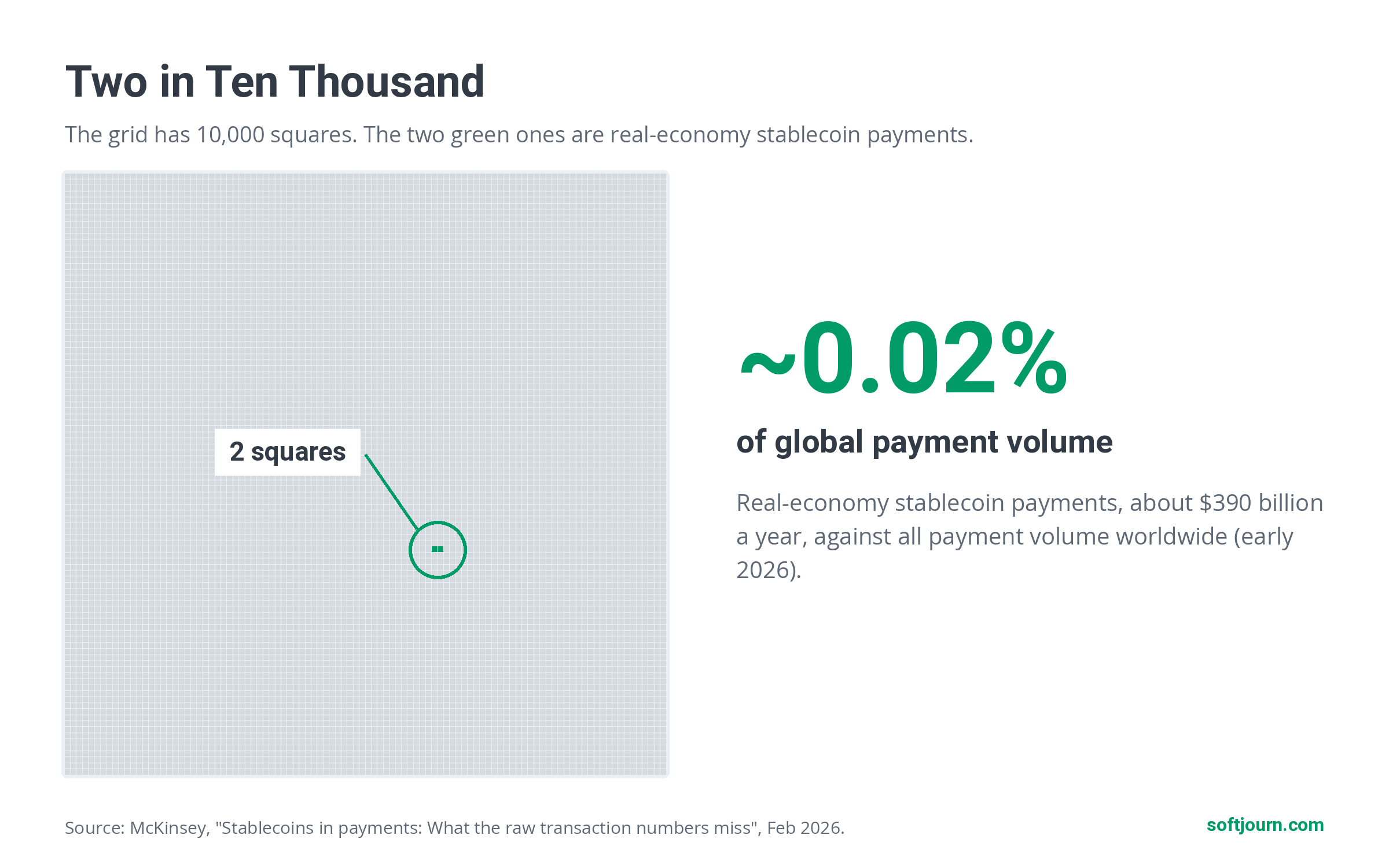
The scale still needs perspective. McKinsey estimated real-economy stablecoin payments at about $390 billion a year in early 2026, roughly 0.02% of global payment volume. Most stablecoin supply still goes to crypto trading and to dollar access outside the US banking system, rather than to everyday business payments.
Tokenized Bonds and Repo: The EIB Story
The European Investment Bank shows how slowly, and how steadily, this area moves. In April 2021, three years after the challenge our engineers joined, the EIB issued a €100 million two-year digital bond on public Ethereum and settled it with Banque de France central bank tokens. By March 2026, it had issued six digital bonds in three currencies. In June 2026, it issued €77.5 million of commercial paper that lives natively on Clearstream's D7 ledger, the same kind of instrument our engineers sketched at the 2018 challenge.
The bigger volumes sit in market infrastructure. Broadridge's distributed ledger platform for repo, the short-term loans backed by securities that banks use to fund themselves, processed about $9 trillion in December 2025, an average of $384 billion a day.
DTCC received SEC no-action relief in December 2025 for a tokenization service and ran live tokenized trades with more than 30 firms, including BlackRock, Goldman Sachs, and J.P. Morgan, on July 15, 2026. It launched the service on October 28, 2026 on the Canton Network, a public network, and on DTCC's private network built on Hyperledger Besu, and plans to add the Stellar network in the first half of 2027 and Solana in the second half. We find that platform choice telling: Besu is an enterprise Ethereum client that is still actively maintained, while GoQuorum, the one we built on, was archived the same year.
Tokenized US Treasury and money market products held about $14.7 billion across 117 products in October 2026, according to rwa.xyz, with Circle's USYC, Ondo's USDY, and BlackRock's BUIDL each above $2 billion. That is real money, and it is still tiny next to the Treasury market itself. For most fintech products, this layer stays out of sight: you would reach tokenized bonds or funds through a custodian or a bank, not by running a ledger yourself.
Tokenized Deposits: Banks Tokenize the Edge and Keep Their Own Books
A tokenized deposit is an ordinary bank deposit recorded as a token on a ledger, so it can move between institutions around the clock and remains a claim on the bank. Banks kept their main ledgers and tokenized the layer that faces other institutions. JPMorgan's Kinexys network handles about $7 billion a day, against nearly $12 trillion a day that J.P. Morgan Payments processes on its conventional rails (August 2026).
JPMorgan's deposit token, JPMD, went live for institutional clients on Coinbase's Base network in November 2025. HSBC brought its Tokenised Deposit Service to the US in April 2026, and six UK banks ran a live tokenized sterling deposit pilot through mid-2026. In July 2026, Swift said its own blockchain-based ledger was ready for initial use, with 17 banks, including Citi, HSBC, and Wells Fargo, preparing to pilot round-the-clock cross-border payments in tokenized deposits.
That puts banks and stablecoin issuers in competition for the same role. The fight over whether stablecoins can pay yield to holders, which banks see as a threat to their deposits, is one of the two disputes that stalled the CLARITY Act, the US market-structure bill, in the Senate on September 15, 2026. For a payments product, this means your bank may offer a deposit token before you would ever need a chain of your own.
Smart Contracts: What Became of Our 2018 Platform Choices
A smart contract is a program stored on a blockchain that carries out agreed terms automatically, such as transferring ownership when payment arrives. In 2017 and 2018, we evaluated Ethereum, Hyperledger Fabric, Open Transactions, OpenChain, and Eris, which was later renamed Monax. We picked Monax for SJ Coins, our internal employee currency, and Quorum for the EIB challenge.
Eight years on, here is where those platforms stand:
- Ethereum: the leading smart contract network, holding almost half of all stablecoin supply.
- Hyperledger Fabric: still maintained, with version 3.1.5 released in June 2026.
- Burrow: the open-source chain that grew out of Monax, which Hyperledger retired in 2022.
- GoQuorum: the enterprise Ethereum client JPMorgan built and sold to Consensys in 2020, archived in June 2026.
- OpenChain: no code changes since 2016.
- Open Transactions: no commits in its original repository since 2014.
Neither of the two platforms we picked is still maintained. For us, the platform choice carried more risk than the technology itself. We are not the only ones. Hyperledger archived Sawtooth, once one of its headline ledgers, in February 2024 at its maintainers' request. In September 2024, Besu's maintainers announced they would remove Tessera-based private transactions, which Quorum networks relied on. In May 2025, R3, the company behind Corda, announced a strategic shift toward the public Solana network. Before a ledger component goes into your architecture, check its maintenance status and how active its maintainers are.
Blockchain and AI: Rival for Budget, Partner in Payments?
AI took blockchain's budget and many of its developers, but the two technologies do meet in one place, which is payments. AI agents that book, buy, and pay need a way to move money with verifiable permission from a user.
Google's Agent Payments Protocol (AP2), announced in September 2025 with more than 60 partners, supports cards, real-time bank transfers, and stablecoins, the last through an extension called x402 built with Coinbase and the Ethereum Foundation. Stripe's Tempo payments blockchain lists OpenAI and Anthropic among its design partners for uses "from agentic payments to remittances". These are early announcements, and there are no volumes to report yet. We cover the engineering side in Agentic Payments: What Fintech Platforms Need to Build Before AI Agents Move Money.
The other proposed overlap, recording AI decisions or content origins on a blockchain, is mostly a vendor pitch. The main industry standard for content provenance, C2PA Content Credentials, does not require or use blockchain directly, according to the Content Authenticity Initiative.
For AI, the test is the one we apply to every blockchain question: a ledger helps when several parties need to verify a record and none of them owns it. In most AI projects, one company owns the record, so our AI Development Services team builds audit trails into conventional systems instead.
What Does This Mean for Fintech and Ticketing Teams?
For a product team, the useful question in 2026 is whether you have a counterparty problem. In other words, do you need to settle money or assets with parties outside your own ledger, around the clock?
For Fintech CTOs: When Stablecoin Rails Are Worth It
Cross-border payouts are where stablecoins make the clearest case: the World Bank put the average cost of sending a $200 remittance at 6.49% in early 2025. Stablecoin rails earn their place when you settle with outside parties and at least one of these applies:
- You pay out across borders into expensive corridors.
- You move treasury between entities in different countries outside banking hours.
- Your customers already hold stablecoins.
- You sell to global buyers and want to avoid cross-border card fees.
Count the costs before you build:
- On- and off-ramps: most of the expense sits in moving money on and off the chain and in compliance and licensing, since the transfer itself costs fractions of a cent.
- No chargebacks: stablecoin payments remove a protection your customers know from cards.
- Settlement asset: you have to choose between a stablecoin and a bank's tokenized deposit before regulators have finished all of their rules.
If none of these conditions applies, card networks, FedNow or RTP, and a good payment orchestration layer will serve you better. Our fintech consulting team helps scope that decision using your real transaction data.
For Ticketing CTOs: Secure Tickets Don't Need a Blockchain
NFT tickets were the ticketing industry's blockchain bet, and they didn't pay off. In 2017, a promoter said the Aventus ticketing blockchain "effectively ends the ability for ticket touters to continue in business" (The Ticketing Business). Aventus later dropped ticketing from its pitch, and touts, as the UK calls ticket scalpers, are still in business.
Ticketmaster used NFTs for commemorative collectibles and token-gated presales, while the tickets themselves stayed in its own system. For the 2026 World Cup, FIFA sold tradable on-chain "Rights to Buy", but FIFA's own page says a Right to Buy is not a ticket, and FIFA issued the tickets in its own app.
The tools that work are centralized, including rotating, phone-bound barcodes, identity-bound transfers, and resale inside the ticketing app. Regulators are pushing in the same direction. In November 2025, the UK government announced a ban on reselling tickets above face value, with fines for platforms of up to 10% of global turnover, and the King's Speech in May 2026 promised a bill, which has not been published yet.
When a European ticketing platform asked us to plan its access control app, another team built the blockchain components, and our job was to make access control work with both blockchain-based and standard digital tickets, so the platform's clients could choose either.
The stronger case for blockchain in ticketing is on the money side. Paying out promoters, venues, and artists across borders is a settlement problem, and card networks and payment processors now offer stablecoin settlement for it. For most platforms, that is a payments integration with a regulated provider, and the ticket itself stays in the existing system.
Much of the fraud also happens before a real ticket is involved at all: Lloyds Bank found that more than 90% of Oasis ticket scams started with fake social media listings paid by bank transfer. We explain where blockchain still adds value in ticketing, and where it doesn't, in Blockchain in Ticketing.
For Loyalty Programs: Points Rarely Need a Blockchain
Starbucks ran the best-known test. Its Odyssey program let members collect NFT "Journey Stamps" that unlocked perks and experiences, and Starbucks closed it on March 31, 2024, after a 15-month beta. Our own first blockchain project, SJ Coins, was an internal loyalty currency, and we shut it down too. Loyalty points are a liability on one company's books, and that company wants full control over how points are earned, spent, expired, and reversed after fraud, so there is no trust gap for a shared ledger to close. The exception is a coalition program, where several companies issue and redeem one currency and settle with each other. Even there, ask first whether the members would accept a neutral operator running a database with an audit trail, which is cheaper to build and to run.
What We Learned Building Five Blockchain Projects
Between 2017 and 2019, we built five blockchain projects. None of them is running today, and each one taught us something we still use when clients ask about the technology.
SJ Coins (2017): Our first project was an internal loyalty currency on Monax. Employees earned coins and spent them at an office vending machine run by a Raspberry Pi, and we planned to use them to crowdfund local social projects. The proof of concept worked, but it was hard to maintain, so we shut it down. Our own 2018 white paper admitted that employees could join corporate giving "without this technology".
London Blockchain Hackathon (2018): Our team built a hackathon prototype on Monax for a challenge set by the Bank of Papua New Guinea: a digital identity system for people without ID documents or bank accounts.
EIB Blockchain Challenge (2018): Anatoliy Okhotnikov and Valeriy Sukhotskyi built a smart commercial paper on Quorum in two days. The smart contract held the paper's terms and its owner and moved it from the paying agent to the clearing house to the investor. Bloomberg quotes, SWIFT messages, the request for an ISIN, and the cash itself were left to existing systems, to be connected later as external inputs, which is close to how tokenization works at the EIB and DTCC in 2026.
Credit monitoring proof of concept (2019): For a bank's innovation team, we tested whether Hyperledger Fabric could keep an immutable history of every decision on a credit line. The project never went to production. The test showed the bank's team the pros and cons of blockchain for credit monitoring without paying for a production build.
Cryptocurrency Banking Service (2019): We built a prototype on Quorum that let bank customers buy and sell a test token of our own from a regular online banking account, with Bitcoin and Ethereum planned for later. It stayed an internal demo, and six years later, US banks and brokers started offering crypto trading inside regular accounts.
Three lessons came out of these projects:
- Choosing the platform was the riskiest call: Burrow (Monax) and GoQuorum, the two platforms we built on most, are no longer maintained.
- The blockchain part of a working design is usually small: most of the system runs on conventional infrastructure, which is why the software architecture around the ledger decides whether the project works.
- A proof of concept earns its budget when it gives a clear answer cheaply: a "no" counts as a clear answer.
That is why we run emerging-technology experiments through research and development before anyone commits a production budget. Most of the blockchain conversations we have had with clients since 2019 started with the same question: who outside your company needs to write to this record, and why can't one of you keep it? Most of them ended with a well-designed database.
Do You Need Blockchain? A 5-Question Test
Dr. Wasserman gave us the criterion in 2018: blockchain must offer "a unique advantage over the existing way of doing something" (interview, 6:35). These five questions turn that into a decision.
- Do you need to settle money or assets with parties outside your own ledger?
- Do those parties need to hold and move the same asset without reconciling separate books, even if one operator runs the network?
- Do you need something bank rails don't give you, such as settlement outside banking hours, cheaper cross-border payouts, or payments from customers who already hold stablecoins?
- Can a regulated provider, such as Stripe, Visa, or a bank's tokenized deposit service, cover it without you running a chain?
- Can you accept immutable records and payments without chargebacks?
How to read your answers:
- "No" to any of the first three: a well-designed database with an audit log, or the bank rails you already use, will do the job.
- "Yes" to the first three and "yes" to question four: connect to regulated rails through a provider.
- "Yes" to the first three and "no" to question four: building your own chain makes sense only if you are market infrastructure yourself; otherwise, join an existing network or wait for a regulated provider.
- "No" to question five: keep the payment on cards or bank rails, whatever you answered above.
What We Would Tell Our 2018 Selves
If we could send one note back to the team building SJ Coins in 2017, it would say that blockchain was going to work, just not where everyone was looking. It ended up in settlement between banks, market operators, and payment networks, mostly out of sight, while the consortium projects and NFT tickets that got the headlines closed one after another.
For a fintech or ticketing product in 2026, that leaves a short list of cases where a ledger earns its cost: cross-border payouts, round-the-clock treasury moves, and settlement with parties who don't share one system. Outside that list, the honest answer is usually a well-designed database, a modern payment rail, and good audit logging, which are cheaper to build and easier to maintain.
If you are weighing a blockchain feature, start with our discovery phase: it answers the five questions above with your own systems and data before anyone builds anything. If the test points you toward a ledger, our blockchain development architects can help you choose a regulated provider or network and build the conventional systems around it.
Frequently Asked Questions
AI replaced blockchain as the place where budgets and developers go, but the two do different jobs. AI makes predictions and decisions, while a blockchain keeps a shared record that several parties can verify. They meet in payments, where agent payment protocols such as Google's AP2 already support stablecoins.
In most enterprise use cases, conventional databases and modern payment rails already have. Where institutions need a shared ledger, regulated versions run by incumbents, such as DTCC's tokenization service and bank deposit tokens, are replacing the open consortium model of 2018.
Most failed projects could not get enough companies to join and pay for a shared network. The technology itself works, and its costs fell sharply after 2024.
Yes. About $302 billion of stablecoins existed in October 2026, DTCC launched its tokenization service in October 2026, and Visa, Stripe, and PayPal all support stablecoin payments. Most people who use it never notice.
Yes, as settlement infrastructure rather than a product feature. The next steps are already scheduled: the US stablecoin rules take effect on January 18, 2027, and DTCC expects to connect its tokenization service to the Stellar network in the first half of 2027. For most fintech and ticketing products, that future arrives through banks and payment providers, not through a chain of their own.
A blockchain makes records hard to change after the fact, which helps when parties don't trust each other. A record is only as accurate as the data entered into it, though, and stablecoin payments come with no chargeback protection.