






AI Proof of Concept: Know It Works Before You Build
AI POC

AI Proof of Concept: Know It Works Before You Build

Softjourn's AI proof of concept development services show whether an AI feature is worth funding before you commit the build budget. We test it on your own data and real tasks against quality, cost, and speed thresholds you sign off up front. In weeks you get a working prototype, measured results and a go or no-go decision your leadership can act on, plus code that carries into the build.

Trusted by product teams in North America and the UK:

PowWow
UPC
Tacit Innovations_Video
Ticket River
PEX
iKobo
Ticketbud
SecuTix
Ticketpro
Tacit Innovations
Ticketmaster Worldwide

What Is an AI Proof of Concept?

An AI proof of concept (PoC) is a short, bounded build that tests whether one AI feature works on your real data, at a cost and speed your business accepts. It answers a single feasibility question with a go or no-go decision. A PoC that connects to several live systems takes longer, often several weeks. If you are still choosing which use case to pursue, start with an AI readiness assessment.

What an AI PoC Proves on Your Data

Whether the Output Is Good Enough

Whether the Output Is Good Enough

Demos run on clean sample data, while real work brings messy documents, unusual requests and edge cases. A PoC measures output quality on your documents, records and real tasks. Every result is scored against an expected one, so quality becomes a number your team can discuss.

What Each Request Will Cost

What Each Request Will Cost

Model usage is billed by the amount of text each request sends and receives, so the bill grows with context size and every active user. A PoC measures cost per request at realistic volumes and finds the smallest context and the model that keep it inside your budget. You see the monthly operating cost next to the build estimate before you commit.

How Fast It Responds

How Fast It Responds

Users leave when an answer takes too long, and some workflows need a response in under a second. We measure response time on the same test set, so speed is checked together with quality. We report both the average and the slowest answers, because the slow ones are what users notice.

Whether Your Data Is Ready

Whether Your Data Is Ready

In February 2025, Gartner predicted that organizations will abandon 60% of AI projects unsupported by AI-ready data through 2026. A PoC shows early whether your data is complete, current and accessible enough for the feature, and what it takes to close the gaps.

How It Fits Your Systems and Rules

How It Fits Your Systems and Rules

An AI feature reads from your systems and has to follow your access and privacy rules. The PoC runs inside the boundaries you set, such as a sandbox without production access, and shows which integrations and permissions the full build will need.

What Production Will Take

What Production Will Take

With measured results in hand, we estimate the production build: integrations, data preparation, monitoring and timeline. You know the full investment before you approve it.

Have an AI feature in mind? Find out what it will deliver and what it will cost to run.

Plan Your PoC

How Softjourn Runs an AI Proof of Concept

Decide what success means before any code is written.

We turn the idea into one feasibility question, such as whether AI can pull the right fields from your invoices or answer support questions from your help center. Together we set pass thresholds for output quality, cost per request and response time, plus any rule that allows no exceptions, such as never inventing facts.

Measure the feature against the work it will really do.

We build a test set from your real requests, documents and edge cases, each with an expected result your domain experts approve. The same set runs at every step, so results stay comparable from the first prototype to the final run. From your side, this needs a product owner and a domain expert to approve the test set.

Spend only on what answers the question.

We build the smallest version that can be tested end to end: data access, retrieval, prompts and the user flow. When several approaches fit, we compare them side by side.

See the numbers, including where the feature falls short.

We run the full test set and report quality, cost and speed against the thresholds from step one. Where a result misses a threshold, the report shows which cases failed and why.

Get a decision you can defend to your leadership.

A go comes with a production estimate and an architecture outline. A no-go comes with the reasons and the conditions that would change the answer, such as better data or a newer model. Either way, the decision rests on measured results from your own data.

One Question, Agreed Thresholds

What You Get at the End of an AI PoC

A Working Prototype

A Working Prototype

A prototype your team can try on real tasks, running in a test environment on your data. Stakeholders judge the feature by using it.

Test Set and Evaluation Report

Test Set and Evaluation Report

The approved test set and a report with results for every case. You can rerun the same set on any future version, including one built by another team.

Cost and Speed Measurements

Cost and Speed Measurements

Response times, cost per request and projected monthly model costs at your expected volume, all measured on the test set and compared with your thresholds.

A Go or No-Go Decision

A Go or No-Go Decision

A written recommendation with the reasons and the test results behind it.

A Production Estimate

A Production Estimate

For a go: the architecture outline, integrations, data preparation, monitoring and a timeline for the full build, with the operating cost next to it.

Code and Tests You Own

Code and Tests You Own

The prototype code, prompts, test set and evaluation scripts stay in your repository. If you continue with us, the build starts from them.

What Happens After a Go?

  • The solution architect from the PoC oversees the build, and the engineers who ran the PoC continue into it where possible, so nobody has to relearn your data and constraints.

  • The prototype code, prompts and test set become the starting point of the production build.

  • We add what production needs: integrations, permissions, monitoring, fallbacks and load testing.

  • Every change runs against the same test set, so quality stays measurable after launch. See how our AI software development team takes a PoC into production.

What Happens After a No-Go?

  • You get the reasons in writing, with the test results behind them.

  • We name what would change the answer, such as cleaner data, a narrower scope or a newer model, and when it is worth testing again.

  • Your build budget stays unspent, and the test set is ready for the next attempt.

Fund the build on measured results, or keep the budget for the next idea.

Talk to Our AI Team

Proof of Concept Examples From Our Work

Types of AI Proof of Concept We Build

Most AI features follow a few patterns, and each has its own deciding question: whether a chatbot answers from your content without inventing facts, whether an agent acts safely inside your systems, or whether a workflow reads messy documents reliably. We shape the PoC around the question that decides whether your feature is worth building, and every type below starts from thresholds agreed up front and ends with a go or no-go decision.

Why Softjourn for Your AI PoC

A proof of concept is worth paying for only if the team running it will tell you when the answer is no. Our AI PoCs come from the R&D team that tests AI on our own systems and on client projects, and we publish the results, including the cases where we advised against a tool. Softjourn has built software for 25+ years and has run an R&D practice since 2008.

Our engineers have spent years in fintech, event ticketing, expense management and media, so a PoC starts with the constraints your industry brings, such as PCI DSS scope in payments or receipt and policy data in expense management. Before the PoC touches your data, we agree which systems and records it can access.

LangGraph
BMAD Method
BrowserStack
MCP
Claude Code
Codex
LLM APIs

Bring the AI feature idea and a sample of your data, and we will scope what the PoC should prove.

Book a Scoping Call

AI Proof of Concept FAQ

A proof of concept answers whether something can work: one feature, on your data, against agreed thresholds. A product prototype shows how the product will look and feel to users, and an MVP is the smallest version you release to real customers. The working prototype at the end of a PoC runs on your data with only the interface needed for testing. In AI projects the PoC comes first, because answer quality and running cost are the biggest unknowns. Our article on PoC vs prototype vs MVP covers the differences in more detail.

A focused PoC on one data source can take about a week, as our own website chatbot did, although on client data, access approval and test set review add time. PoCs that connect to several live systems or need data preparation take longer, often several weeks. We set the timeline once the feasibility question and the data sources are clear.

The cost depends on four things: how many data sources the PoC uses, how much data preparation it needs, how many systems it connects to and how large the test set is. We estimate the PoC after scoping, when the question and the data sources are clear, and show the expected model usage costs next to it. Once the scope is agreed, the price is fixed. If the scope changes along the way, we agree the new price with you before doing the extra work.

You need a sample of the data the feature will use in production, such as documents, records or past support requests, plus a set of real questions or tasks with the answers your experts expect. The data does not have to be perfect, because finding out whether it is good enough is part of the PoC. If you are unsure what data you have, an AI readiness assessment maps it first.

Before the build, we agree on thresholds for output quality, cost per request and response time, plus any rule that allows no exceptions, such as no invented answers. In our ticket-to-pull-request pipeline PoC, that rule was no AI deployment access to production. Every case in the test set is scored against an expected result. The PoC succeeds when the results meet the thresholds, and the report shows which cases passed and which failed.

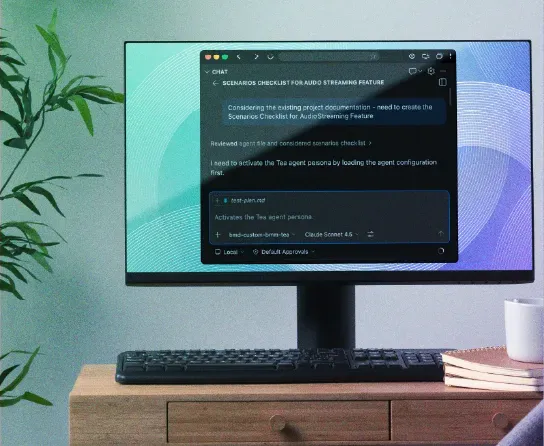
You get a no-go decision with the reasons, and the full build budget stays unspent. A no-go can also cover only part of the feature. In our proof of concept with BMAD, an open-source framework of AI agents, AI proved useful for QA documentation, but UX specifications needed enough rework to cancel out the time saved.

Most of it does. The test set, prompts, data access and evaluation scripts carry into the build, and the prototype code becomes its starting point. Production adds what a PoC leaves out on purpose: integrations, permissions, monitoring and load handling. The same test set keeps running through the build, so you can compare quality at every stage.

Only if you have not chosen the use case yet. An assessment compares your possible AI use cases against your data and systems, and a recommendation to build now leads straight into a PoC. If you already know which feature to test, we start with the PoC. Both steps are part of how our AI development services take a feature from idea to production.

Let’s Discuss Your Project

Fill Out the Form to Discuss Your Idea With Us!

  • We were encouraged because Softjourn asked the right questions, involved people with the right experience in to the conversations. Showed good leadership in managing the process of walking them through the sales process, keeping them on track, and has a lot of strong knowledge in the financial area, as they are a small software developer company and there are always so many other things that are pulling us in multiple directions. As well Softjourn shows a lot of experience in multiple programming languages and in combining them in to one product.
    Toffer GrantFounder at PEX
  • The new design is much more modern and will help us be more competitive, and also provide a much-improved experience for our customers. Communication and organization were both great – Softjourn's team demonstrated their expertise by providing multiple suggestions for improving our current UI/UX.
    Emily Korczyk
    Emily KorczykHead of Design at Eventgroove
  • I feel like Softjourn's team knew what they were doing and that they had the experience and enthusiasm we needed. Any challenges that we threw at them they were willing to take on and solve for us!
    Omar Sider
    Omar SiderPresident at Superstar
  • Softjourn's work on the Access Control App is a shining example of how well a project can go. All of our requirements were met, no code changes were needed, and the app worked extremely well from the start.
    Stephen Glicken
    Stephen GlickenCEO & Co-Founder at Project Admission