













 AI in Your Delivery

Ship features faster without lowering the quality bar. Softjourn engineers use AI at every stage of development, from requirements to release, wherever it makes the work faster or better, and keep human judgment on design, architecture and every final decision. You get shorter release cycles, sharper code reviews and a partner that has measured where AI pays off.
Trusted by product teams in ticketing, fintech and media:
For product owners and business analysts who own the scope
AI agents now draft user stories, requirements and test plans from interviews and existing specs, shortening the slowest part of discovery. Your analysts start from a solid draft and spend their time on decisions. In our proof of concept, a feature requirements draft went from about 24 hours to 3.5, with a specialist reviewing every one.
For product designers who own the user experience
AI speeds up competitor research, persona work and the repetitive production that eats design hours, such as replacing and resizing assets. Your designers get more time for flows and user testing. On one client rebrand, an AI agent replaced about 150 themed assets in 45 minutes, work estimated at 12–16 hours by hand.
For engineering leads who own delivery speed
AI coding assistants write routine code, explain unfamiliar code and help trace bugs, and the time they save depends on how well they know your codebase. Your engineers spend less time digging through unfamiliar services. On a live client project, one senior engineer estimated that specific debugging tasks ran up to 30x faster.
For tech leads who own code quality
AI review agents check each pull request for bugs, risky changes and style issues before a person opens it, which keeps review queues short. Your reviewers spend their time on design and business logic. On one client project, a second AI agent reviews every pull request and has caught issues neither the developer nor the coding agent flagged.
For QA leads who own release quality
AI generates test cases, drafts test plans and repairs tests that break after a change, so coverage keeps up with fast development. Your QA team spends less time on upkeep and more on risky scenarios. In our AI-supported QA pipeline, a test framework migration went from 4–5 hours to about 15 minutes.
For engineering managers who own long-lived products
Documentation falls behind on most long-lived products, and AI connected to project tools can keep it in step with the code. Your team gets current docs and edge-case unit tests without a separate documentation sprint. On our own project tracker, a 170-page product document six months behind the code was updated in one run.
For DevOps leads who own releases
AI drafts release notes, pull request descriptions and pipeline configuration, and flags risky changes before they ship. Your release process keeps its approvals, with less manual writing around each release. Our AI agents have no deployment access to production, and every release goes through the client's existing pipeline.


Feature requirement drafts went from about 24 hours to 3.5. Accuracy was around 70% and some document types needed a full rebuild in about 20% of cases, so every draft gets a specialist's review.

Savings ranged from 25% to 44% depending on the task type. The largest cut was integration test documentation, which went from 9 hours to 5, while general test plans saved 29%.

By the team's estimate, tasks that took one to two days now take one to two hours when the scope is clear. AI-written code can carry more bugs than manual code, so local testing and QA matter more on these projects.

On one client project, edge-case unit tests that used to take two to three days now generate in seconds, and an engineer validates every test before it is used.

AI connected to project tools updates documentation as the code changes, and an engineer reviews each update before it merges.

In our AI-supported QA pipeline, repairing a test that broke after a code change went from 30 minutes to about 5. AI proposes the fix, and a QA engineer reviews it before it merges.

AI drafts code, tests and documents, and a named engineer reviews, edits and approves each change before it merges. Accountability stays with the team that signs off the release.

On AI-augmented projects, the repository holds plain-text rules for AI: architecture boundaries, coding conventions and approved libraries. When an agent once missed a cross-project dependency, the team added it to these rules.

On our agentic projects, a separate AI agent reviews each pull request first, and then an engineer reviews it. The reviewing agent checks the change independently of the agent that wrote it.

A new AI practice starts as a proof of concept on real tasks, and the team adopts it only when the numbers hold.

Engineers keep AI out of architecture decisions, and AI only flags issues in payment and security-critical code for an engineer to fix and approve. Some small edits also stay faster by hand.

Code written with AI goes through the same pipeline checks, tests and code review as any other change, including dependency and vulnerability scanning.

AI agents work in development environments only and have no deployment rights or access to production systems. Every release goes through your existing approvals.

Softjourn's AI usage policy bars AI tools from passwords and keys. On each project we agree with the client which AI tools may work with their code and data.
Softjourn already runs agentic delivery on a live client project. An AI agent takes a well-defined task from ticket to pull request, an engineer reviews the result, and delivery throughput there rose by 125%. Other work moves to agents one task type at a time.
Most teams move through three stages. In a classic SDLC, people carry out every step by hand. In AI-augmented development, AI works inside each phase while engineers own the standards, the reviews and every change. Agentic delivery is the third stage, where agents take whole tasks under engineer review. Read more in our guide to agentic versus vibe coding.
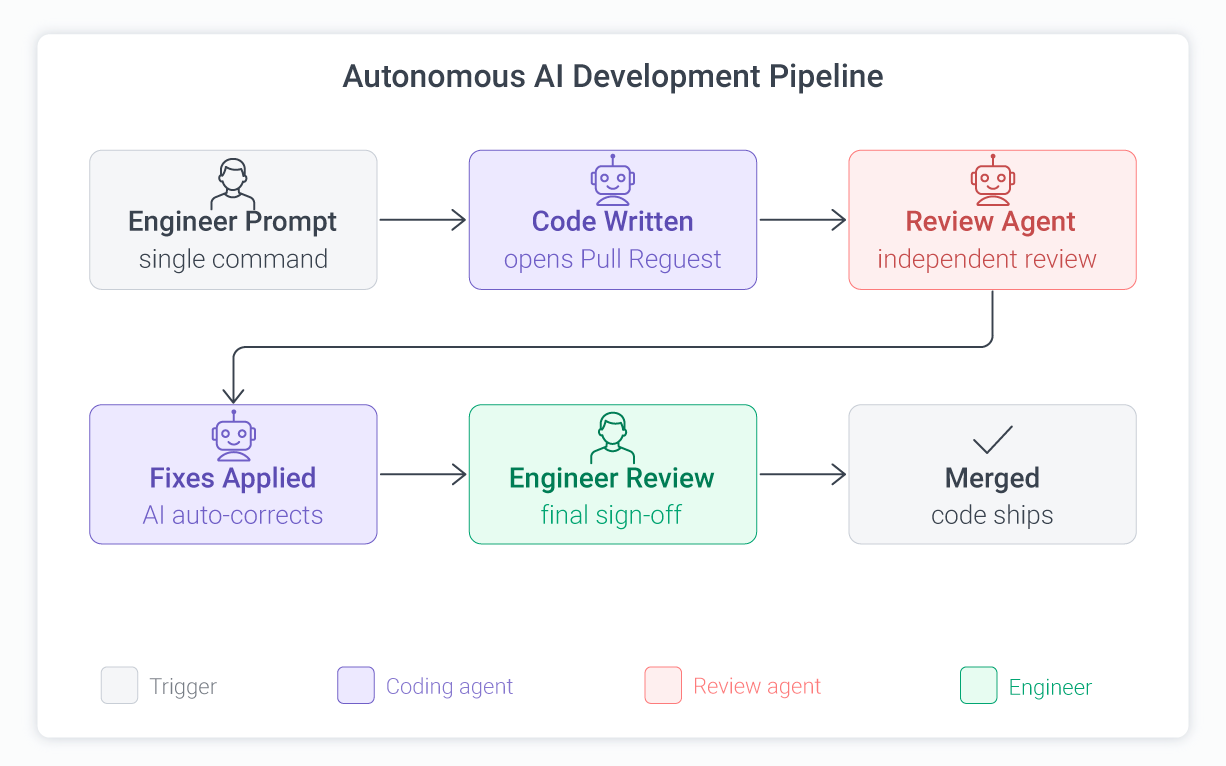


Softjourn's R&D team built a pipeline on a live client project where one AI agent takes a ticket to a pull request and a second agent reviews it. Delivery throughput rose by 125%, with an estimated 5 to 10x gain on well-defined tasks. An engineer owns quality, and the AI has no production access.
A structured proof of concept tested BMAD, an open-source framework of role-based AI agents, on QA and business analysis tasks from a client engagement. Integration test documentation dropped from 9 hours to 5. Requirement drafts came much faster but reached only about 70% accuracy, so a specialist reviewed every output.
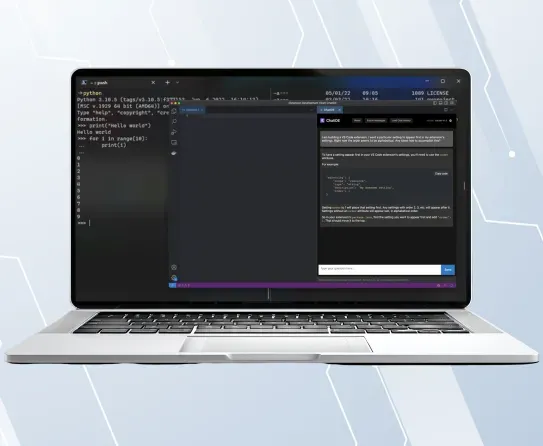
Over several months of work on a client's live project, engineers used an AI assistant inside the IDE for debugging, test generation and code changes. By the engineer's estimate, specific debugging tasks ran up to 30x faster and test generation 10 to 20x faster, while some small edits stayed quicker by hand.

In a client team with an established AI development culture, AI tools connected to live project infrastructure took over documentation and unit test generation. Documentation dropped from about a week to minutes, and well-defined coding tasks ran 5 to 10x faster.

Three experiments on client design work showed where AI helps designers. An AI agent replaced about 150 themed assets in 45 minutes, work estimated at 12 to 16 hours by hand, while AI missed product rules when it restructured an onboarding flow.
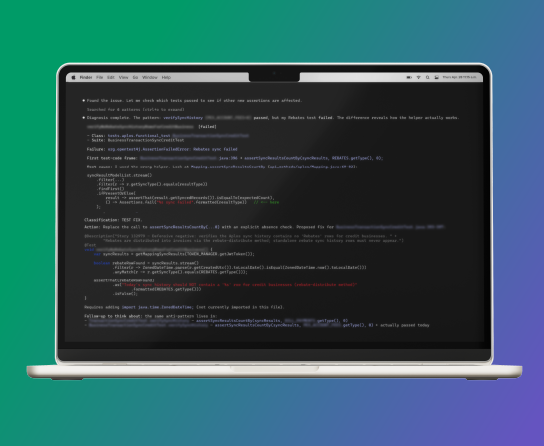
Our QA engineers built a pipeline where AI drafts test plans, writes tests and repairs failing ones under engineer review. A test framework migration went from 4 to 5 hours to about 15 minutes, and repairing a broken test from 30 minutes to about 5.
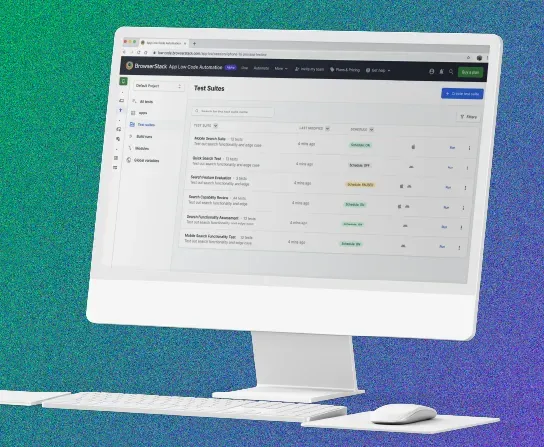
Two QA engineers ran month-long proofs of concept with a low-code test tool on two client engagements. On one, sanity testing went from 30 minutes to 10. On the other, test data setup took 50 to 85% of all steps, and the team decided against the tool.
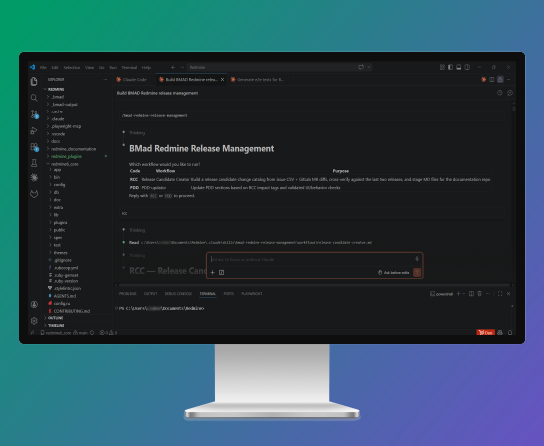
A 170-page product design document for Softjourn's own project tracker had fallen months out of date. An automated workflow cleared the six-month backlog in one run, and updating a section now takes minutes of processing plus a targeted human review.
Softjourn has built software for event ticketing, fintech, expense management and media companies for 25+ years. AI-augmented delivery follows the same rules in each of them, and the checks change with the risks of each industry, from traffic peaks when big events go on sale to payment data and approval trails.
Platforms in our industries run on years of business rules, and AI helps engineers read, test and document that logic before they change it. Our engineers start with the work that has the clearest acceptance criteria, such as tests, documentation and well-scoped features, and keep the closest human review on the code where a wrong change costs the most: payments, inventory and customer data.
Ticketing platforms change fast before big on-sales, when inventory, pricing and checkout logic move at once. AI helps teams write and update tests for these flows quickly, while engineers own every change to seat inventory and payment code.
Financial software needs audit trails and careful review of anything that moves money. AI drafts code, tests and documentation, an engineer approves every change, and on every project we agree with the client that AI agents get no access to production systems or payment data.
Expense platforms carry years of business rules for policies, approvals and receipts. AI helps engineers read that logic, cover it with tests and document it before changing it, so updates to approval flows ship with fewer surprises.
There are two ways to start. A Softjourn team that already works this way can join your project through team augmentation or a dedicated team, or our engineers can help your own team adopt the practice through AI consulting. Either way, we first look at how your team delivers today and agree what to measure, then pilot AI on real tasks from your backlog. Practices that improve speed without hurting quality move to the rest of the team, and others get dropped.
AI in Your DeliveryA Softjourn team joins your engineering organization for the long term and brings its AI-augmented practices with it. The time AI saves goes back into your roadmap as more scope per sprint at the same team size, and we review the numbers with you against what we agreed to measure at the start.
Softjourn engineers choose AI tools per project and per task, and the set changes as models improve. The core of today's setup is Claude Code and other AI assistants inside the IDE, MCP servers that connect AI to project tools, the BMAD framework for role-based agents and a separate AI agent for code review.
Our R&D practice, running since 2008, tests new tools on internal projects and live client work before they reach your project, and publishes what it measures. Behind it are 25+ years of building software for event ticketing, fintech, expense management and media companies.
AI-augmented software development means AI works inside every phase of delivery, from requirements to release, while engineers set the standards, review the output and stay accountable for each change. Most teams already have AI coding assistants, and delivery gets faster only when the process around them changes as well: clear requirements, agreed review rules and measured results. Softjourn engineers already work this way on client projects.
The terms overlap, and many companies use them as synonyms. AI-assisted development usually describes an individual developer using AI tools for coding tasks. AI-augmented development describes how the whole team delivers with AI, from requirements to release. We compare an AI-assisted team with a dedicated team in our article on AI-assisted development vs a dedicated team.
An AI-augmented developer uses AI tools across daily work, from reading requirements and writing code to testing and documentation, and stays responsible for the result. On our AI-augmented projects, project rules for AI live in the repository, so every developer on the team works from the same instructions.
No. The work shifts toward clear specifications, review and verification. In our own tests, AI drafted requirement documents in 3.5 hours instead of about 24, and a specialist still had to review every one because accuracy was about 70%. Engineers spend less time on repetitive work and more on decisions AI cannot own, such as architecture and release approval.
On each project we agree with you which AI tools the team may use with your code and data. AI agents have no access to production systems, passwords or keys, and every change goes through review by an engineer. Our code review includes dependency and vulnerability scanning, and for code that AI tools already wrote, a code audit checks security, architecture and maintainability.
It depends on the task. On well-defined coding tasks our teams estimate 5 to 10x gains, and on QA documentation the savings were 25–44%. Gains across a whole project are smaller, because review, testing and clarifying requirements still take time: on one live client project, delivery throughput rose by 125%. We measure the effect on your own tasks against a baseline before scaling.
Ask the vendor to walk one recent change from ticket to production and show what AI produced and what the engineer changed. Ask where AI did not help and why. Softjourn publishes these limits in its case studies, such as the low-code test tool a team decided against.
Yes. Our engineers help client teams choose the tools, set rules for AI-written code and measure the effect, and they train your team in the same format we use for internal knowledge sharing. See AI consulting services for how an engagement runs.
Yes. Building AI into your product, such as assistants, retrieval over your data or AI agents, is the work of our AI development services. The same engineering team uses AI-augmented delivery to build them, and our R&D practice tests new tools before they reach client work.

We were encouraged because Softjourn asked the right questions, involved people with the right experience in to the conversations. Showed good leadership in managing the process of walking them through the sales process, keeping them on track, and has a lot of strong knowledge in the financial area, as they are a small software developer company and there are always so many other things that are pulling us in multiple directions. As well Softjourn shows a lot of experience in multiple programming languages and in combining them in to one product.

The CTO left the company after about eight years, and I needed to replace him. I didn't want to replace him with a single CTO because that created a single point of failure, so I went back to Softjourn. You just can't run an SaaS company without development work. Nearly every time I meet someone, and they're having problems with developers, I tell them "you need to call Softjourn". Softjourn just gives me tremendous peace of mind, and I can't emphasize that enough.


Softjourn really helped us grow to the next phase, and provided the stability for the transition to 2.0. I really enjoyed working with Softjourn, and am excited to keep on working with them.


I felt like Softjourn offered a much more professional approach, distance never became an issue, and the team really understood the goals of our project. There was a lot more collaboration rather than a one-way push saying this is what you need to do.