
When Growth Outpaces Your Tech: What to Do Before Things Break
From architecture decisions to load testing and legacy modernization, here’s how companies stay technically sound when growth stops waiting for anyone.

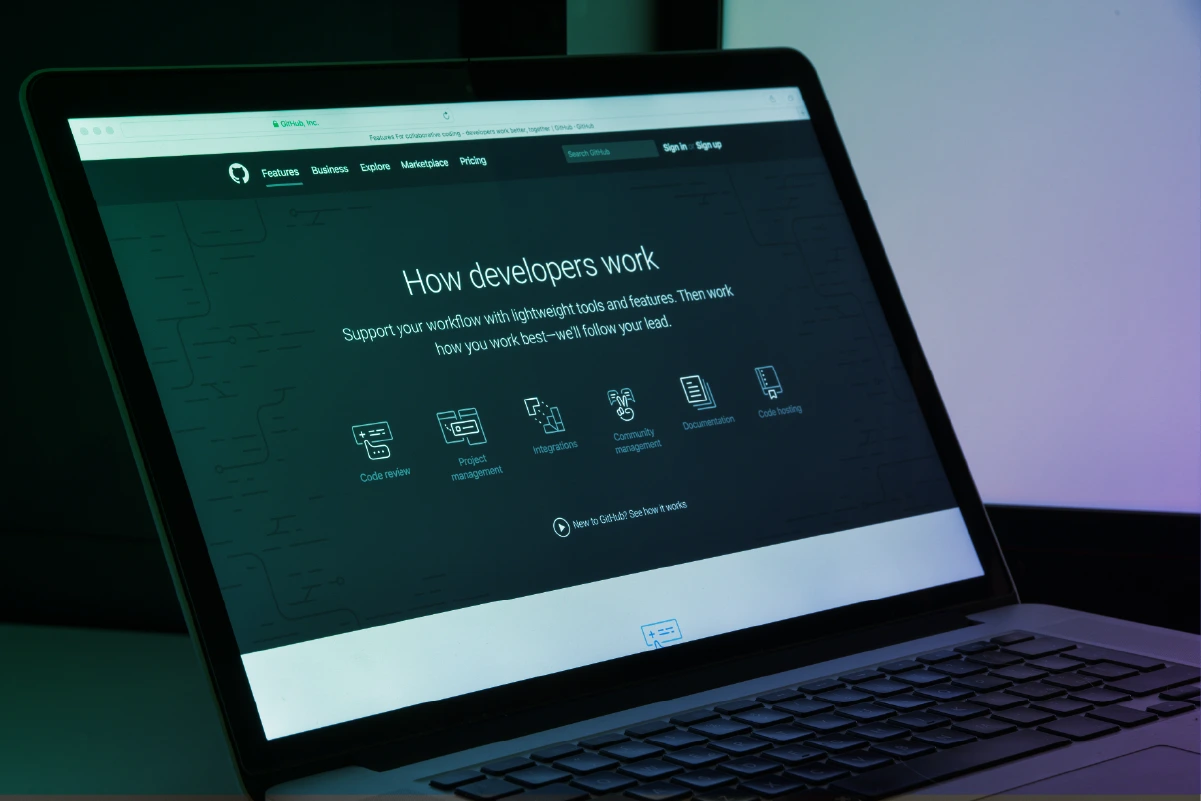
In April 2026, GitHub published a candid post-mortem. Two outages in quick succession had disrupted merge queues and taken down search for thousands of developers, driven entirely by demand that had grown faster than anyone planned for.
GitHub had already mapped out a tenfold capacity increase heading into late 2025. Within months, that projection was obsolete. The real target became thirty times current capacity, driven by the surge in AI-assisted development flooding the platform. When infrastructure couldn’t keep pace, the cracks showed publicly: corrupted commit states, degraded search, and manual remediation across hundreds of repositories. Eventually, even the pricing model had to change because absorbing that infrastructure cost under a flat subscription no longer worked.
Worth noting this wasn’t a scrappy startup caught off guard: GitHub is a trillion-dollar-backed platform with some of the most experienced infrastructure engineers in the industry.
Most companies won’t face that scale of demand overnight, but the pattern repeats constantly at smaller scales and with less public scrutiny. For instance, a SaaS platform lands a few large enterprise clients, and the database starts crawling, or a ticketing company announces a high-demand event, and the site goes down in the first five minutes.
Rapid growth is supposed to be good news. The question is whether your systems were built for the company you are now, or the one you were two years ago.
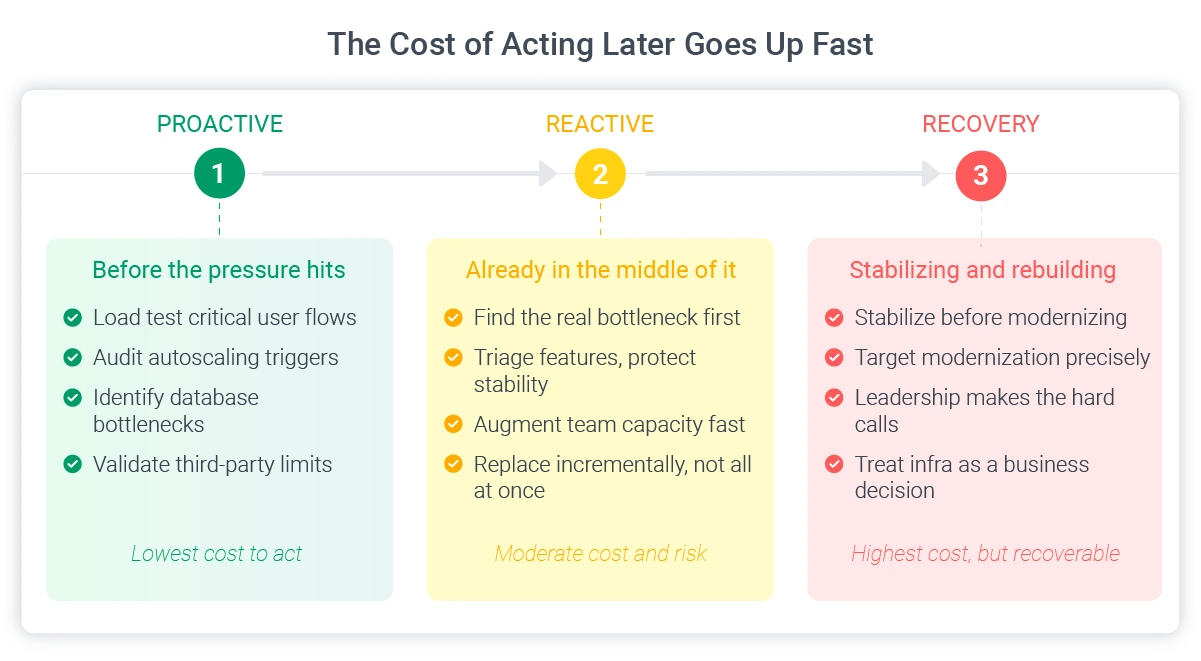
This article walks through three stages most fast-growing companies move through: preparing before the pressure hits, managing through a surge you didn’t fully anticipate, and stabilizing after the system has already shown its limits.
Before the Pressure Hits
The companies that handle growth best tend to make boring decisions early. Not exciting ones. Not bleeding-edge architecture choices or ambitious rewrites. Just sound decisions made before demand forced their hand.
The most practical starting point is understanding what your system can actually handle, not what you assume it can. Load testing is the most direct answer to that question, and it’s underused at every stage of growth. One ticketing platform Softjourn worked with had a specific target: sell 20,000 seats in five minutes. That sounds simple until you examine what’s happening underneath.
During the assessment, a single query on the user profile page was taking over five seconds to execute and regularly triggering autoscaling events. The autoscaling itself was making things worse, adding more application instances that all competed for the same slow database. A single query on the user profile page, with the right optimization, ran in 53 milliseconds instead of five seconds, roughly 145 times faster. The platform also had nearly ten million phantom ticket records sitting in the database adding weight to every query that touched it.
None of that would have surfaced in a product demo; it showed up under simulated load.
Architecture decisions matter just as much, and they’re harder to fix after the fact. Spektrix, a ticketing and CRM platform serving arts and cultural organizations, faced a familiar problem: traffic spikes during high-demand events were straining infrastructure that wasn’t built to flex. Working with Softjourn, they rebuilt around a serverless Azure architecture, using event-driven functions, CDN integration for faster content delivery, and scalable storage designed for elastic load. The result is a platform that can absorb traffic spikes across 200+ clients without manual intervention, and at a cost that scales with usage rather than running at peak-capacity pricing all year.
A few questions worth asking before the next growth phase arrives:
- Can you load test your most critical user flows? Checkout, authentication, search, ticket purchase. These are the paths that break first under pressure.
- Is your autoscaling strategy based on the right signals? Scaling on response time alone often makes database-bound problems worse, not better.
- Do you know where your actual bottlenecks are? Most teams assume it’s the application layer. More often, it’s the database.
- Are your third-party dependencies load-tested too? Payment processors, identity providers, and CDNs all have limits. If you haven’t verified theirs, yours don’t mean much.
The investment in answering these questions before a growth event is a fraction of what it costs to answer them during one.
When You’re Already in the Middle of It
Not every company gets to prepare in advance. Sometimes the growth comes faster than the roadmap, or the system held up through the early stages, and everyone assumed it would keep holding. Until it doesn’t.
If your platform is already under strain, the priority shifts. You’re no longer optimizing for the future; you’re stabilizing the present while trying not to slow down the business that’s actually growing.
The first thing to get clear on is where the pressure is actually coming from. Teams under stress often reach for the most visible solution, which is usually adding more servers or instances. GitHub did this too, scaling application capacity while the real constraint was database architecture. More instances competing for a slow or overwhelmed data layer tends to amplify the problem rather than solve it. Before scaling anything, understand what’s actually bottlenecked.
A few approaches that make sense once you have that clarity:
Triage First, Build Later
One of the most effective moves available to a leadership team during a growth crunch is also one of the least glamorous: pause non-critical feature work and redirect engineering capacity toward stability. This is a business decision as much as a technical one. A delayed feature costs you time. An outage during peak growth costs you customers and credibility.
That same discipline applies to how you approach fixing what’s broken. The instinct under pressure is often to plan a full rewrite or platform migration, but that path is long, introduces new risk, and leaves the struggling system running in the meantime. Incremental replacement, swapping out one component at a time while everything else keeps running, is a more realistic approach for companies that can’t afford downtime.
Pivot, a Canadian AV management platform, faced exactly this situation as its user base grew. A single shared development environment meant testing conflicts, delayed deployments, and slower feature delivery. Softjourn re-architected the platform incrementally, introducing multi-environment development, a modular architecture, and automated CI/CD pipelines while the existing system stayed live. The result was parallel development capability, faster releases, and a platform that could actually keep pace with Pivot’s growth.
Bring In Outside Capacity Quickly
If your internal team is stretched and the growth isn’t slowing down, staff augmentation gives you access to domain-specific engineers without the lead time of a full hiring cycle. This works especially well when the gap is in specialized areas like cloud infrastructure, database optimization, or load testing at scale. Softjourn has worked with companies in exactly this position, stepping in as an extension of an internal team rather than a replacement for it.

Use Third-Party Infrastructure Where It Makes Sense
Payment processing, identity management, and notification systems all have mature options that handle their own scaling. The tradeoff is real: less flexibility, occasional surprises when vendors change APIs or pricing, and limits on customization. For a company managing rapid growth with a lean team, absorbing that tradeoff while keeping the core product moving is often the smarter call. You can build proprietary later, from a position of stability.
One other thing worth naming: documentation and process discipline tend to collapse during fast growth, and that creates its own problems when you need to onboard engineers quickly or hand off systems under pressure. Even a lightweight set of architecture notes and runbooks buys significant time when things go wrong at 2am.
Rebuilding After the System Has Hit Its Limits
Sometimes the warning signs were there and got deprioritized. Sometimes the system genuinely held up until it didn’t. Either way, if you’ve already experienced outages, performance degradation, or a platform that’s visibly struggling to support the business running on top of it, the conversation shifts from prevention to recovery.
Recovery has two phases that often get conflated: stabilization and modernization. Stabilization means stopping the bleeding, getting the system to a state where it’s reliable enough to operate without constant firefighting. Modernization is the longer work of rebuilding for where the business is going. Trying to do both at the same time, under pressure, is where a lot of companies get into trouble.

Stabilize Before You Modernize
The temptation after a significant outage or performance failure is to announce a full platform rebuild. That announcement can feel decisive, but it often delays the stabilization work that actually needs to happen first.
A Texas-based financial institution Softjourn worked with faced this directly. Their legacy core banking platform was approaching end-of-life, with vendor support ending and system stability becoming increasingly unreliable. Rather than a rushed migration, Softjourn helped architect a structured transition: a custom integration layer connecting more than 30 third-party systems, careful data migration that preserved all historical records, and a phased handoff that kept daily operations running throughout. The new infrastructure was ready one to two months ahead of the legacy system’s shutdown, allowing parallel operation and thorough validation before the final cutover.
That buffer wasn’t luck. It was the result of treating stabilization and modernization as sequential steps rather than simultaneous ones.
Modernization Doesn’t Always Mean a Rewrite
Legacy platforms often carry the assumption that modernizing means replacing everything. In practice, the most successful modernizations tend to be targeted. Myers-Briggs had a mobile application built on Xamarin that was no longer supported by the Android Play Store, effectively creating a hard deadline for action.
The goal wasn’t to redesign the product or change what it did. It was to move the codebase to Ionic, preserve all existing functionality, and get back onto supported infrastructure as quickly as possible. Softjourn delivered the rewrite in just over three months, launching on both the Apple Store and Google Play with a single codebase that reduced long-term maintenance costs and made future updates significantly more straightforward.
Targeted modernization with a clear objective moves faster, costs less, and carries far less risk than a ground-up rebuild. The question worth asking isn’t “what should we rebuild?” It’s “what specifically is preventing us from scaling, and what’s the minimum change that solves it?”
What Recovery Actually Requires From Leadership
Technical teams can identify bottlenecks and propose solutions, but recovery at this stage requires decisions that sit above the engineering layer. Which systems are business-critical and which can be deprecated? What level of downtime is acceptable during a migration? Is the current team resourced to execute a modernization while keeping the product running, or does outside help make more sense?
These aren’t questions with universal answers, but they’re the ones that determine whether a recovery effort succeeds or stalls. The companies that come through this stage well tend to have leadership that treats infrastructure investment as a business decision rather than a purely technical one.

Final Word
Growth is the goal, but scaling your architecture should be part of that goal from the start. Rapid expansion validates your product and your market fit, and it has a way of exposing every architectural shortcut and deferred infrastructure decision you made along the way in equal measure.
Whether you’re preparing for growth, managing through it, or rebuilding after it, the path forward usually involves the same ingredients: an honest assessment of where the real constraints are, disciplined prioritization, and knowing when to bring in people who have solved the same problems before.
Working with an experienced technology partner ensures your architecture can handle anything that comes at it, and the best time to start that conversation is before the growth arrives. The second best time is right now.