
The Technical Side of Regional Expansion: Can Your Platform Survive a New Market?
Before You Expand to a New Market, learn about the technical decisions that can make or break regional expansion.

Not long ago, a director of IT at a large event ticketing company sat down with us to discuss how a regional expansion would look for his company.
The company's ticketing platform had been running well in its home markets for years, built on a mature tech stack with serverless architecture, payment processing, identity management, and a CMS for venue branding all wired together. The business wanted to bring that same platform into several new territories across Europe.
However, expanding into these regions means dealing with different payment providers, new invoicing flows, and local data regulations like PSD2. It also means the platform needs multi-lingual and multi-currency capabilities, and any ticket scanning or printing hardware at the venues needs to connect to the existing stack.
Even something as simple as "which payment gateway do we use here?" can turn into a project-level decision with cost, compliance, and technical tradeoffs attached, potentially requiring an engineering answer.

This pattern isn't unique to ticketing; it repeats across industries, whether it's a fintech company launching a payments product in a new country, an EdTech platform expanding from North America into the EU, or an expense management company adding support for new currencies and banking partners.
This article walks through the technical decisions that actually determine whether a platform expansion succeeds: architecture readiness, payments, regulatory compliance, infrastructure, and the build-vs-extend tradeoff.
It's written for CTOs, directors of IT, and engineering leaders who are past the "should we expand?" question and are facing the "how do we actually make this work?" part.
Why the Technical Layer Is Where Expansion Plans Stall
When companies plan a regional expansion, the early conversations tend to focus on market fit, partnerships, and revenue projections. Technical planning usually shows up later, as something the engineering team handles once leadership gives the green light.
The problem is that technical decisions take the longest to get right and cost the most when you get them wrong.
Evaluating payment providers, mapping regulatory requirements, and figuring out whether your architecture can actually support multi-region deployment don't happen in a sprint or two. When these are treated as follow-up tasks rather than planning inputs, the timeline starts slipping before development has even begun.

Think about what a typical expansion project actually requires on the technical side:
- A payment provider evaluation, including contract negotiations, sandbox testing, and compliance verification for the new region.
- Regulatory mapping for data residency, privacy laws, and industry-specific requirements.
- Infrastructure decisions about whether to extend your existing cloud environments or deploy new ones, factoring in latency, data sovereignty, and cost.
- Localization that goes deeper than translating the UI: currency formatting, tax calculation logic, date and address formats, and right-to-left language support where applicable.
- Back-office adjustments for invoicing, accounting standards, and reporting formats that differ by market.
Payment provider onboarding alone can take weeks or months, depending on the region and how much compliance documentation is involved. Each item on this list comes with its own dependencies and timelines that are easy to underestimate when they're buried in a project plan rather than surfaced during initial scoping.
The companies that actually hit their expansion timelines tend to bring engineering leadership into the conversation at the same stage as business development. When the CTO or director of IT is part of the initial scoping, technical blockers come up early enough to plan around rather than react to mid-project.

The Technical Decision Stack for Regional Expansion
Every regional expansion has its own quirks, but the technical decisions tend to fall into the same categories regardless of industry. What changes is how complex each one gets depending on your platform, your target market, and how much of your current architecture was built with a single region in mind.
Here's what needs to be evaluated before committing to a timeline or budget.
Payments and Checkout
Payments are usually where the first surprises show up. Your current payment processor may not operate in the new region, or it may operate there without support for local payment methods that customers actually use. Currency handling, tax calculation rules, chargeback regulations, and settlement timelines all vary by market, and a checkout flow built for one country can produce failed transactions or compliance violations in another.
Payments are complex enough to warrant their own workstream, which we cover in more detail later in this article.
Regulatory and Compliance
Compliance requirements can vary dramatically between regions, and they affect more than just your legal team. PCI DSS is a global standard, but how it's enforced and audited can differ. GDPR applies if you're handling data from EU residents, regardless of where your servers are located. PSD2 and the upcoming PSD3 in Europe impose specific requirements on how payment transactions are authenticated and processed.
For fintech companies, KYC (Know Your Customer) and AML (Anti-Money Laundering) obligations can change by country, sometimes requiring different identity verification providers or document types. And these aren't one-time checkboxes. Regulations shift, and your platform needs to be built in a way that lets you adapt without a major rearchitecture every time a rule changes.

Infrastructure and Cloud
If your platform currently runs in a single cloud region, expanding geographically means deciding how to handle multi-region deployment. Separate environments give you cleaner data isolation for sovereignty requirements but increase operational overhead. Extending a single environment is simpler to manage but can introduce latency and may conflict with data residency laws. Cloud costs also scale in ways that can catch teams off guard when they're suddenly running infrastructure across multiple geographies.
Hardware and Physical Touchpoints
This one doesn't apply to every company, but for businesses with a physical component (ticketing platforms, retail, hospitality), hardware compatibility is a real concern. Ticket printers, barcode and QR code scanners, POS terminals, and kiosks can all vary by market. Vendors that dominate in one region may not even be available in another.
The platform needs to communicate with whatever hardware is deployed at the venue or location, which means testing against different devices, protocols, and sometimes entirely different print or scan workflows. This is easy to overlook in the planning stage because it feels like a procurement decision, but it directly affects how your software gets built and tested.
ERP and Back-Office Systems
Depending on the business model in the new region, your back-office systems may need significant adjustments. A company that sells directly to consumers in one market might operate through B2B partnerships in another, which means different invoicing flows, different revenue recognition, and potentially different accounting standards.
Tax reporting formats vary by country; VAT handling in Europe works differently than sales tax in the US. If your ERP system was configured around one market's requirements, expanding means either reconfiguring it or building a translation layer between your platform and the local reporting expectations.
Identity and Access Management
If your platform supports multiple user types (customers, venue staff, partners, administrators), you need to think about how identity management scales across regions. Can your current authentication system handle multi-tenant, multi-region deployments? Are there region-specific requirements for how user data is stored or how authentication works?
For platforms that rely on single sign-on (SSO) or federated identity, adding new regions can surface assumptions that were invisible when everything ran in a single geography.
Case Study Snapshot: Evaluating a Codebase for Regional Expansion
A UK-based fine arts ticketing platform wanted to expand into the North American market, but first needed to understand whether its existing codebase could handle the demands of a new region, including features like donations and CRM capabilities that North American audiences expected. Softjourn conducted a technical assessment and code audit, evaluating code quality, security posture, scalability, and performance. The result was a detailed analysis that gave the client the clarity to decide between enhancing their existing system and pursuing a full rewrite, allowing them to move forward with confidence. Read the full case study →

Assessing Your Codebase Before You Commit
Before building anything new for a regional expansion, it's worth stepping back and asking a more fundamental question: can your current platform actually handle what you're about to ask of it?
Most platforms aren't originally built with multi-region deployment in mind. They're built to solve problems in one market, and they do that well. But over time, assumptions get baked into the code that only become visible when you try to take the platform somewhere new. For example, currency might be hardcoded, date formats might be locked to a single locale, or tax logic might be embedded directly in the checkout flow rather than abstracted into a configurable layer.
A code audit before expansion isn't about finding bugs. It's about understanding how much of your architecture is genuinely portable and how much is quietly tied to a single market's assumptions.
What to Look For
There are a few areas that consistently surface issues when platforms are evaluated for regional expansion:
- Hardcoded regional assumptions: Anything in the codebase that assumes a specific currency, language, date format, tax structure, or regulatory framework becomes a liability when you expand. The question is whether these are configurable or whether changing them means touching code in dozens of places.
- Scalability under new load patterns: Expanding to a new region doesn't just add users. It can change when and how your platform gets used. A company expanding from one timezone to three may suddenly face overlapping peak traffic windows that the infrastructure was never designed to handle.
- API flexibility: Can your APIs support different payment providers, identity systems, and third-party services without major rework? If your platform was built around tight coupling to specific vendors, swapping them out for regional alternatives becomes expensive.
- Security posture: New regions often mean new compliance requirements. A codebase that meets the security standards of one market may have gaps when measured against another. This is especially true for fintech or healthcare platforms moving into regions with stricter data protection or transaction authentication rules.
- Technical debt: If your architecture has grown organically over several years, there's a good chance technical debt has accumulated in ways that won't cause problems in your current market but will create real friction during expansion. Outdated dependencies, deprecated components, and legacy patterns are all worth identifying before you carry them into a new region and multiply the maintenance burden.

The Role of Architecture Assessments
A technical assessment or architecture review gives you a realistic picture of what expansion will actually cost and where the risks are. It's not just about code quality in the abstract; it's about evaluating whether the decisions made for one market still hold when the platform needs to serve multiple markets simultaneously.
The output should be specific enough to drive decisions: what can stay as is, what needs to be refactored, what needs to be rebuilt, and roughly how much effort each of those paths requires. Without that, expansion budgets are guesswork.
Case Study Snapshot: Architecture Assessment for Multi-Market Scaling
A Toronto-based technology company was preparing to scale its platform into new markets when concerns arose about the scalability and long-term viability of a recently proposed architecture. Softjourn conducted a full codebase and infrastructure audit, evaluated key architectural decisions, and ultimately recommended a rebuild using AWS, PostgreSQL, and a microservices approach. The assessment gave the CEO clarity on the right path forward, and Softjourn's team went on to build the new system alongside the client's engineers. As the client's CEO noted, the partnership "built the foundation for what could become a market-leading solution." Read the full case study →

Payments Deserve Their Own Workstream
Of all the technical decisions involved in regional expansion, payments tend to generate the most complexity per square inch.
It's tempting to treat payments as one line item in the broader expansion plan, but in practice, getting payments right in a new market touches architecture, compliance, user experience, and vendor relationships all at once. It deserves its own dedicated workstream with its own timeline.
Why Payments Get Complicated Fast
The payment landscape varies significantly by region, and not just in terms of which providers are available. Consumer expectations around how they pay differ too.
In the US and UK, card payments dominate. In the Netherlands, iDEAL handles a large share of online transactions. In Germany, bank transfers and invoice-based payments are common. In Brazil, Pix has rapidly become the default for digital payments.
If your checkout flow only supports the methods that work in your home market, you're leaving conversion on the table in every new region.
Beyond payment methods, there are structural differences that affect how your platform processes transactions:
- Settlement timelines: How quickly funds reach you varies by provider and region, and your cash flow assumptions from one market may not hold in another.
- Chargeback and dispute rules: Different card networks and regions have different dispute resolution processes, timeframes, and liability rules.
- Currency handling: Multi-currency support isn't just about displaying prices in the local currency. It involves exchange rate management, rounding rules, and reconciliation across currencies in your reporting and accounting systems.
- Fraud patterns: The types of fraud that are most common differ by market, and a fraud detection model trained on transaction data from one region may be ineffective or overly aggressive in another.
Building a Provider-Agnostic Payment Layer
The companies that handle multi-region payments most smoothly tend to be the ones that built (or rebuilt) their payment layer to be provider-agnostic. Instead of tightly coupling the checkout experience to a single processor, they abstract the payment layer so that adding a new provider or payment method is a configuration change rather than a development project.
This is easier said than done, especially if your platform has been running on a single processor for years. But the investment pays off quickly once you're operating in multiple markets with different provider requirements.
Softjourn worked with a major expense management client on exactly this kind of challenge. The client needed to add support for US Bank, Wise, and Finicity, each with different API requirements, different data handling expectations, and different compliance considerations.
Before the actual connecting could even begin, significant work was needed on the client's own system: restructuring the architecture, adding multi-currency support, and building proper data validation layers.
When Off-the-Shelf Isn't Enough
Sometimes the challenge isn't connecting to new providers but outgrowing the existing payment infrastructure entirely.
Viamericas, a money transfer company, reached a point where its third-party solution couldn't keep pace with its growth. Rather than continuing to stretch an off-the-shelf system, they worked with Softjourn to build a custom wire transfer platform for the Latin American market, including OCR vendor evaluation, Check21 interfacing, and automated hold capabilities that weren't available in their previous setup.
The result gave them a competitive edge in serving unbanked customers across the region.

Infrastructure That Scales Across Borders
Your cloud setup might be working perfectly for a single-region deployment, but expanding geographically introduces a set of infrastructure questions that don't have one-size-fits-all answers.
Single Environment vs. Multi-Region Deployment
The first decision is structural: do you extend your existing cloud environment to serve users in new regions, or do you deploy separate environments for each market?
Extending a single environment is simpler operationally, as you have one codebase, one deployment pipeline, and one set of monitoring dashboards. But it can introduce latency for users who are far from your servers, and it may conflict with data residency laws that require certain information to stay within a specific country or jurisdiction.
Separate environments give you cleaner data isolation, which makes compliance with regulations like GDPR more straightforward. The tradeoff is operational overhead: you're now maintaining multiple environments, keeping them in sync, and managing deployments across all of them. For smaller teams, this can stretch resources thin quickly.
Most companies end up somewhere in between, with shared application infrastructure but region-specific data storage and processing. The right answer depends on your regulatory requirements, your team's capacity, and how much regional variation your platform actually needs to support.
Automating Infrastructure for Repeatability
One of the biggest risks with multi-region deployment is configuration drift, where environments that are supposed to be identical slowly diverge as teams make manual changes in one region but not another. This leads to bugs that only appear in specific regions and are difficult to reproduce or diagnose.
Infrastructure as Code (IaC) tools can help here by defining your infrastructure in version-controlled configuration files. When you need to deploy in a new region, you're running the same automated setup rather than manually provisioning servers and configuring services. This keeps expansion repeatable and reduces the chance of human error compounding across regions.
Softjourn used this approach when helping UPC, a payment processing company, migrate its infrastructure to AWS while maintaining PCI DSS compliance. Terraform was used to manage the infrastructure configuration, ensuring consistency across environments and making the setup reproducible for future expansion.

Cloud Cost Management
Running infrastructure in multiple regions means paying for data transfer between those regions, maintaining redundant services, and monitoring a wider footprint. Teams that don't plan for this often find their cloud bill scaling faster than their revenue in the new market.
A few things help keep costs under control:
- Right-sizing from the start: Don't replicate your home region's full infrastructure in a new market on day one. Scale up as actual usage grows rather than provisioning for projected peak traffic that may take months to materialize.
- Autoscaling and serverless where appropriate: For workloads with unpredictable or spiky traffic (an e-commerce platform during a major on-sale, for example), serverless architecture or aggressive autoscaling can prevent you from paying for idle capacity between peaks.
- FinOps practices: Treating cloud spending as an ongoing operational discipline rather than a one-time budgeting exercise. This means regular cost reviews, tagging resources by region and project, and setting alerts before bills surprise you.
Case Study Snapshot: Serverless Infrastructure for Scalable Growth
Spektrix, a leading ticketing and CRM platform for the cultural sector, needed a scalable way to onboard clients who lacked the technical resources to customize their own booking flows. Softjourn built a serverless architecture on Microsoft Azure with Terraform, including a portal for custom branding, automated workflows, and CDN-based traffic routing through Cloudflare. The infrastructure was designed to handle high-traffic spikes during major on-sales while keeping costs controlled through Azure's built-in elasticity. The result positioned Spektrix to onboard 200+ new clients over the following two years. Read the full case study →
Before You Commit, Assess Your Readiness
Before locking in a timeline or allocating budget for regional expansion, it pays to take an honest look at where your platform actually stands. Not where you hope it stands, or where the team says it stands, but what a structured assessment would actually reveal.
The list below is designed to help engineering leaders and CTOs quickly identify which areas are ready for expansion and which need work before moving forward. It's not exhaustive, but it covers the categories where we've seen the most expansion projects stall or run over budget.
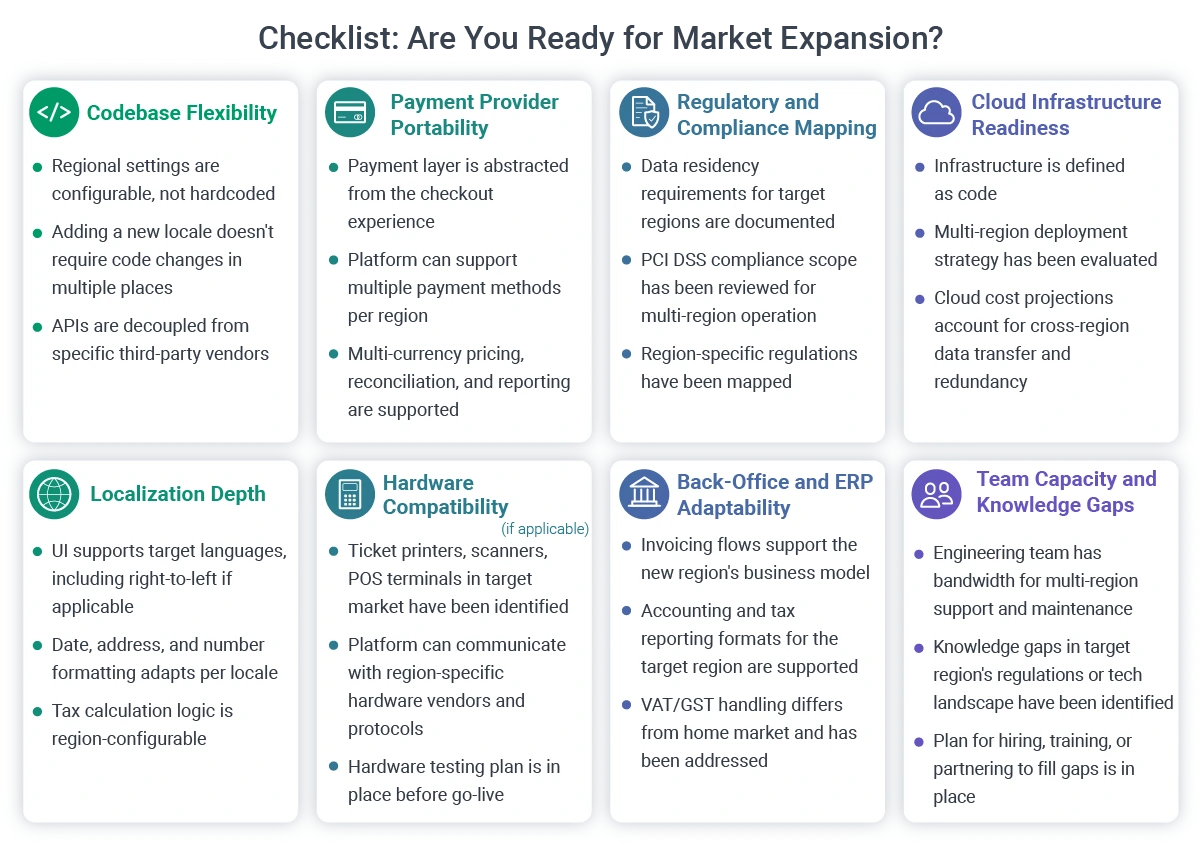
If you have completed most of these requirements, you're likely in a strong position to move forward with confidence. If you aren’t quite there yet, it likely means the first phase of your project should be a technical assessment and remediation plan rather than jumping straight into development for the new market.
Final Word
Regional expansion is exciting when the business case is strong. But the companies that pull it off on schedule and on budget are the ones that treat the technical planning as the foundation of the project rather than an afterthought.
The pattern is consistent across industries: the earlier engineering leadership is involved in the conversation, the fewer surprises show up mid-project. A code audit, architecture assessment, or infrastructure review before you commit to a timeline isn't slowing things down. It's the step that keeps everything else from slowing down later.
If you're evaluating a regional expansion and want a clear picture of what your platform can handle today and what it needs before going live in a new market, contact Softjourn. We've helped countless businesses work through exactly these decisions, and we'd be happy to do the same for you.