AI-Powered Personalized Learning: Implementation Guide for Education Platforms
What building genuine AI-powered personalization into an education platform actually takes, and where most implementations quietly fall short.

Imagine this: Two learners enroll in the same corporate compliance course. They see the same videos, take the same quizzes, and have the same deadlines. One finishes in the first week and scores well above the certification threshold. The other logs in twice, stalls on a module unrelated to their actual role, and drops off entirely.
The platform treated them identically; nothing about the content changed based on what either learner already knew, how they were progressing, or what kind of instruction actually worked for them. That gap, not motivation nor aptitude, is what most personalization efforts are trying to close.
How Do We Close the Gap?
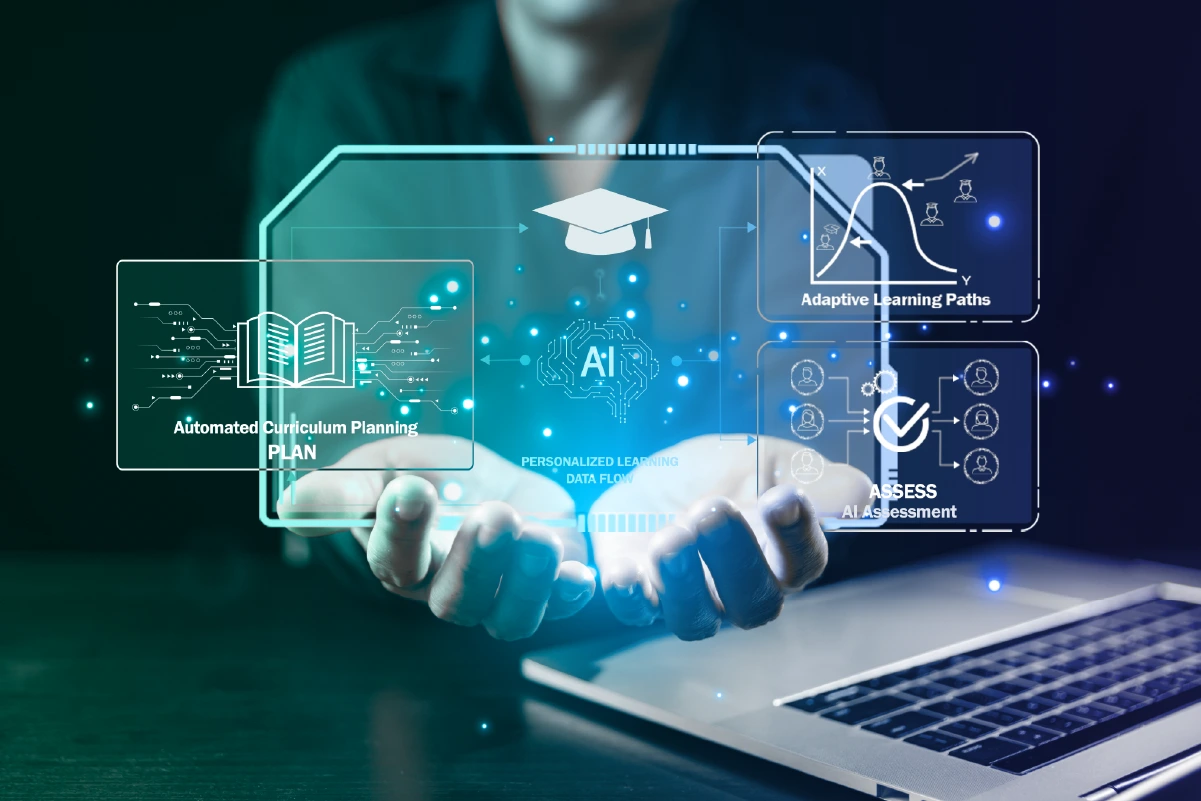
"AI-powered personalization" gets used loosely enough in EdTech marketing that it has started to mean almost nothing on its own. Some platforms use the phrase to describe a recommendation widget that suggests the next video. Others mean something closer to what the term should imply: a system that adjusts sequence, difficulty, and even format based on how a specific learner is actually performing.
The difference matters more than the terminology suggests, because building the second kind requires decisions that most platforms never make explicitly: what data the system needs to collect, how much of it is needed before recommendations mean anything, and where AI should stop and a human instructional designer should take over. This article works through those decisions in the order a technical or product leader would actually need to make them.
For a broader look at the platform decisions personalization fits into, from LMS architecture to compliance to AI more generally, see our complete guide to EdTech software development.
What "AI-Powered Personalization" Actually Means (and Doesn’t)
Most platforms that claim personalization are doing one of two things, and only one of them is actually personalization in a meaningful sense.
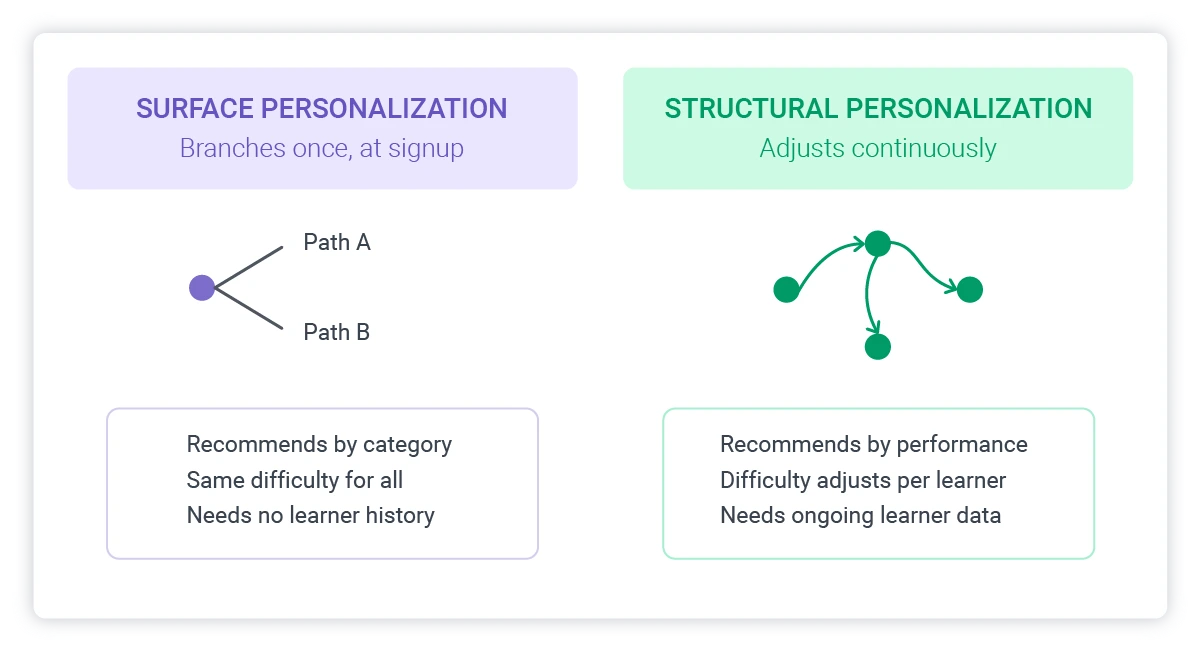
Surface personalization changes what a learner sees without changing how the system understands them. A “recommended for you” carousel, a next-course suggestion based on category, a static path that branches once at signup based on a role selected from a dropdown. These features are easy to build, easy to market, and genuinely useful in a limited way. They are not adaptive. The system isn’t learning anything new about the person using it after that first branch point.
Structural personalization is different in kind, not just degree. It means the system tracks how a learner is actually performing, quiz scores, time spent, which explanations they needed twice, which format they engage with versus skip, and uses that data to adjust what happens next. A learner who breezes through foundational material sees it condensed or skipped. A learner who stumbles on a specific concept gets more practice on that concept specifically, not a generic “try again” loop.
The distinction shows up clearly in a simple comparison:
Surface Personalization | Structural Personalization |
Branches once, at signup or enrollment | Adjusts continuously based on ongoing performance |
Recommends based on category or popularity | Recommends based on individual performance data |
Same difficulty curve for every learner | Difficulty and pacing adjust per learner |
Requires no learner history to function | Requires enough data to make a meaningful prediction |
The pillar the industry has been building toward for years, adaptive learning paths that genuinely respond to an individual learner’s demonstrated need, sits firmly in the second column. It’s also the harder, more expensive thing to build, and it’s worth being honest about that difference before committing a roadmap to it.
The Three Things AI Personalization Actually Requires
Structural personalization sounds straightforward in a pitch deck. In practice, it depends on three things being in place, and most “AI personalization” initiatives that stall after launch are missing at least one of them.
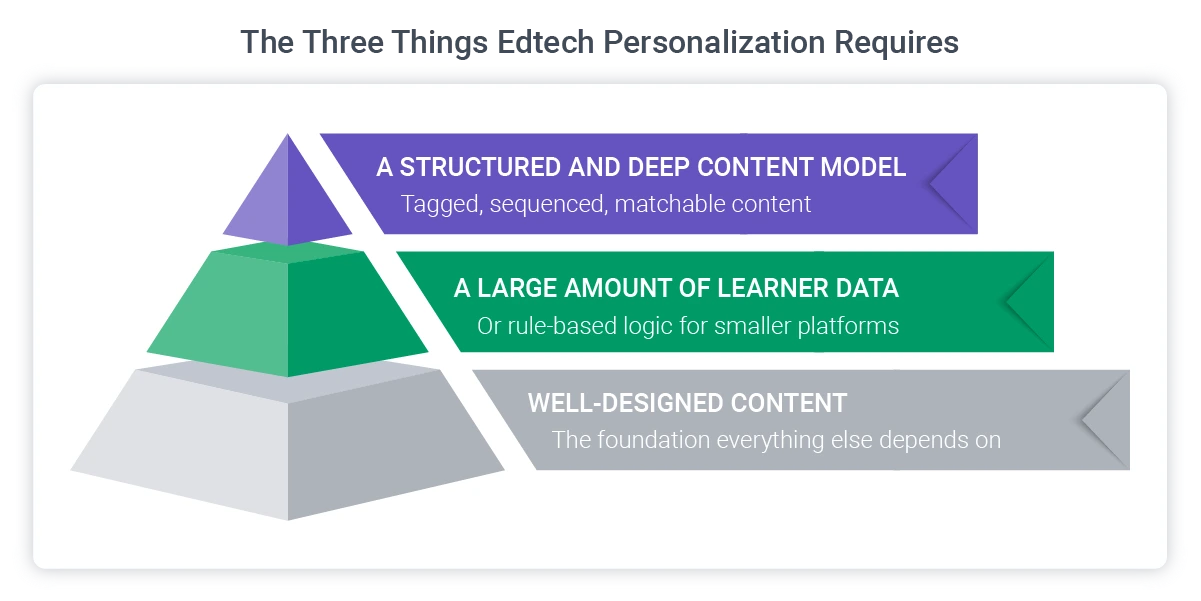
A Structured and Deep Content Model: Personalization requires content to be tagged, sequenced, and related to other content in ways a recommendation engine can actually use. A folder of videos and PDFs isn’t enough. Each unit needs metadata about what it teaches, what it assumes the learner already knows, and what else could substitute for it if a different format would serve a struggling learner better. Retrofitting this structure onto an existing content library after the fact is possible, but it’s slower and more expensive than building it in from the start.
A Large Amount of Learner Data: A recommendation engine trained on a few hundred learners will make confident-sounding suggestions that are statistically meaningless. Adaptive systems generally need enough historical performance data, across enough learners taking enough different paths, before a pattern is a pattern and not noise.
This doesn’t rule out smaller platforms, though. Rule-based adaptive logic, branching learners based on defined performance thresholds rather than a trained model, can deliver real personalization without the data volume a statistical recommendation engine needs. It’s a reasonable starting point, and one that can evolve toward a full ML-driven approach as the learner base grows.
Well-Designed Content: A platform that personalizes the delivery of poorly designed content is still delivering poorly designed content, just with a more sophisticated delivery mechanism. AI can adjust pacing and sequence, but it can’t fix a course that never explained a concept clearly in the first place.
Skip any of these and the personalization layer ends up with nothing good to work with, nothing reliable to learn from, or nothing to correct for.
How AI Personalization Looks in Practice
The theory holds up better with a concrete example of a system built to match individual profiles to outcomes at scale.
Girls in Tech, a nonprofit with members across dozens of countries, offers a working example of this in practice. The organization needed a recruitment platform where job seekers could verify their skills directly on their profiles rather than relying on a resume alone, so Softjourn built a matchmaking model that pairs individual skills-assessment results with employer needs, reducing mismatched hires for both sides. The platform demonstrates the core personalization principle in this guide: matching an individual's demonstrated ability, not a generic category, to the right outcome.

The outcomes hold up at the institutional level too, beyond a single matching use case. Colorado Technical University's Accounting I course saw its pass rate climb to an 81% average, a 27% increase, after adopting an adaptive learning platform, with course retention rising from roughly 86% to 95% over the same period [EDUCAUSE Review]. The American Women's College at Bay Path University documented a similar pattern: students exposed to its adaptive learning platform re-enrolled at a rate roughly 10 percentage points higher than the comparable national average for retention [EDUCAUSE Review].
The research explains why: it comes down to matching, not just adapting. A 2025 study published in Computers and Education: Artificial Intelligence found that learners who received machine-learning-driven personalized recommendations completed courses at a rate about 30% higher than those who didn't, with recommendation accuracy for course-type preference exceeding 70% [Computers and Education: AI]. Separately, research in Information Processing & Management found that predicting learner engagement and using it to personalize course recommendations reduced MOOC dropout rates by an average of 28.67% across two large real-world datasets [Information Processing & Management].
Whether the "match" is a job candidate to an employer or a struggling learner to the right remediation content, the underlying requirement is the same: a system that can hold enough structured information about both sides to make a connection that's actually useful, not just plausible-looking.
Where AI Personalization Breaks in Production
The theory works cleanly in a controlled study. In production, with real learners and real data gaps, a few specific failure modes show up consistently.
The cold-start problem: A recommendation engine needs history to work from, and a brand-new learner has none. Early sessions either get generic, unpersonalized content, or the system guesses based on thin signals and gets it wrong. Platforms that handle this well tend to fall back to simple, rule-based onboarding until enough data accumulates, rather than pretending to personalize from session one.
Recommendation loops that narrow instead of expand: A system tuned purely to engagement will keep serving a learner more of whatever they already respond to, which can mean less exposure to material they actually need but haven’t shown interest in yet. The same dynamic that makes a video platform’s recommendation engine effective at keeping people watching can make a learning platform’s engine effective at keeping people comfortable, which isn’t the same as effective at teaching them.
The trust gap when a recommendation feels wrong: A learner who gets steered toward remedial content they don’t think they need, or skipped ahead past something they wanted to review, will often just disengage rather than tell the system it made a mistake. Design that surfaces the reasoning (“recommended based on your last quiz”) tends to hold up better than a black-box suggestion, because it gives the learner a chance to override it instead of quietly losing trust in the system.

That trust question comes down to whether an AI system is willing to admit what it doesn’t know. Softjourn’s own R&D team ran into this directly while building an internal support chatbot, one built specifically to refuse answering questions its source documentation didn’t cover, rather than guessing at a plausible-sounding response.
The same limitation shows up in decisions, not just answers. Softjourn’s design team ran a separate internal experiment testing AI tools across real UX work, and found that AI could accelerate production dramatically but couldn’t reliably take over decisions requiring context it was never given. An AI-restructured onboarding flow looked reasonable at a glance, but silently misclassified a mandatory step as optional, an error that would have caused real problems for users if it had shipped unreviewed. The parallel for a learning platform is direct: AI can adjust pacing and recommend content, but decisions with real consequences for a specific learner still need a human checkpoint.
Data Architecture for Personalization: Unglamorous, But Needed
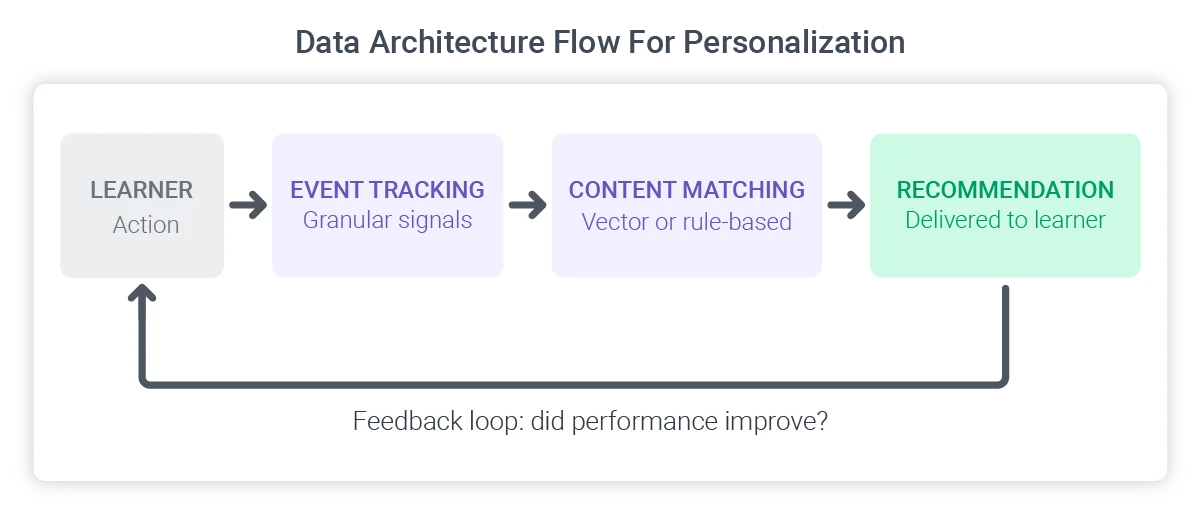
Everything discussed so far depends on a data layer that most platforms underestimate when scoping a personalization project. A few components tend to show up in any system that actually works:
- Event tracking at the right granularity: Not just “completed course” or “failed quiz,” but quiz-question-level results, time spent per unit, content format engaged with versus skipped, and retry patterns. Coarse tracking produces coarse recommendations.
- A content matching layer: Some form of embedding or vector representation that lets the system compare a learner’s current state against available content and find the closest fit, rather than relying on rigid, manually defined rules for every possible path.
- A feedback loop that closes: The system needs to know not just what it recommended, but whether the recommendation worked, did the learner’s performance actually improve after the adjustment. Without that loop, the system can’t get better over time; it just keeps making the same kind of decision indefinitely.
- Integration with existing LMS or SIS data: Personalization built as a bolt-on system disconnected from the platform’s system of record tends to drift out of sync fast. The personalization layer needs to read from and write back to the same source of truth the rest of the platform uses.
Although these aspects are unglamorous work, it’s usually where personalization projects quietly run over budget. Softjourn’s own R&D team ran into the same underlying pattern internally: unstructured information that needs to be turned into something a system can actually query and act on.
One project involved keeping a 170-page internal product document synchronized with a codebase that changed every sprint, a problem that used to cost hours of manual work per update and had fallen badly behind schedule after a migration.
A related project took 25 years of scattered project history, case studies, survey responses, and internal logs, and structured all of it into a single AI-searchable knowledge base.
Neither project touched education. But both are proof of the same underlying capability a personalization layer depends on: turning messy, disconnected information into something structured enough for a system to actually use.
To Build, Buy, or Extend?
The pillar guide’s build-versus-buy framework applies here too, but personalization sharpens the decision in a specific way: most off-the-shelf LMS platforms offer some version of “AI personalization” as a feature, and it’s worth being skeptical of what that actually means before assuming it solves the problem.
A few questions cut through the marketing quickly:
- Does the platform’s personalization adjust sequence and difficulty, or just recommend what to click next? Many vendor “AI” features are surface personalization dressed up in AI language. Ask for a specific example of how the system changed a learner’s path based on their performance, not just what it recommended.
- Can the vendor’s system read and write to your existing content model, or does it require rebuilding your content library in its format? This is often where “buy” quietly turns into “buy and then rebuild everything anyway.”
- Does your platform have enough learner volume to make the vendor’s ML-driven recommendations meaningful, or would a simpler rule-based approach get you further for less? A large-scale vendor solution built for enterprise data volumes can be the wrong tool for a mid-market platform that would be better served starting with rule-based branching.
Extending an existing LMS with a purpose-built personalization layer is often the middle path that makes sense for platforms with an established content library and learner base but no adaptive capability yet. Building from scratch makes more sense when personalization is meant to be a core differentiator of the product itself, not an add-on feature bolted to something else.
Whichever direction fits, the decision benefits from an honest look at the content model, data volume, and integration requirements covered earlier in this guide, before signing on with a vendor or committing engineering time to a build.

Closing Thoughts
Personalization done well is one of the more genuine differentiators left in EdTech, precisely because it’s hard to fake. A recommendation widget is easy to bolt onto any platform. A system that actually adjusts to how a specific learner is doing requires the content model, the data foundation, and the instructional design discipline covered in this guide, and most competitors haven’t put in that work.
Getting it right starts with an honest read on where your platform stands today: what your content model actually supports, how much learner data you have to work with, and whether your existing instructional design would hold up under closer scrutiny.
For a broader look at the platform decisions personalization fits into, from LMS architecture to compliance to AI more generally, see our complete guide to EdTech software development.
Contact Softjourn to talk through what a personalization layer would actually take for your platform.