-1-1920x620.webp)
The $500K MVP Didn't Survive AI. The Risk Did.
AI has made it far cheaper to find out whether an idea works, and that is changing what clients should expect to pay before they know.

Something has changed in the first conversation we usually have with clients.
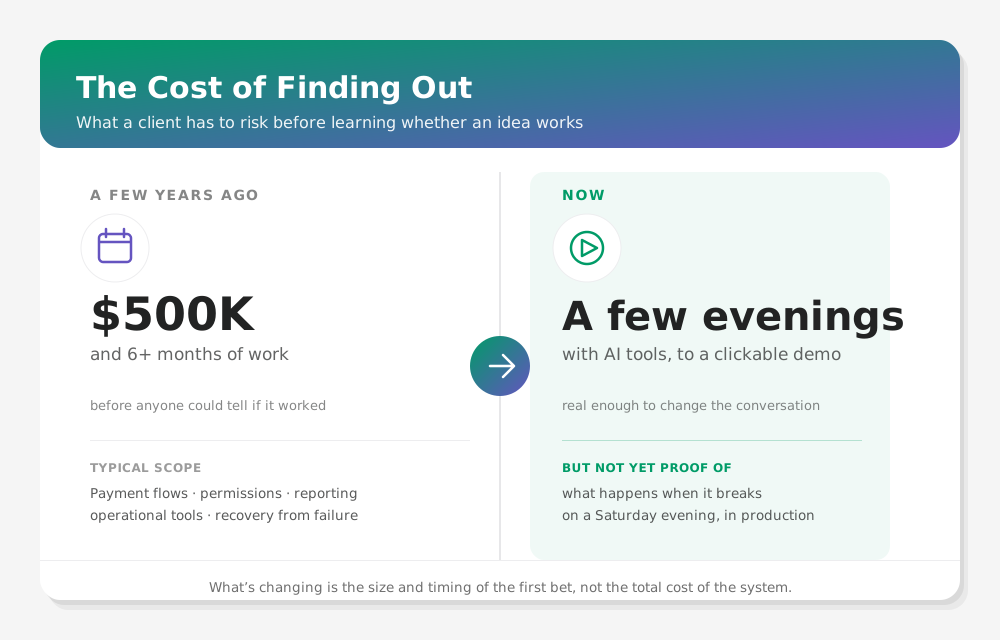
A few years ago, a serious first release usually meant months of work and a substantial six-figure budget. Once the scope included payment flows, permissions, reporting, operational tools, and recovery from failure, an estimate could move toward half a million dollars without anyone being surprised.
Now a client may open the meeting by showing us a demo. Most often, someone on their team has spent a few evenings or a couple of weeks with AI tools, and they already have something we can click through. It may be a rough MVP, but it is real enough to change how much money a company has to risk before they learn whether an idea is worth building.
I run a software services company, so I also have to address the uncomfortable part directly. AI is changing the economics of execution. If it removes a week of boilerplate, documentation, or repetitive testing, we cannot quietly put that week back on the invoice. The client should see the benefit. That means our value shifts from how fast we can produce something to the judgment that makes it safe, and to who is accountable when it fails.
A client no longer needs a $500K commitment just to get a first credible answer. That doesn’t mean every system once priced at $500K can now be delivered for $50K. It means the size and timing of the first commitment are changing, not necessarily the total cost of the system.
A Cheaper Way to Learn
When someone tells me, "We built an MVP in two weeks," I want to know what that actually means. Sometimes it means the team made the idea visible enough for people to react to, or it means they built just enough software to test one assumption about the product or the technology. Both are useful, and AI has made both methods much cheaper. A small beta release to real users can move just as fast, but only if everyone knows beforehand what has not been built yet.
The demo itself is the easy part, because we control the conditions when we run it. What worries me is what happens once it becomes live, like if a customer ends up with the wrong access or something breaks on a Saturday evening. Who finds out first? Will the client be the one who sees the break? Who decides what to do about it? And before anyone pushes a quick fix, do they know what else that fix could break?
A demo is great to have. But it does not mean the work of an MVP is done or that there are enough results to plan the final product around.
Where the Speedup Really Comes From
So how much of a speed advantage does AI actually provide? At Softjourn, we have tested this on our own engineering work rather than relying on outside benchmarks, and the honest answer is that it depends more than most headlines suggest.
In one Softjourn R&D project, where our team ran real internal engineering work through a structured, AI-assisted development process, tightly defined coding tasks ran five to ten times faster. While these numbers are strong, I wouldn’t want to turn the results into a sales benchmark. In reality, the time savings we found weren’t just from using AI, but from our team accurately describing tasks, properly setting up the agent with clear information, and double-checking results.
Similarly, research from METR, a nonprofit that studies how AI tools actually perform in real-world use, shows why blanket multipliers rarely hold up. METR's 2026 survey of 349 technical workers found a median self-reported AI speedup of 3x, but a perceived gain in value that was far more modest: between 1.4x and 2x.
An earlier METR 2025 randomized study of experienced developers exposed an even sharper gap between perception and reality: 16 experienced open-source developers tackled 246 real tasks in familiar codebases. Working with AI actually slowed them down by 19%, yet they walked away convinced they had been 20% faster because of it.
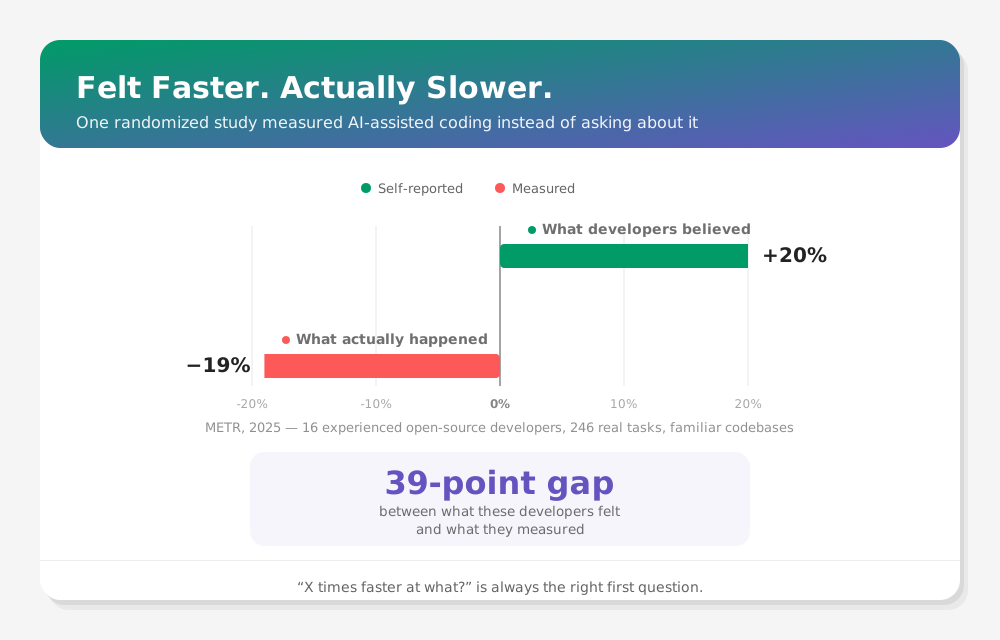
So when I hear that AI makes development X times faster, my first question is always: X times faster at what? In practice, the fastest runs have usually started slowly, because the team has spent time debating the business rule, excluding data, or finding the person who will carry the risk, and that is what lets AI move quickly afterward.
One incident on an internal project made this painfully concrete in our recent R&D project. An agent was asked to remove database columns that appeared unused in the service it could see. It did exactly that, but unfortunately, it did so without realizing four other projects depended on those columns, and several services were temporarily disrupted.
From the agent's point of view, removing the columns was sensible; however, we had handed it an incomplete map. A developer who knows the history of a project would double-check a column name if it rings a bell, but an AI agent doesn’t have that history. No prompt could make it guess a dependency it had never been shown. Luckily, in the end, the fix was quite simple: the team wrote down the cross-project dependencies and kept them with the repository context.
The database incident gave "explicit context" a very practical meaning for me. As execution gets cheaper, providing explicit context to AI agents becomes mandatory. That does not mean a larger specification; it means not leaving out important information and context that can make an agent think a potentially dangerous action is sensible.
The Risk Doesn't Disappear; It Moves
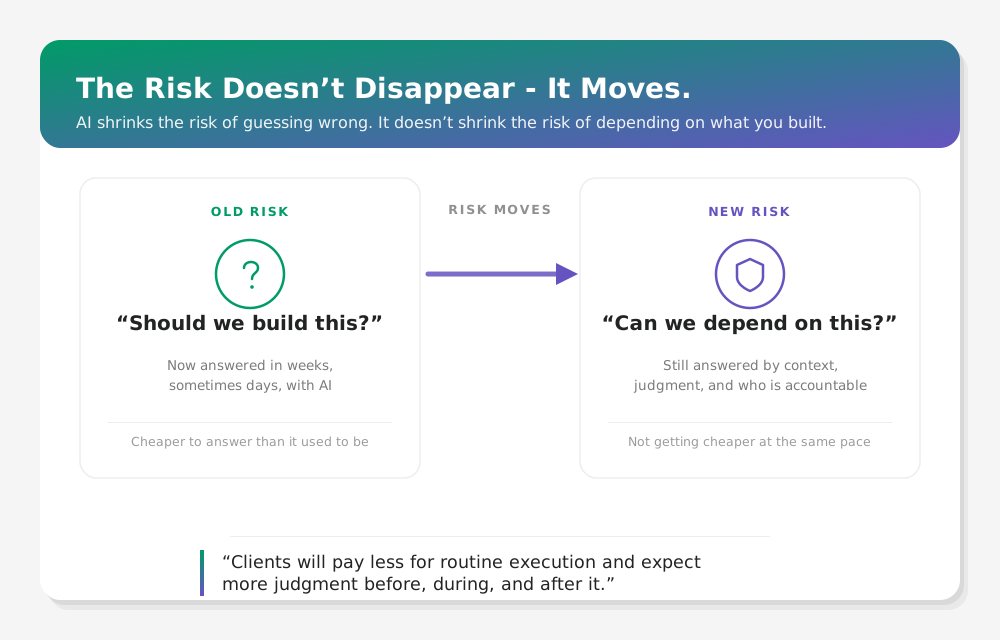
Cheaper, faster MVP execution with AI is real, and it can be worth having. But it changes the shape of the risk more than it removes it. As AI makes execution faster, the judgment and context around that execution start to matter more, not less.
If your team already has a working demo and you're trying to figure out what it actually takes to get from there to something you can depend on, that's worth a conversation before you commit the next budget cycle to it. Talk to Softjourn's expert team about what that next step should actually look like.