-1-1920x1080.webp?v=1787600810797)
AI-Assisted Development vs. Dedicated Team: Do You Need More Bodies or More Tokens?
Before adding headcount or handing more of the roadmap to AI tools, it helps to know which problem you're actually trying to solve, and the data on AI-assisted development is more mixed than most vendors let on.

A CTO we talked to recently described her decision this way: she had two proposals on her desk, one from a vendor pitching a dedicated team, one from her own VP of Engineering pitching a licensing budget for AI coding agents, and both slides claimed roughly the same outcome: Faster delivery, lower cost, and less risk.
That's the position a lot of engineering leaders are in right now. AI coding tools have gone from novelty to standard equipment fast: 85% of developers now use AI regularly for coding and development, and 62% rely on at least one AI coding assistant, agent, or editor as part of their daily workflow. At the same time, a growing body of controlled research complicates the story that adoption alone tells. The result is a genuinely harder decision than it looks: does the capacity gap in front of you get closed by better tooling around your current team, or does it need people?
-1366x768.webp?v=1787604410794)
This article builds on topics from our Guide to Hiring Dedicated Development Teams, which covers engagement model comparisons, when a dedicated team makes sense (and when it doesn't), and how to vet a vendor once you've decided people are the right answer.
What "AI-Assisted Development" Actually Means in 2026
Ask five people to define AI-assisted development and there's a decent chance you get five different mental pictures, and that fuzziness is exactly why so many capacity decisions go sideways before the first sprint even starts. Some leaders picture a developer with autocomplete on steroids, catching syntax errors and suggesting the next line of a function. Others picture something closer to a junior engineer who never sleeps, picking up a ticket, writing the code, opening a pull request, and waiting for review. Those are not the same tool, they don't carry the same risk profile, and they don't require the same oversight, so treating them as interchangeable is where a lot of AI-assisted development strategies quietly fall apart.
It's worth drawing the line clearly:
- AI coding assistants work inside a developer's existing workflow. Think autocomplete, inline suggestions, and chat-based help inside an IDE. A human is writing the code, making the decisions, and reviewing every line before it ships; the AI is a faster typist with decent context awareness.
- AI coding agents work with more autonomy. Given a ticket or a scoped task, an agent can plan the approach, write the code across multiple files, run tests, and in some setups open a pull request without a human touching the keyboard in between. A person still reviews the output, but the shape of the work has shifted from "assisted" to "delegated."
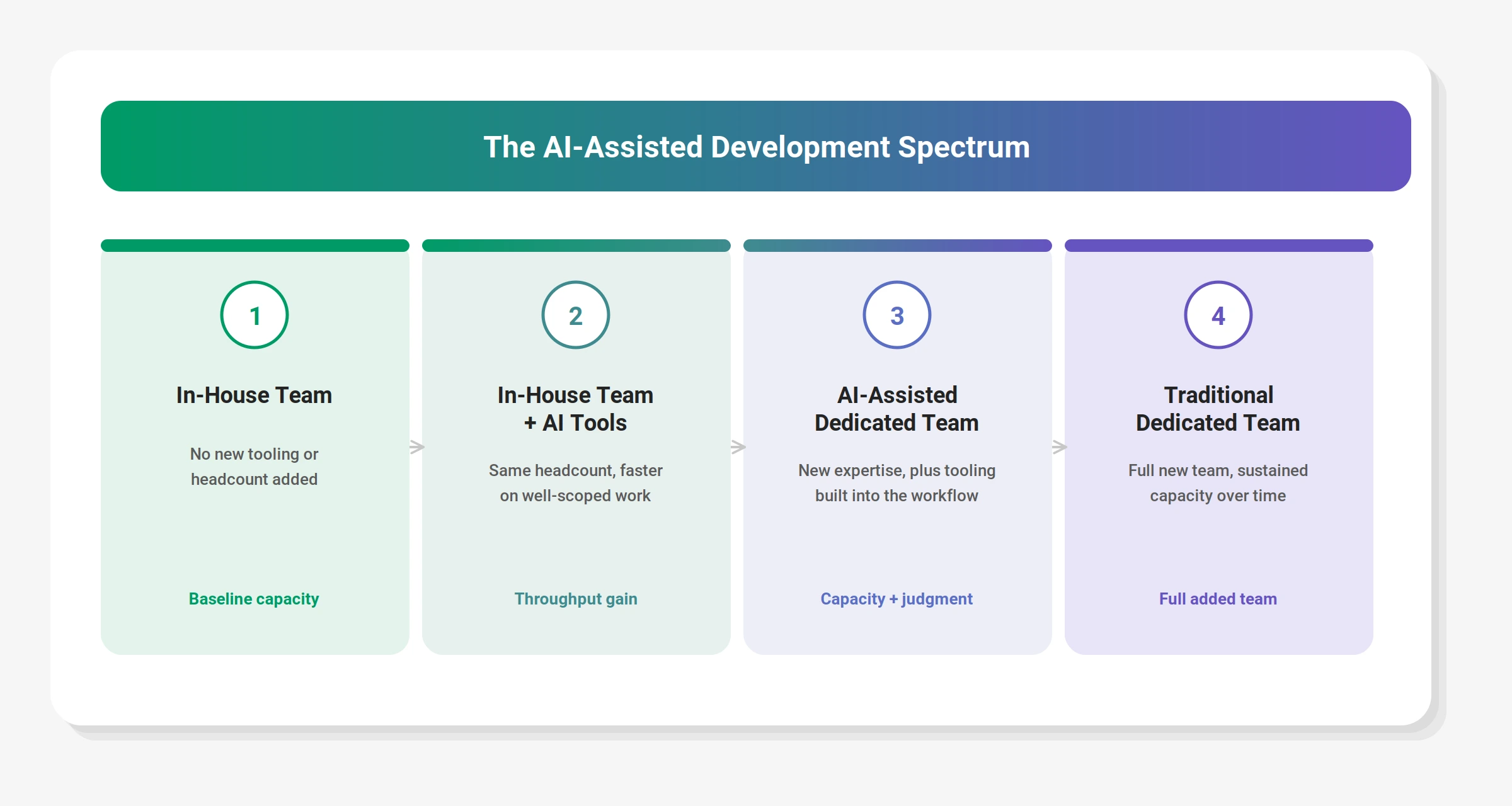
Most companies experimenting with AI-assisted development in 2026 are somewhere on a spectrum between those two poles, and where a team sits on that spectrum matters more to this decision than whether they're "using AI" at all.
A team using assistants inside a well-understood codebase is closing a different kind of gap than a team standing up agentic workflows to offload entire categories of tickets. The first tends to make an existing team modestly faster. The second starts to look, at least on paper, like added capacity, which is exactly why it gets compared to a dedicated team in the first place.
What the Data Actually Shows
The adoption numbers from the intro tell a story of enthusiasm, but enthusiasm and results are two different measurements, and the gap between them is where the real decision-making value lives. The most rigorous evidence on this so far comes from METR, a nonprofit research group that ran a randomized controlled trial (the same study design used in clinical drug trials) on sixteen experienced open-source developers working in codebases they knew well.
Before the study, those developers predicted AI tools would speed them up by 24%. The measured result was the opposite: developers using AI tools took 19% longer to complete the same real-world tasks, and even after finishing, they still estimated that AI had made them roughly 20% faster (METR, 2025).
That finding made headlines for good reason, but it's worth sitting with the nuance rather than the headline. METR studied experienced developers working in mature, high-context repositories using early-2025 tools, and the organization has been explicit that the result is a snapshot of one moment rather than a permanent verdict.
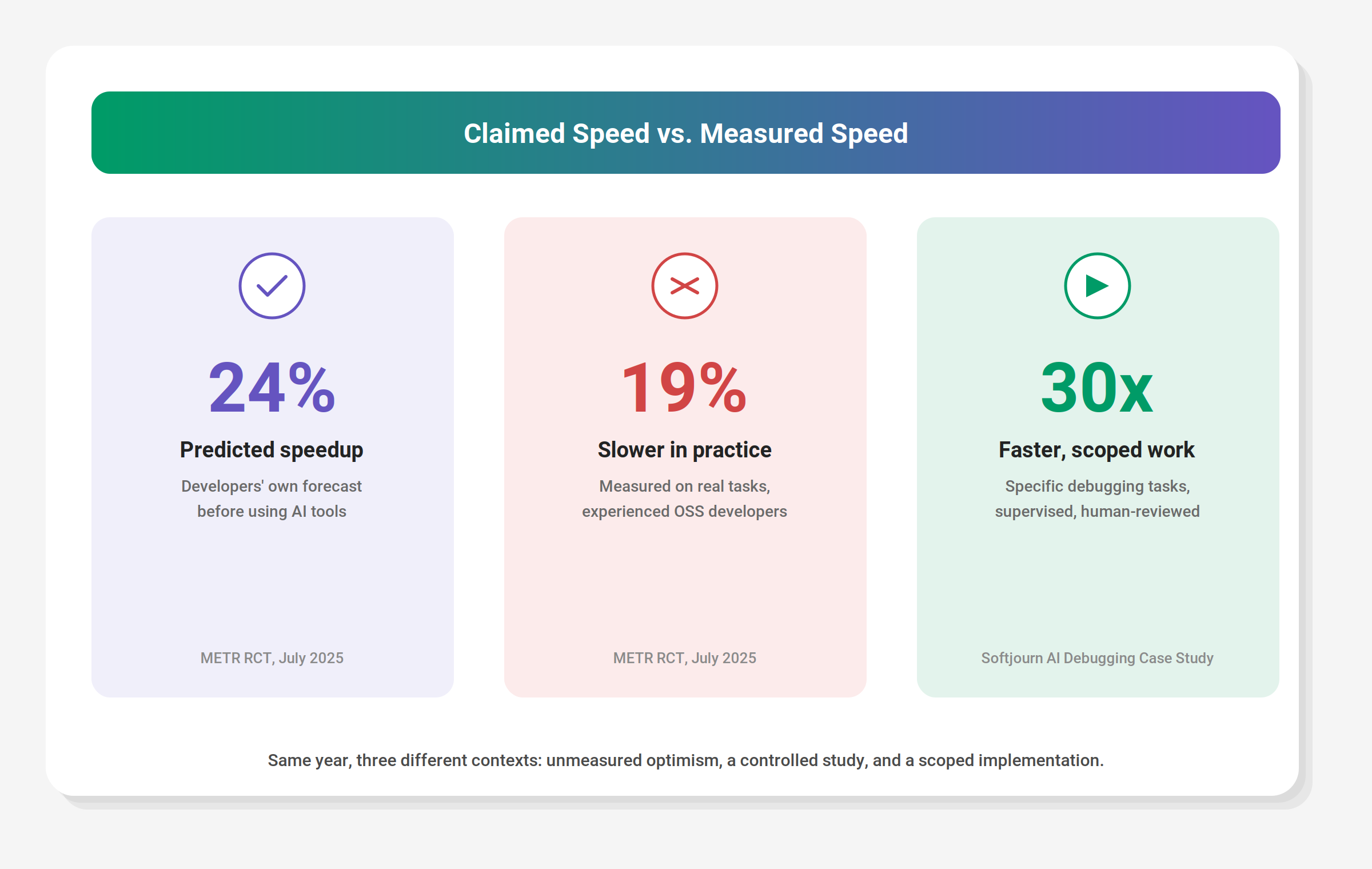
A February 2026 follow-up found some evidence that the picture may be shifting toward a modest speedup, but METR flagged real limitations in that data: developers increasingly declined to participate in tasks that required working without AI, which likely skews the sample toward people and tasks where AI helps least (METR, 2026). In plain terms, the tools may be improving, but the measurement got harder at the same time, and neither study is the kind of clean, confident number a vendor slide usually implies.
There's a broader pattern worth naming here too. MIT's Project NANDA found that roughly 95% of generative AI pilots at large organizations fail to produce a measurable return on the company's bottom line (MIT NANDA). That number describes enterprise AI initiatives generally, not engagement-model decisions specifically, and the report's methodology has drawn some pushback over its sample size, but it points at the same underlying issue this article is built around: AI tooling gets adopted faster than it gets evaluated, and the gap between "we're using AI" and "AI is measurably working" is often wider than it looks from the outside.
None of this means AI-assisted development doesn't work. It means the honest answer depends heavily on the task, the codebase, the team's experience level, and how the tooling gets implemented, which is a very different message than the productivity multipliers most vendors lead with.
Where Softjourn's Own R&D Found Real Gains, and Where It Didn't
Vendor case studies about AI productivity tend to share one thing in common: they rarely explain what didn't work. Softjourn's R&D team has spent the past year and a half running structured experiments across debugging, QA, documentation, and even UX work, measuring each one against a real baseline rather than a marketing claim, and the results are a genuinely mixed picture. Some of that work points toward real capacity gains an in-house team can absorb without adding headcount. Some of it shows the limits of what AI-assisted development can do on its own, which is exactly the kind of honesty this decision requires.
Claude Code as an IDE Collaborator
Our R&D team rebuilt how engineers handle debugging, test generation, and dependency updates by bringing Claude Code directly into the development workflow as a reviewing collaborator rather than a replacement. Specific debugging tasks ran up to 30x faster, automated test generation gained 10 to 20x, and dependency update overhead dropped meaningfully across active projects, all with a human reviewing every step. Read More→
An Autonomous Ticket-to-PR Pipeline
Two collaborating AI agents ran a fully autonomous pipeline that took tickets through planning and execution without a human touching the keyboard in between. Well-defined tasks moved 5 to 10x faster, and client-side delivery throughput rose 125% on the pilot project, which is the closest thing in Softjourn's own data to the "AI as added capacity" claim vendors like to make. Worth noting: this gain showed up specifically on well-scoped, routine work, not on judgment-heavy tickets. Read More→
The BMAD Method Applied to QA and Business Analysis
A structured proof of concept tested the BMAD AI framework against real QA and BA workflows for an entertainment technology client. Documentation time dropped 25 to 44% depending on task type, with the largest gains on repetitive specification work. The honest finding sits in what didn't scale as cleanly: judgment-heavy work like PRD creation needed enough rework that the time savings mostly disappeared. Read More→
.svg?v=1787609119451)
Agentic Documentation Pulled From Live Project Context
An agentic workflow connected large language models to live project infrastructure through MCP servers, pulling context directly from repositories, ticketing systems, and internal docs. Documentation that used to take engineers a week to write dropped to minutes, with the engineer still reviewing and editing before anything shipped. Read More→
AI Tools Tested Against Real UX Work
Not every experiment lived in code. Softjourn's design team ran structured tests of AI tools across three UX workflows: competitive research, large-scale asset rebranding, and onboarding flow redesign. The standout result was rebranding 150 themed assets in 45 minutes, a 95% reduction from the manual baseline, though gains varied considerably by task type across the three workflows tested. Read More→
The pattern across all five experiments is consistent: AI-assisted development delivers its biggest, most reliable gains on well-defined, repetitive, or pattern-matching work, and its gains shrink fast as a task demands more judgment, context, or original decision-making. That distinction turns out to matter more than any single multiplier when it comes to deciding whether tooling alone can close a capacity gap.
Signals That AI-Assisted Work With Your Current Team Is Enough
Not every capacity gap needs a new hire or a new vendor. Based on the pattern in Softjourn's own R&D data, plus the broader research on where AI tools genuinely help, a handful of signals tend to point toward staying with your current team and investing in better tooling instead.
- Repetitive, well-scoped bottleneck - debugging, test generation, documentation, and dependency updates are exactly the categories where Softjourn's own experiments showed the largest, most consistent gains. If that's where your team is losing hours, tooling is a reasonable first move before adding headcount.
- Deep existing codebase context - AI coding tools amplify existing knowledge rather than replace it. A senior engineer using an AI agent to handle routine tickets can move considerably faster, while a team unfamiliar with the codebase gets much less benefit from the same tooling, because the review burden stays high regardless of who or what wrote the code.
- Internal discipline for review - every gain in Softjourn's R&D results came with a human reviewing the work before it shipped. If your team doesn't have the bandwidth or process to review AI-generated code carefully, the tooling can create more cleanup work than it saves.
- Volume over judgment - a backlog full of small, well-defined tickets is a good candidate for AI-assisted throughput, while a backlog full of architectural decisions, ambiguous requirements, or new product direction is not, regardless of how capable the tooling has become.
- Speed now, not a six-month ramp - standing up new tooling and workflows around an existing team can happen in weeks. Bringing a new team, whether staff augmentation or a dedicated team, up to full context and velocity takes longer, even with a strong vendor.
The common thread across all five: AI-assisted development tends to be the right call when the problem is throughput on known work, not when the problem is a gap in expertise, judgment, or sustained capacity the team doesn't have the hours to cover even with better tools.
Signals That Point Toward a Dedicated Team
The flip side of the list above holds just as often. Certain conditions mean better tooling around your current team won't close the gap, no matter how good the AI agent is, because the problem was never really about throughput on known work.
- Missing expertise, not missing hours - if the gap is a skill set your team doesn't have (deep payments compliance knowledge, a legacy language specialist, ticketing-specific architecture experience), no amount of AI tooling gives your existing engineers that judgment. Tools amplify what a team already knows; they don't teach a team something it has never done.
- Sustained capacity over months, not a burst of tickets - a roadmap that needs a cross-functional group working independently for six months or more is a staffing problem, not a tooling problem. AI-assisted throughput helps an existing team move faster through its backlog, but it doesn't add the ongoing bandwidth of additional engineers, QA, and project management working in parallel.
- Judgment-heavy or ambiguous work - Softjourn's own BMAD results showed the gains disappearing on tasks like PRD creation, where the work depends on interpreting intent rather than executing a known pattern. Architectural decisions, unclear requirements, and new product direction fall into the same category, and that's exactly where experienced people outperform tooling.
- Limited bandwidth to review AI output - every genuine gain in the R&D data depended on a human reviewing the work carefully. A stretched team with no time to review AI-generated code properly isn't actually saving time, it's deferring the cost to whoever finds the bug in production.
- Need for continuity and institutional knowledge - a dedicated team accumulates context over the life of an engagement in a way that a licensing budget for AI tools cannot replicate. If the product is going to keep evolving for years, that accumulated judgment compounds in a way pure tooling doesn't.
Read together with the previous section, the two lists point at the same underlying test: is the gap in front of you a matter of getting more done with what your team already knows, or a matter of the team not having what it needs in the first place? AI-assisted development answers the first question well, while it rarely answers the second.
.svg?v=1787609082819)
The Middle Path: Dedicated Teams That Build AI-Assisted Workflows In
Framing this as AI-assisted development versus a dedicated team suggests a cleaner split than what actually happens in most real engagements. In practice, the strongest dedicated teams aren't choosing between people and tooling, they're building AI-assisted workflows directly into how the team delivers, which means the "more bodies or more tokens" question often resolves into "both, applied deliberately."
Vanco's engagement with Softjourn is a useful example. Vanco needed deep payments domain knowledge for a system rewrite, the kind of judgment a licensing budget for AI tools couldn't supply on its own, and brought in a dedicated team that scaled to match each project phase. That team now works inside a development process that includes AI-assisted debugging and documentation as standard practice, applying the same gains from Softjourn's R&D data on top of the domain expertise a dedicated team provides, rather than choosing one over the other.
The practical takeaway: choosing a dedicated team doesn't mean opting out of AI-assisted development, and choosing AI-assisted development doesn't mean an organization has ruled out ever needing dedicated capacity. The better question is which gap is in front of you right now, and whether the people you already have, with better tooling, can actually close it.
Making the Call
The question this article opened with, more bodies or more tokens, doesn't have a universal answer. Start with what's actually creating the pressure. If the bottleneck is repetitive, well-scoped work sitting on top of a team that already knows the codebase and has the bandwidth to review AI output carefully, better tooling around that team is usually the faster, cheaper first move. If the gap is missing expertise, sustained capacity over months, or judgment-heavy work that depends on context no model has, that points toward bringing in people, whether through staff augmentation or a dedicated team.
And for many organizations, the honest answer isn't a clean either-or. The strongest setups treat AI-assisted workflows as something a well-resourced team builds into how it works, not a substitute for the team itself.
Contact Softjourn to get started on evaluating whether your current team, a dedicated team, or a combination of both actually fits the gap you're trying to close.
If you're looking for more guidance, explore our Complete Guide to Hiring Dedicated Development Teams.