-1-1201x801.webp?v=1783980686209)
What Your Technical Due Diligence Is Missing in the Age of AI-Generated Code
AI-generated code is now the norm. Here's what buyers, investors, and new teams need to verify before they inherit it.

Last year, one of our clients was preparing to acquire a software platform. The demos were smooth, the revenue case held up, and the codebase passed a visual review. Before committing, they brought in our team for an independent technical assessment.
Three weeks later, they had a full picture of the platform's architecture, its open-source licensing exposure, its security posture, and a clear roadmap for what modernization would actually cost. The acquisition closed. It went well.
That engagement would look different today, and not because the process was wrong.
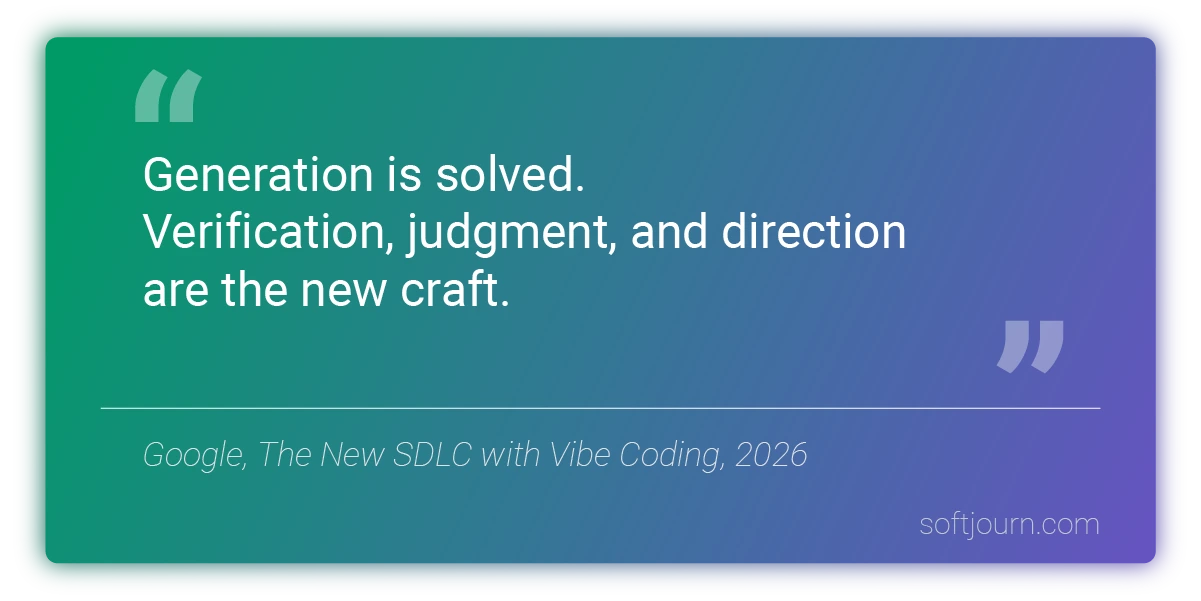
Since 2024, AI coding tools have become a standard part of how software gets built. According to data cited in Google's 2026 engineering paper on agentic development, an estimated 41% of all new code is now AI-generated, with 85% of professional developers using AI coding tools regularly.
That code often functions well enough to ship, but it doesn't always function well enough to scale, survive a security audit, or make sense to a team that didn't write it. The gap between "it works" and "it's well-built" has widened considerably, which means technical due diligence efforts must cover more ground than they did even a few years ago.

What Technical Due Diligence Actually Covers
Due Diligence vs. Code Review: Not the Same Thing
Technical due diligence is not a code review. The terms get used interchangeably, but they describe very different scopes of work.
A code review is typically internal, and is either conducted by the same team that wrote the code or a third-party auditor, and is focused on errors in the code and if it meets the team's standards. Technical due diligence is an independent, structured assessment of an entire software product, usually commissioned before a significant business decision: an acquisition, a major investment, a partnership, or a decision to hand a critical system to a new development team.
What a Proper Software Assessment Covers
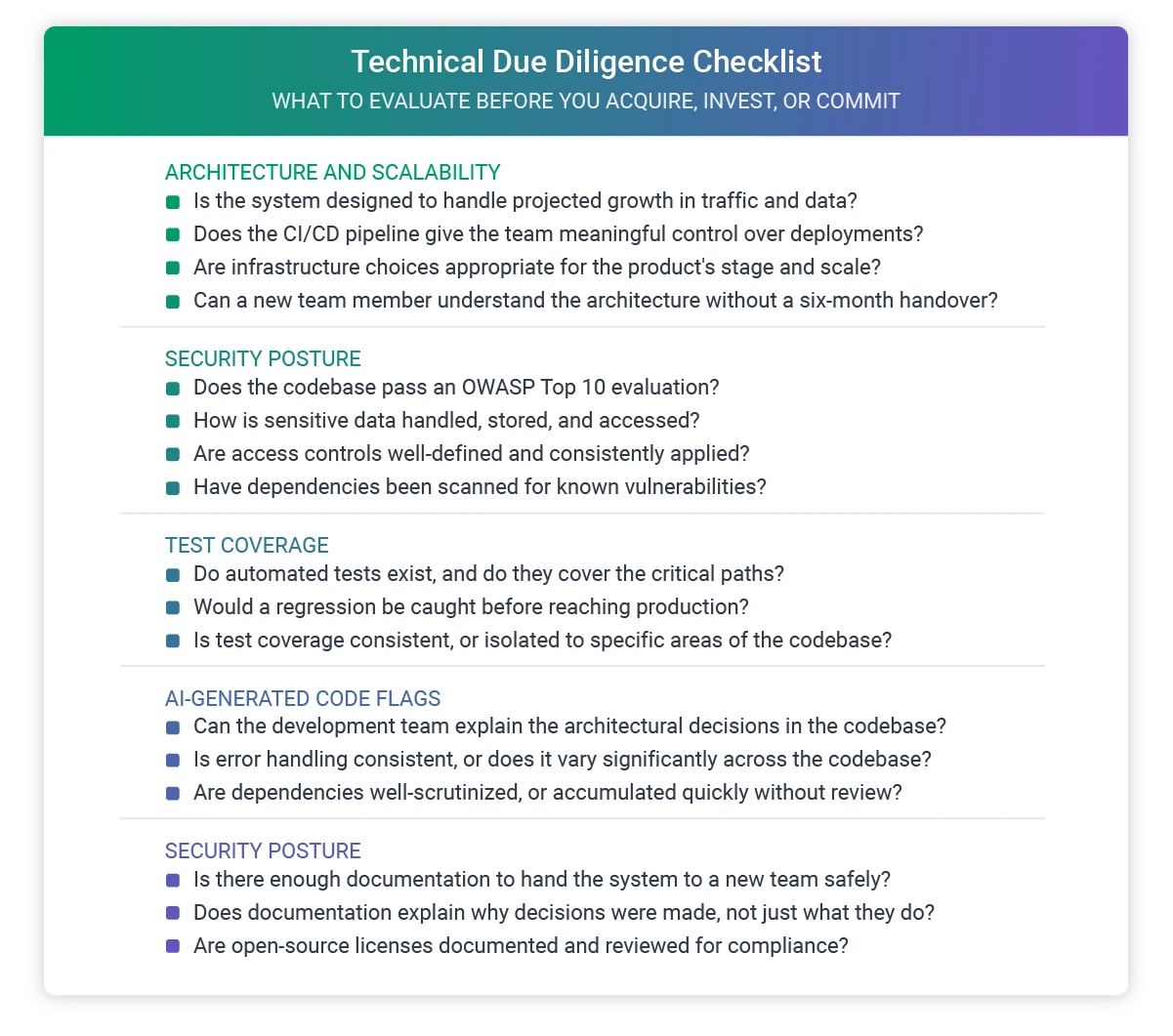
At a minimum, a proper technical assessment covers:
- Code quality and maintainability: Is the code written to a consistent standard? Can a developer who didn't write it understand and modify it without significant risk?
- Architecture and scalability: Is the system designed to handle growth? Are there structural decisions that will become expensive problems at higher volumes?
- Security posture: Are there known vulnerabilities? Does the codebase follow security best practices, or are there gaps that would fail an OWASP audit?
- Test coverage: Does automated testing exist, and does it actually cover the critical paths? A codebase with no tests is a codebase that can't be changed safely.
- Technical debt: What shortcuts were taken, what dependencies are outdated, and what will it realistically cost to address them?
- Licensing compliance: For products built on open-source dependencies, are there licensing terms that create legal exposure for the buyer?
- Documentation: Can the system be handed to a new team without six months of institutional knowledge transfer?
That last one is more telling than most buyers expect. A well-documented system signals a team built it with longevity in mind. The absence of documentation is often a signal of the opposite.
The Goal Is Accurate Information, Not a Reason to Walk Away
The goal of technical due diligence isn't to find a reason to walk away. It's to walk in with accurate information, so the decision, whether to proceed, renegotiate, or plan a remediation budget, is based on what the product actually is rather than what it appears to be.

AI: The New Variable in Every Codebase
Why AI Changes What Auditors Need to Look For
For most of software development's history, code was written by humans, line by line. That's no longer reliably true, and it changes what due diligence needs to look for.
AI coding tools, ranging from autocomplete assistants to fully autonomous agents that can write, test, and submit code without a developer typing a single line, are now standard across the industry.
When the vast majority of professional developers use AI coding tools regularly, and an estimated almost half of all new code is AI-generated, any software product built or significantly modified in the last two years almost certainly has AI-generated code in it. The question is what kind.
The Spectrum Matters More Than the Presence of AI
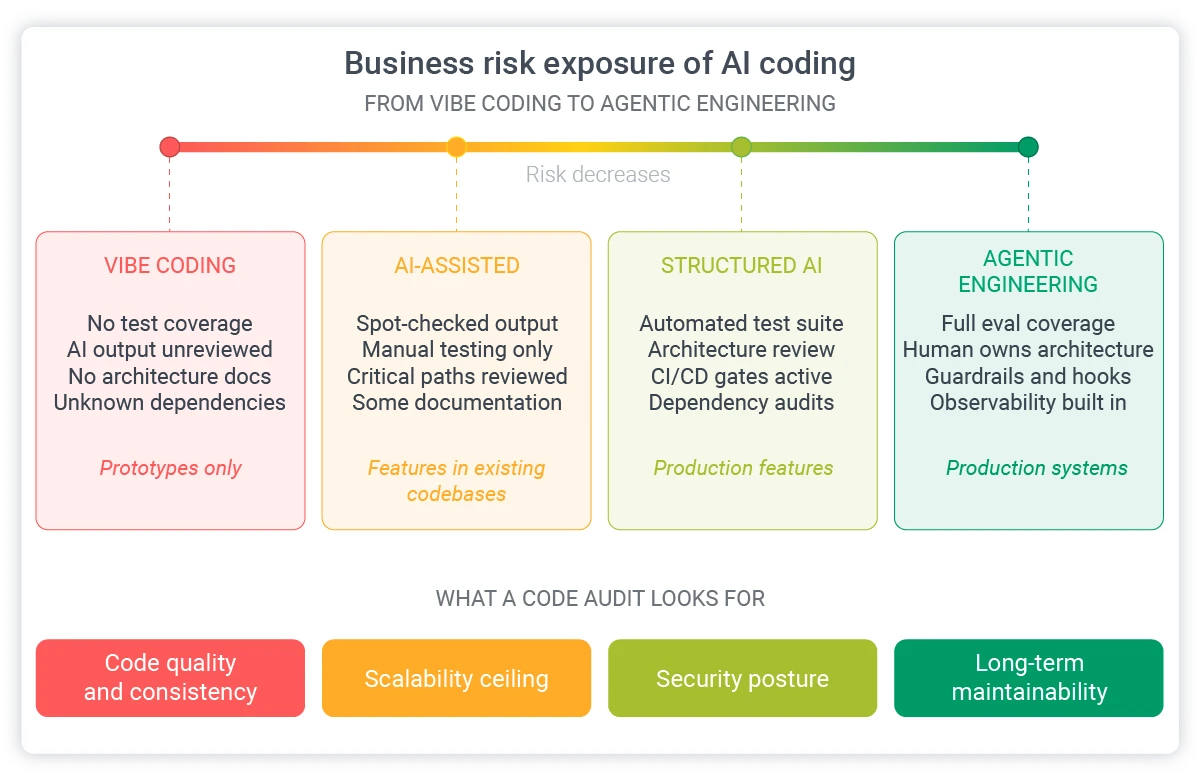
Not all AI-assisted development carries the same risk. The distinction that matters here is not whether AI was used, but how.
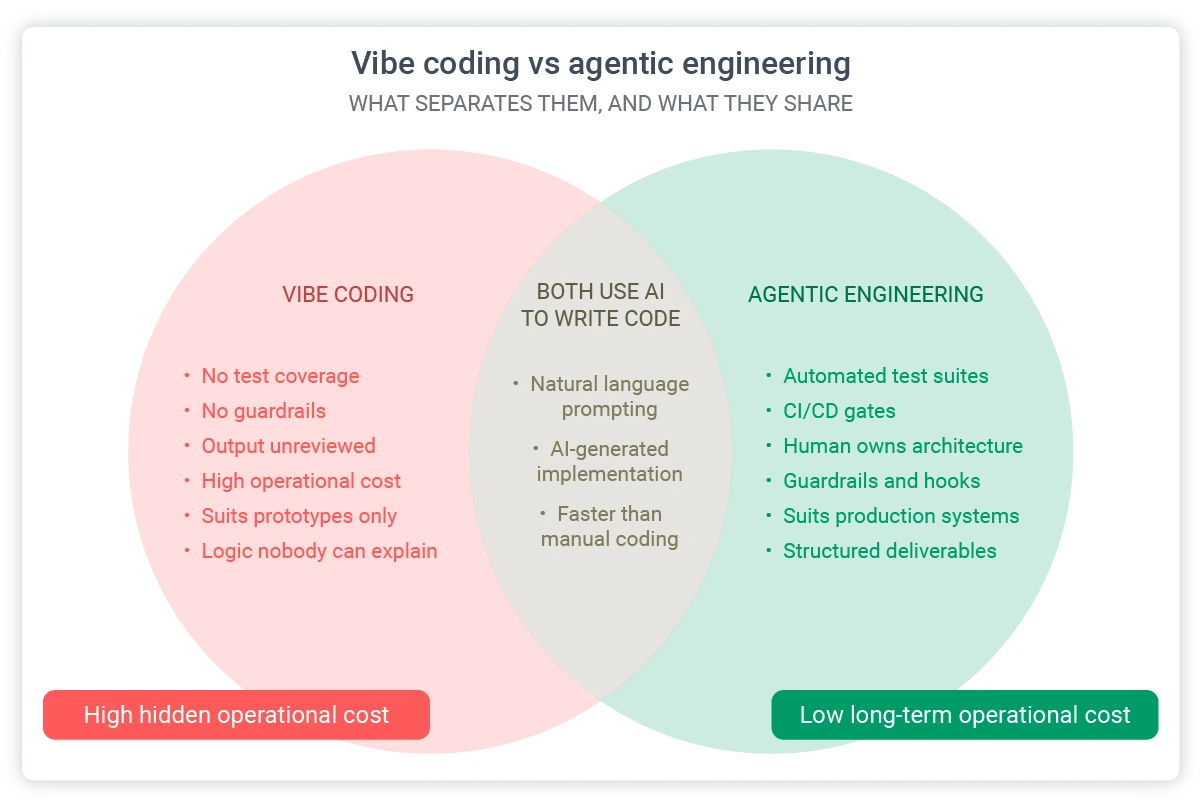
On one end is what's now commonly called "vibe coding": a developer describes what they want in natural language, accepts whatever the AI produces, and ships it. Fast, low-friction, and increasingly common in startups and early-stage products where speed is everything.
On the other end is what Google's 2026 engineering paper calls "agentic engineering": AI handles implementation, but within a structured system of automated tests, guardrails, and human oversight of architecture and quality.
The difference in output quality between these two approaches is significant. Vibe-coded software can look clean, pass a demo, and even pass basic tests. What it often lacks is the structural discipline that makes a codebase maintainable under real conditions. Google's paper describes this economic reality directly: vibe coding carries low upfront cost but high operational cost over time, through maintenance burdens, security remediation, and the compounding expense of working around brittle, poorly structured code.
For anyone evaluating a software product before a major commitment, this creates a specific new question that didn't exist three years ago: not just "is this code well-written?" but "how was this code produced, and what does that mean for what we're inheriting?"
The signals aren't always obvious on the surface. That's precisely the problem.
What Vibe-Coded Codebases Look Like in Practice
Building Features With AI: The 80% Problem
AI coding tools are genuinely impressive at getting to a working first draft. Google's 2026 paper describes what engineers have started calling "the 80% problem": AI can rapidly generate roughly 80% of the code for a feature, but the remaining 20%, the edge cases, error handling, and subtle correctness requirements, demand the kind of contextual judgment that current AI models don't reliably have.
In a well-run engineering team, that last 20% is where the most important decisions get made. In a vibe-coded codebase, it's often where the work simply stopped.
Warning Signs of Technical Debt and Structural Risk
The warning signs of a vibe-coded codebase aren't always dramatic. They tend to show up as a pattern of small gaps that compound into something expensive:
- Minimal or absent test coverage: AI-generated code is frequently shipped without meaningful automated tests. When there's nothing to verify correctness, there's nothing to catch regressions either.
- Inconsistent error handling: Some functions handle failure gracefully; others don't handle it at all. This inconsistency is a common artifact of code generated in separate sessions without a unifying standard.
- Missing or generic documentation: AI tools can generate documentation, but it tends to describe what code does rather than why decisions were made. Architectural reasoning is rarely captured.
- Brittle dependencies: Vibe-coded projects often accumulate dependencies quickly, without much scrutiny of licensing terms, maintenance status, or compatibility with the rest of the stack.
- No clear code ownership: When AI generates large portions of a codebase, it's common for no human on the team to have deep familiarity with critical sections. That becomes a problem the moment something breaks in production.
- Logic nobody can explain: This is the most telling signal. If the development team can't walk an auditor through why specific architectural decisions were made, there's a reasonable chance those decisions were made by an AI that was never asked to justify them.
Functional Is Not the Same as Sound
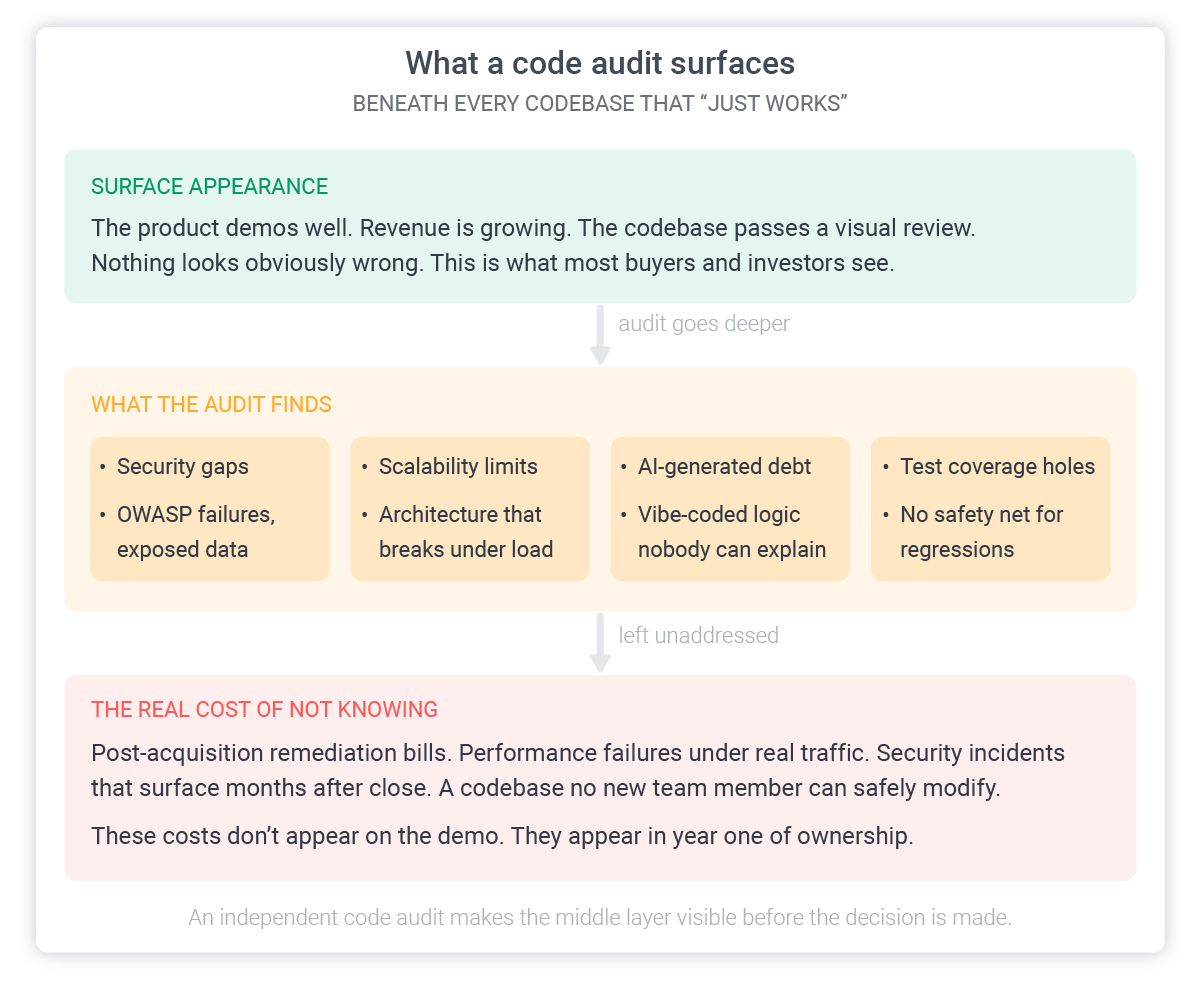
None of these signals mean the product doesn't work. Many vibe-coded platforms work well under normal conditions and at the current scale. The issue surfaces when conditions change: when traffic spikes, when a security audit happens, when a new team inherits the codebase, or when a feature change triggers an unexpected cascade through poorly understood code.
For a buyer or investor, that's the exposure. A product that works today but will require significant remediation to scale, secure, or maintain is a different asset than its surface appearance suggests.
What a Proper Code Audit Actually Surfaces
A Technical Assessment is More Than a List of Problems
A well-run technical assessment doesn't just produce a list of everything wrong with a codebase. It produces a prioritized picture of what the product actually is, what it will cost to maintain and grow, and what decisions a buyer or investor needs to make before committing. The difference between a useful audit and an unhelpful one is largely in what gets examined and how findings get communicated.
The Coverage Areas That Matter: Scalability, Security, and Debt
A structured code audit conducted for due diligence purposes typically works across several layers simultaneously:
- Architecture and infrastructure review: This goes beyond whether the system is built on recognizable technology. It examines whether the architecture is appropriate for the product's scale requirements, whether the infrastructure is well-configured, and whether the CI/CD pipeline gives the team meaningful control over what gets deployed and when.
- Code quality and maintainability assessment: Reviewers look at consistency of standards across the codebase, how readable the code is to someone who didn't write it, and whether the structure will support future development without constant firefighting.
- Security analysis: Using frameworks like OWASP Top 10 as a baseline, auditors look for known vulnerability patterns, check how sensitive data is handled, and identify gaps in access controls. This is frequently where the most consequential findings surface.
- Dependency and licensing audit: Every external package or library the product relies on carries its own risk profile: licensing terms that may create legal exposure, maintenance status, known vulnerabilities, and compatibility with the rest of the stack. In complex microservices architectures, this can mean analyzing thousands of packages.
- Test coverage evaluation: Not just whether tests exist, but whether they cover the critical paths, whether they're automated, and whether they would catch a regression before it reached production.
- Technical debt mapping: Auditors identify outdated dependencies, architectural shortcuts, and areas of the codebase that will require significant investment to modernize, then provide realistic effort estimates so buyers understand what they're committing to.
What Good Findings Look Like
The output of a technical assessment should give decision-makers three things: a clear picture of what the product's foundations actually look like, a prioritized list of issues with enough context to understand their severity, and a roadmap for what remediation or modernization would realistically involve. Anything less is a checklist, not an assessment.
When It Matters: Use Cases for Technical Due Diligence

1. Before an Acquisition
This is the highest-stakes scenario for technical due diligence, and the one where an independent assessment pays for itself most visibly. A buyer needs to know what they're actually purchasing before the deal closes, not after.
When one of our clients was preparing to acquire a JavaScript-based platform built on a complex microservices architecture, they needed a full independent technical assessment within a tight timeline. Our team conducted an exhaustive audit covering frontend architecture, backend services, security posture, licensing compliance across thousands of dependencies, and performance characteristics, gathered through recorded live demonstrations when direct production access wasn't available.
The audit confirmed solid foundations, surfaced clear optimization opportunities, and gave the client complete licensing visibility. The acquisition proceeded with confidence.
2. Before a Sale
Sellers benefit from independent assessments too, arguably more than buyers. Entering a negotiation without knowing what your own codebase contains is a risk that tends to surface at the worst possible moment.
An industrial commerce platform approaching a sale wanted no surprises at the negotiation table. Softjourn conducted Java and PHP backend audits within two weeks, and during the PHP audit, identified a significant security vulnerability related to access to sensitive data, one that could have materially affected the sale had it surfaced during buyer due diligence instead. The client went into negotiations with an accurate picture of their product's strengths and a prioritized list of what needed addressing.
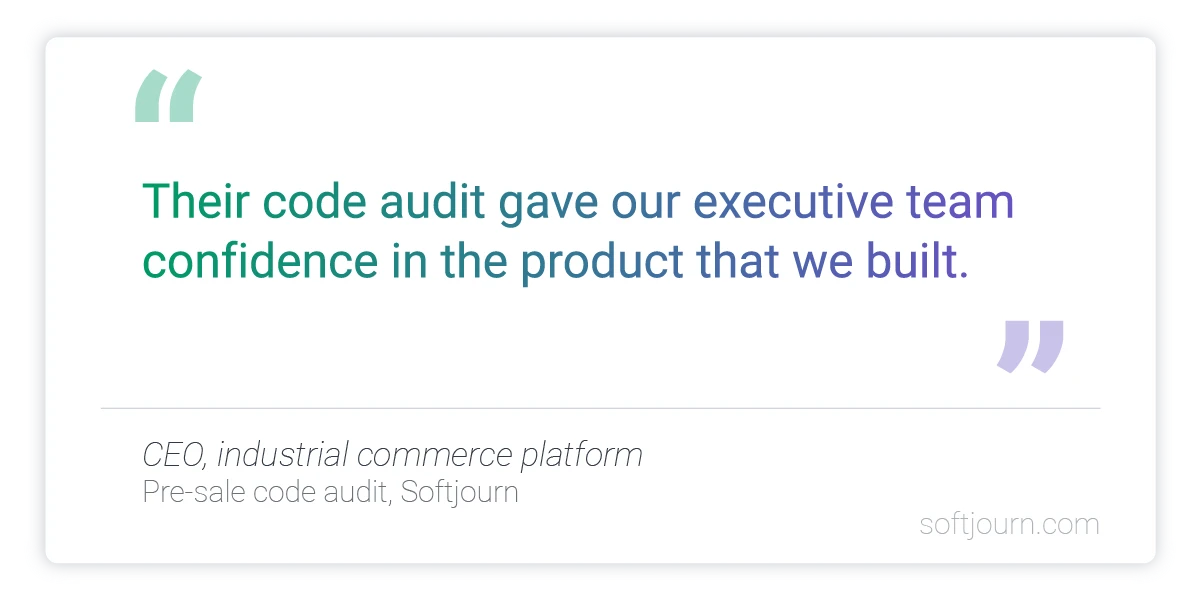
"Their code audit service gave our executive team confidence in the product that we built and provided validation on items that needed to be fixed." — CEO, client
3. Before a Major Architecture Decision
Technical due diligence isn't only relevant in M&A contexts; it can also be essential when building new features, modernizing a legacy platform, or before major upgrades.
When a technology company was evaluating a newly proposed architecture recommended by a recently hired Solution Architect, they weren't sure whether to proceed with the new approach or cut their losses before committing further. Rather than make a costly decision without an objective view, they brought us in for an independent assessment.
Our senior architects evaluated the existing and proposed codebases, reviewed the AWS infrastructure and CI/CD pipeline, and assessed whether the new direction was technically sound and cost-effective for the long term. The findings led to a recommendation to rebuild rather than refactor, a significant call that the CEO approved based on the clarity of the assessment.
"In just over a year, we've built the foundation for what could become a market-leading solution. It wouldn't have been possible without the partnership, dedication, and skill of the Softjourn team." — CEO, client
4. When a New Team Inherits a Codebase
Acquisitions and sales aren't the only moments that create this problem. Any time a new development team takes over a product, whether through a partnership, a vendor change, or an internal restructure, they're inheriting someone else's decisions. Understanding what those decisions were before work begins is considerably cheaper than discovering them mid-sprint.

What to Look for in an Impartial Assessor
The Conflict of Interest Problem
The most important word in "impartial software assessment" is the first one. A firm that audits your codebase and then pitches you the remediation project has a financial interest in what it finds. That doesn't mean their findings are wrong, but it does mean the incentive structure might not be working in your favor. An assessor whose only job is the assessment, and whose report stands regardless of what comes next, is in a fundamentally different position.
This is worth asking about directly before engaging anyone: what happens after the report? If the answer involves a seamless transition into a development engagement, understand that context when you read the findings.
On the other hand, a firm that already understands your platform and the goals you're working toward can be a natural fit to continue as a development partner, if that's the direction you want to take. The key is knowing which arrangement you're in before the assessment begins, not after.
What Separates a Useful Assessment From a Checkbox Exercise
Beyond independence, there are a few qualities that distinguish assessments worth commissioning from ones that produce a report nobody acts on.
- Senior reviewers doing the actual work: Technical due diligence requires experienced judgment, not just tool output. Static analysis tools and security scanners are part of a good process, but the interpretation of findings, the prioritization of what matters and what doesn't, and the architectural recommendations require engineers who have seen enough codebases to know what normal looks like and what doesn't.
- Domain familiarity: A team that has worked extensively in fintech, ticketing, health care, or enterprise SaaS will recognize patterns and risks specific to those environments that a generalist assessor might miss. Licensing structures, compliance requirements, and scalability demands vary significantly by industry, and that context shapes what a finding actually means in practice.
- Structured, actionable deliverables: A good assessment produces more than a list of problems. It produces prioritized findings with enough context to understand severity, realistic effort estimates for remediation, and a clear framework for decision-making. If the output doesn't help you decide what to do next, it hasn't done its job.
- Transparency about limitations: No assessment is exhaustive, and any firm that implies otherwise is overselling. Access constraints, timeline limits, and the inherent complexity of some systems mean that honest assessors are clear about what they examined, how deeply, and where the boundaries of their findings are.
- A Note on Timeline: Legitimate technical due diligence doesn't require months. A well-scoped audit of a complex platform can be completed in two to three weeks by an experienced team working with appropriate access. If a firm is quoting significantly longer timelines for a standard pre-acquisition assessment, it's worth understanding why. Equally, if the timeline is being compressed to the point where coverage is obviously incomplete, that's worth questioning too.

Technical Due Diligence in the Age of AI Code
AI-generated code isn't going away, and neither is the risk of acquiring, investing in, or inheriting a codebase that looks better on the surface than it performs in practice. The gap between a product that demos well and one that's genuinely built to scale has always existed. The widespread adoption of AI coding tools has made that gap harder to see and easier to stumble into.
Technical due diligence done well closes that gap before it becomes your problem. It gives buyers, investors, and anyone making a significant commitment to a software product the information they need to proceed with accuracy rather than assumption.
The good news is that a rigorous, independent assessment is achievable within realistic timelines and budgets.
If you're approaching an acquisition, preparing for a sale, or evaluating a system before a major commitment, contact Softjourn to discuss what a technical due diligence engagement would cover for your specific situation.
Frequently Asked Questions
What Is the Difference Between a Code Audit and Technical Due Diligence?
A code audit is a focused technical review of a codebase, typically examining code quality, security, test coverage, and technical debt. Technical due diligence is a broader term that encompasses a code audit but extends to architecture assessment, infrastructure review, licensing compliance, documentation quality, and an overall evaluation of the software product as a business asset. In practice, a pre-acquisition technical due diligence engagement will usually include a full code audit as one of its components.
How Long Does a Technical Due Diligence Assessment Take?
For most platforms, a thorough independent assessment can be completed in two to three weeks by an experienced team with appropriate access to the codebase. The timeline depends on the complexity of the architecture, the number of services involved, and what access the assessor is given. Both of the acquisition-related audits referenced in this article were completed within three weeks and two weeks respectively, covering complex multi-service platforms within tight deal timelines.
What Is Vibe Coding and Why Does It Matter for Due Diligence?
Vibe coding refers to an approach to AI-assisted development where a developer describes what they want in natural language, accepts whatever the AI produces, and ships it without rigorous testing or architectural oversight. The term comes from the broader conversation in the engineering community about the spectrum between casual AI-assisted development and disciplined "agentic engineering," where AI operates within structured guardrails and automated test suites. It matters for due diligence because vibe-coded software can appear functional and well-structured on a surface review while carrying significant hidden costs: poor test coverage, brittle dependencies, inconsistent error handling, and architectural decisions that nobody on the current team can fully explain.
What Should a Technical Due Diligence Report Include?
A useful technical due diligence report should cover: an assessment of code quality and maintainability, a security analysis against a recognized framework such as OWASP Top 10, an evaluation of test coverage, a dependency and licensing audit, an architecture review with scalability assessment, a technical debt map with realistic remediation estimates, and a prioritized set of findings with enough context to inform decision-making. The report should be clear about what was examined, how deeply, and where any limitations in access or scope affected the findings.
Where Can I Find Impartial Software Assessment Firms That Evaluate Scalability and Technical Debt?
Look for firms that specialize in code auditing as a standalone service, rather than as a gateway to a larger development engagement. The key indicators of a genuinely impartial assessor are independence (their findings don't determine whether they win follow-on work), senior reviewers with hands-on architectural experience, and structured deliverables that go beyond tool-generated reports. Softjourn's code audit practice operates on exactly this basis: the assessment is the engagement, and the report stands on its own. You can learn more at softjourn.com/services/code-audit.
When Should I Commission a Technical Due Diligence Assessment?
The most common trigger points are before acquiring a software company or product, before making a significant investment in a technology business, before entering a major technology partnership or vendor dependency, when a new development team is taking over an existing product, and when a company is preparing to sell and wants no surprises at the negotiation table. The earlier in a decision process an assessment happens, the more useful its findings are. An assessment commissioned after a deal closes can still be valuable for planning purposes, but it can no longer influence the terms of the commitment.
What Does a Scalability Assessment Include?
A scalability assessment evaluates whether a software product's architecture and infrastructure can handle growth, both in terms of user volume and operational complexity. In practice, this means examining how the system is structured to manage increased traffic loads, whether the database design will hold up as data volumes grow, how the infrastructure is configured to scale horizontally or vertically when demand spikes, and whether the CI/CD pipeline gives the team enough control to deploy changes safely at higher velocity. It also looks at whether third-party dependencies and service integrations will remain stable under increased load, and whether the current architecture creates bottlenecks that would require significant rework to address at scale. For buyers and investors, a scalability assessment is often the section of a technical due diligence report that most directly informs valuation, because it translates architectural decisions into a realistic picture of what growth will actually cost.
Does a Technical Due Diligence Assessment Always Find Problems?
Not always, and that's worth saying directly. A clean assessment that confirms a product is as solid as it appears has real value, particularly for a seller trying to justify their asking price or a buyer trying to gain confidence before committing. The goal of an independent assessment is accurate information, not a specific outcome. Some engagements surface critical findings; others confirm that the foundations are sound and identify moderate improvements worth planning for. Both outcomes serve the people making the decision.