
Guide to Canada's Real-Time Rail for Financial Institutions in 2026
Canada's new instant payment infrastructure is set to launch in phases starting late 2026, and financial institutions that wait for go-live to start preparing risk losing ground to faster-moving competitors.

Canada's payment system moved $12.2 trillion across 22.5 billion transactions last year, and for a meaningful share of those transactions, the money didn't actually move until hours or days after the payment was initiated. Wire transfers, standard EFTs, even everyday e-transfers all carry that same lag built in, and businesses have spent decades designing cash flow, payroll, and reconciliation processes around it. Payments Canada is now closing that gap with the Real-Time Rail (RTR), a new national payment infrastructure set to go live in phases starting Q4 2026.
The RTR isn't a minor upgrade to the systems Canadian businesses already use. It replaces the slow middle step in how money moves between financial institutions with settlement that happens in seconds, available around the clock.

Transactions will start at a limit of $100,000 CAD, carry far richer data than anything Canada's current rails support, and come with fraud protection built in from day one rather than bolted on afterward.
Whether you're a bank preparing for RTR participation, a fintech evaluating where you fit into the new access model, or a business trying to figure out what changes on your end, the questions are mostly the same: what is this system, when does it actually arrive, and what should you be doing right now to get ready.
This guide walks through all of it, and we'll keep it updated as testing wraps, adoption climbs, and the launch phases roll out.
Why We're Tracking This
Softjourn has spent more than two decades building payment infrastructure for financial institutions and fintechs, including work with real-time and account-to-account payment systems across North America. As Canada's Real-Time Rail moves from pilot phases toward broader rollout, our research and content teams monitor Payments Canada's updates, adoption data, and industry commentary so financial institutions have an accurate, current reference rather than a one-time snapshot. This guide draws from Payments Canada's own public documentation, Datos Insights research, and reporting from outlets like the Financial Post, and we plan to update it as adoption figures, timelines, and participant requirements evolve.
What Did Canada Use Before the Real-Time Rail?
Canadian businesses have never been without ways to move money quickly, they've just paid for it in convenience, cost, or certainty. Before the RTR, three systems handled the bulk of the country's payment volume, each built for a different job and none of them built for speed:
Lynx is Canada's high-value payment system, used for large, time-sensitive transactions between financial institutions. It settles in real time on a transaction-by-transaction basis, but it's designed for interbank and large corporate transfers, not the kind of everyday payment a mid-market business or consumer would touch directly.
ACSS, the Automated Clearing Settlement System, is the batch-based workhorse behind most of Canada's day-to-day payment volume: payroll deposits, pre-authorized debits, and standard EFTs. It works reliably, but it settles on a deferred, next-business-day basis. A payment initiated Friday evening doesn't complete until Monday.
Interac e-Transfer is the closest thing Canada has had to instant payments, and it's the reason Canadian consumers and businesses already trust the idea of moving money in minutes rather than days. Adoption reflects that trust: most Canadian businesses already use Interac e-Transfer in some form. But it was built primarily for peer-to-peer and business-to-consumer use cases, runs on its own closed network, and doesn't carry the structured remittance data that a modern B2B payment needs to auto-reconcile with an invoice.
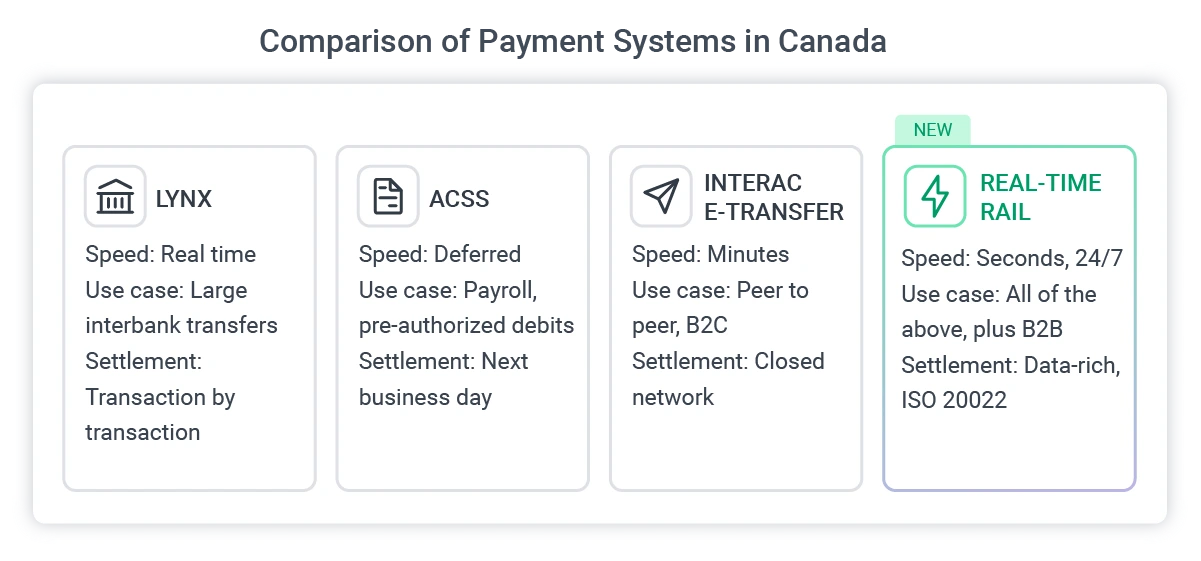
None of these systems is being shut off with this development. What's changing is that Canada will finally have a rail purpose-built for real-time, data-rich payments across use cases none of the three above were designed to serve well: same-day B2B settlement at scale, structured remittance data, and 24/7 availability without the batch cutoffs ACSS still runs on.
Case Study Snapshot: Viamericas: Replacing Legacy Rails with Custom Infrastructure
When Viamericas outgrew its bank-provided Check21 solution, Softjourn helped the money transfer company design, build, and test a custom platform, giving them the operational and economic efficiency a growing remittance business needed as it moved beyond what a legacy system could support. Read More→
What Is the Real-Time Rail?
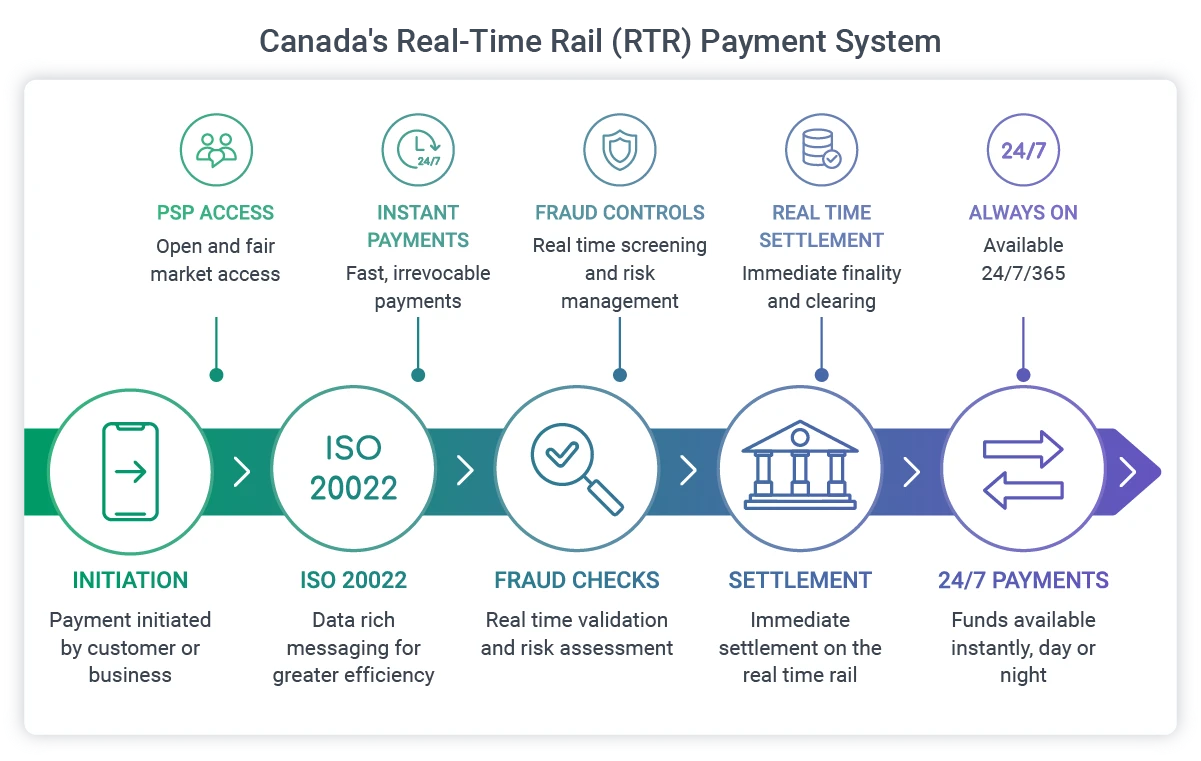
The Real-Time Rail is Canada's new national infrastructure for instant payment clearing and settlement, owned and operated by Payments Canada. Put simply, it does one thing: it lets money move between financial institutions and settle permanently in seconds, any time of day, any day of the year.
A few things define how it works:
- Funds availability within 60 seconds: Participating institutions are required to make funds available to a recipient's account within a minute of a payment being sent, a hard requirement built into the RTR's participation rules.
- 24/7/365 processing: There's no batch window, no weekend delay, no holiday cutoff. A payment sent at 11:00 p.m. on a Sunday clears the same way as one sent at noon on a Tuesday.
- ISO 20022 messaging: Every RTR payment can carry structured data alongside the transfer itself, invoice numbers, tax details, remittance advice, in a standardized format. That's a meaningful shift from ACSS and Interac e-Transfer, where reconciling a payment against an invoice is still largely a manual task for a lot of Canadian businesses.
- A $100,000 CAD initial transaction limit: a starting point we'll unpack further later in this guide.
- Centralized fraud services from day one: Rather than each institution building fraud detection in isolation, the RTR includes network-wide fraud scoring, a shared risk list, and a confirmation of payee service as standard, built-in features rather than optional add-ons.
Payments Canada has described the RTR as a made-in-Canada answer to a global shift. Roughly 80 countries now operate some form of real-time payment system, and Canada has spent years watching how the U.S., the U.K., India, and Brazil handled their own rollouts before finalizing its own approach. That timing shows up in some deliberate design choices, particularly around fraud, that we'll get into later in this guide.
For now, the shorthand version: the RTR is what happens when a country decides that money moving in seconds, with data attached, and clearing at any hour, should be the baseline rather than the exception.
How Do Real-Time Payments Work?
Real-time payments aren't unique to Canada, and understanding the mechanics helps clarify why the RTR is designed the way it is.
At a basic level, a real-time payment is a single credit transfer. The sender pushes funds to a recipient, the two financial institutions exchange a payment message, and the system confirms settlement, all within seconds. Unlike a card payment or a traditional wire, there's no delayed clearing step and no possibility of a chargeback once the payment settles. It's final the moment it's confirmed.
That finality is part of what makes real-time rails valuable and part of what makes fraud prevention non-negotiable. When money can't be pulled back after the fact, the systems moving it need strong verification built in before the transaction completes, not after.
Globally, this model has already reshaped how entire economies handle money. India's UPI and Brazil's PIX are the two clearest examples: PIX alone processes roughly twice as many real-time transactions per capita as UPI, and both systems became default payment methods for millions of people within a few years of launch.
Neither country got there by accident. PIX's growth in particular came from a specific combination of choices: mandatory participation for larger institutions, direct access for fintechs from day one, and government-mandated use for programs like emergency benefit payments. We'll come back to that comparison later in this guide, since it's directly relevant to how quickly (or slowly) the RTR is likely to reach similar scale in Canada.
The U.S. took a different path with FedNow and The Clearing House's RTP network: participation stayed voluntary, fintechs still access the rails through bank partnerships rather than directly, and adoption has been steady but gradual as a result.
Canada's RTR borrows pieces from both approaches. Participation is still tied to Payments Canada membership, but recent legislative changes have opened that membership to a wider range of institutions than the traditional bank-only model allowed, a point worth unpacking in the next section.
When Does the RTR Launch? Timeline and Phases
The short answer: Q4 2026, with a deliberately staggered rollout that continues well into 2027.
Payments Canada has been building toward this launch for close to a decade, and testing accelerated significantly in the run-up. Extensive system integration testing, user acceptance testing, industry assurance testing, and security testing ran through 2025 and into 2026, with industry solution assurance testing beginning in Q3 2026 alongside the publication of the RTR's formal by-laws and rules.
That sequence matters: Payments Canada has been explicit that launch timing depends on testing results, not a fixed calendar date, so the phases below reflect the current target rather than a guarantee.
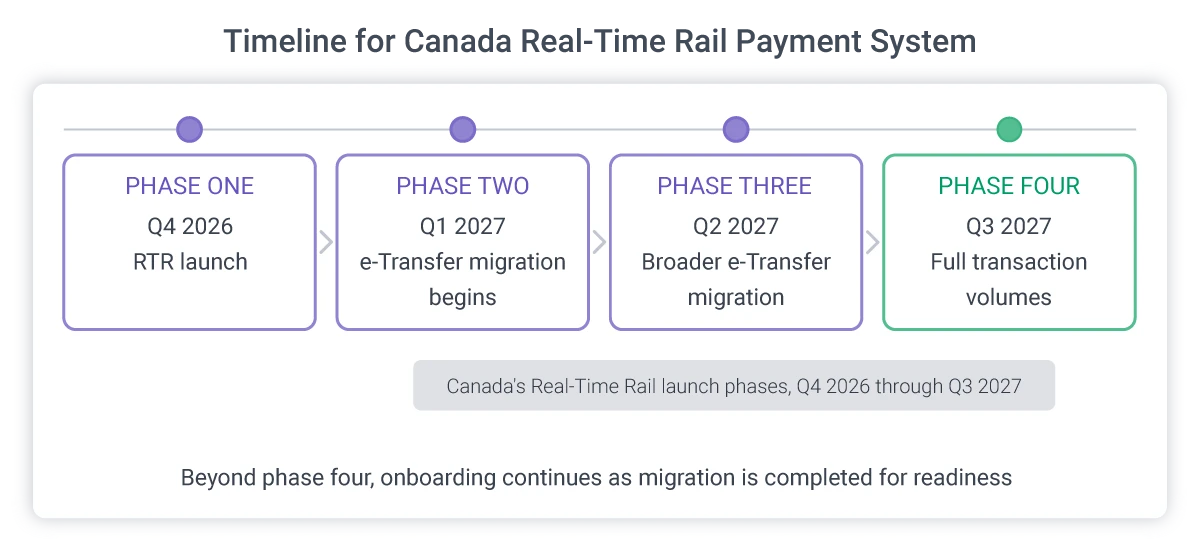
Once live, participants won't all go live at once. The rollout follows four phases:
- Phase one, Q4 2026: Launch of the RTR itself, with initial direct-to-exchange participants going live.
- Phase two, Q1 2027: The first wave of Interac e-Transfer migration participants joins, alongside additional direct-to-exchange participants.
- Phase three, Q2 2027: A broader set of e-Transfer migration participants comes online.
- Phase four, Q3 2027: All participants from the initial launch phases reach full transaction volumes.
Beyond phase four, Payments Canada expects continued onboarding as more institutions complete their own readiness and migration timelines. There's no fixed end date for full market participation, similar to how ACSS itself took years to reach the ubiquity Canadians now take for granted.
The reasoning behind the staggered approach is straightforward: a real-time, always-on payment system carries more operational risk at scale than a batch system does, since there's no overnight window to catch and correct errors. Payments Canada has framed the sequencing as a risk-based strategy, introducing volume and participants gradually so the system, its participants, and end users can build confidence in it before it becomes the default rail for the transactions ACSS and Interac e-Transfer currently handle.
For financial institutions, this timeline is worth flagging early for a practical reason: being ready for Q4 2026 doesn't mean being finished. Institutions migrating existing Interac e-Transfer volume have a full year, into Q3 2027, before they're expected to be at scale, which changes how a readiness roadmap should be sequenced.
Will Interac e-Transfer, ACSS, and Lynx Still Be Used?
Yes, though what "Interac e-Transfer" means technically is about to change.
Lynx and ACSS aren't going anywhere. Neither system's underlying job changes with the RTR's launch. Lynx continues handling large interbank and corporate settlements, and ACSS continues handling the batch-based volume, payroll, pre-authorized debits, standard EFTs, that doesn't need instant settlement. Payments Canada hasn't proposed retiring either as part of this rollout, and there's no reason to expect that changing soon.
Interac e-Transfer is where the transition actually happens. Rather than existing as a separate system running in parallel to the RTR indefinitely, e-Transfer volume is being migrated onto the RTR's infrastructure as part of the phased rollout: phase two (Q1 2027) brings the first wave of e-Transfer migration participants online, and phase three (Q2 2027) brings a broader set. For the end user, the experience of sending an e-Transfer likely won't look much different. Behind the scenes, though, those transactions will increasingly settle through the RTR itself rather than Interac's existing network, picking up the RTR's structured data capabilities and centralized fraud protections along the way.

That migration path matters for a specific reason: Interac e-Transfer already has 71% adoption among Canadian businesses. Rather than asking businesses to learn an entirely new payment behavior from scratch, Payments Canada is routing an already-trusted product through new infrastructure. That's a meaningfully easier adoption curve than what the U.S. faced with FedNow, where RTP and FedNow launched as genuinely new payment experiences most businesses had never used before.
The practical takeaway: nothing currently in use gets shut off. What changes is which rail handles which job, and Interac e-Transfer's move onto RTR infrastructure is the piece most businesses will notice first, even if they never see the underlying system change.
Why Is Canada Building This Now?
Payments infrastructure doesn't usually generate a lot of urgency. It's the kind of thing that works quietly in the background until, one day, it doesn't work well enough anymore. Donna Kinoshita, Chief Payments Officer at Payments Canada, framed the stakes plainly in a piece for Central Bank Payments News:
Modern payment systems are as critical as highways or electrical grids.
That comparison is the clearest way to understand why the RTR exists. Roads and power grids don't get attention until they're congested or failing, and by then, the cost of not having modernized sooner is already showing up everywhere else in the economy.
Payments Canada's own research backs that up. Nearly half of Canadians, 49%, find real-time payments appealing, and over a third, 36%, say they'd likely switch from their current payment methods for the speed and convenience. That's not a niche preference. It's a signal that the country's existing rails are increasingly out of step with what people and businesses expect from every other part of their financial lives.
There's also a global competitiveness angle. Canadians report real friction when sending money internationally: 82% have experienced challenges like high transaction costs, hidden fees, or long processing delays. A domestic payment system built on ISO 20022, the same messaging standard used by real-time rails elsewhere in the world, gives Canada a better foundation for eventually connecting with other countries' systems and reducing exactly that kind of cross-border friction.
The other major driver is access. For most of Canada's history, only a small number of large financial institutions could clear and settle payments directly. Legislative changes to the Canadian Payments Act and the Retail Payments Activities Act, which came into force in 2025, expanded Payments Canada membership eligibility to include:
- Payment service providers (PSPs)
- Credit union locals
- Designated clearing houses
That expansion is deliberate. Opening membership to a broader set of institutions is meant to foster competition rather than simply grow the number of participants for its own sake, and Payments Canada has already welcomed new members under the updated rules, with more expected to join as they complete the requirements.
It's worth looking at how other countries got real-time payments right, and where they didn't. Brazil's PIX system offers the clearest example of what fast, near-universal adoption looks like: mandatory participation for institutions above a certain size, direct access for fintechs from day one, and government-mandated use for programs like emergency benefit payments.
Canada's approach differs on all three counts. Participation remains tied to Payments Canada membership rather than a blanket mandate, and fintech access still runs through the same membership model rather than a separate fast lane. Whether that slows Canada's adoption curve compared to PIX's, and what that might mean for how quickly the RTR reaches everyday use, is worth examining directly against the numbers.
Who Will Be Affected?
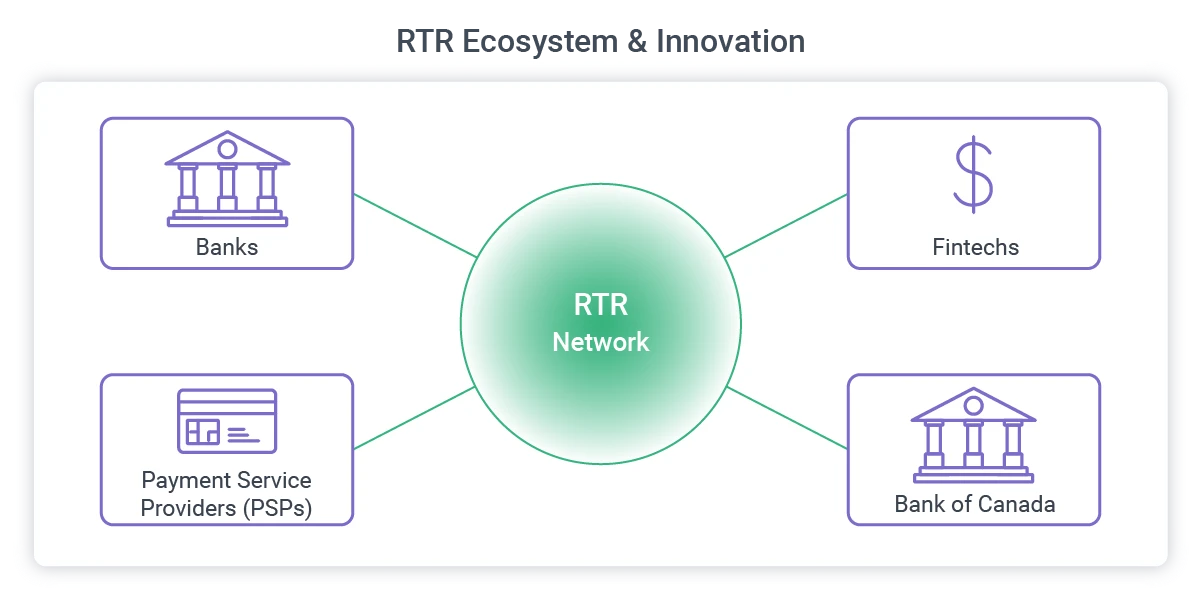
The honest answer is nearly everyone who touches the Canadian payment system, but the impact looks different depending on where an organization sits.
Banks and other financial institutions face the most direct obligations. RTR participation comes with specific requirements: funds availability within 60 seconds, fraud management tools and reporting mechanisms, dispute resolution processes, and incident notification protocols. Larger institutions with existing Payments Canada membership have a clearer path to participation, but “clearer” doesn't mean simple. Connecting to the RTR, whether directly or through a connection service provider, still requires meaningful technical and operational investment ahead of each institution's onboarding window.
Payment service providers and fintechs are in a genuinely new position. Now, PSPs that register under the Retail Payment Activities Act and meet Payments Canada's membership criteria have a real path to RTR participation, either connecting directly or building products on top of participants who do. That access model is new territory for Canada's payment ecosystem.
Credit unions, particularly credit union locals, gained new eligibility under the same legislative changes. That's significant for a market where credit unions have historically had to rely on larger institutions for indirect settlement access.
Businesses, from small operators to large enterprises, are affected less by compliance obligations and more by what becomes possible once their bank or payment provider connects to the RTR. Same-day B2B settlement, structured remittance data, and weekend and holiday processing all become available, but only once a business's financial institution actually participates and the business itself adopts a connected product. Adoption here isn't automatic just because the rail exists.
Consumers will likely feel the least friction of any group, since the RTR is designed to work behind familiar interfaces. Sending money will still look like using a banking app, only faster, available at all hours, and with fewer of the delays tied to weekends, holidays, or bank cutoff times.
The thread connecting all five groups: the RTR only delivers value to the extent that the organization on the other end of a transaction is also connected. That interdependence is exactly why early, coordinated preparation matters more here than it might for a system with a simpler, single-sided rollout.
What Are the Adoption Numbers So Far?
Survey data from late 2025 shows Canadian businesses are more ready for the RTR than the launch timeline might suggest.
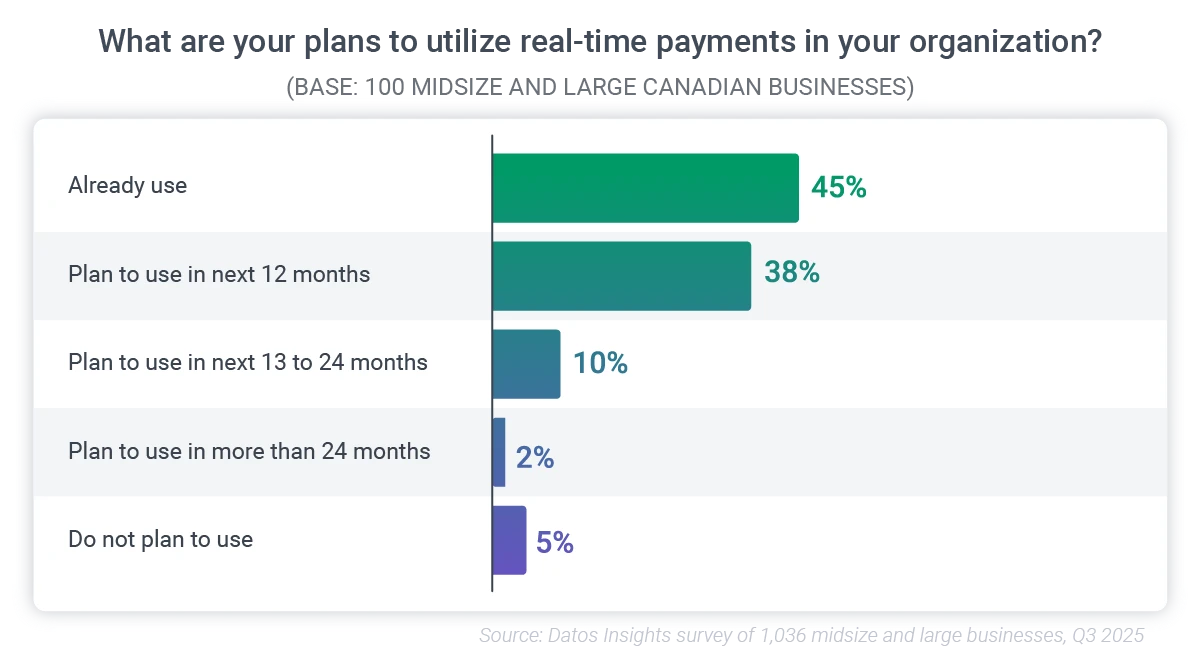
Among 100 midsize and large Canadian businesses surveyed by Datos Insights in Q3 2025, 45% already use some form of real-time payments, and another 38% plan to adopt within 12 months of the RTR's launch. A further 10% expect to adopt within 13 to 24 months, 2% within more than 24 months, and only 5% have no plans to use real-time payments at all. Combined, that puts expected adoption at 83% within a year of go-live, a striking number for a system that hasn't technically launched yet.
83% of surveyed Canadian businesses expect to be using real-time payments within a year of the RTR's launch, combining current users with those planning to adopt within 12 months [Datos Insights, 2025].
Part of that readiness comes from investment appetite rather than existing familiarity. 91% of Canadian businesses surveyed said they prioritize payments technology as part of their broader technology strategy. That's a meaningfully different starting position than the U.S. had with FedNow and RTP.
It's worth pausing on the U.S. comparison directly, since it's the clearest cautionary data point available. The U.S. took eight years from RTP's initial launch to reach an expected 87% adoption rate by the end of 2026. That slow curve wasn't primarily a technology problem. Early U.S. financial institutions largely offered basic rail access without the implementation support, connection tooling, or use-case education businesses actually needed to start using the rails productively. Infrastructure alone wasn't enough to drive adoption; businesses needed a reason and a straightforward path to act on it, and for years, many institutions provided neither.
Canada starts from a different position because of existing Interac e-Transfer adoption. With most Canadian businesses already comfortable using an instant, familiar payment product, the education gap that slowed U.S. adoption is smaller here from day one. The remaining challenge is differentiation rather than education. Financial institutions still need to make clear to their business customers what the RTR actually adds beyond what e-Transfer already does: the $100,000 transaction limit, ISO 20022 data richness, and business use cases well beyond peer-to-peer transfers.
There's also a competitive pressure the U.S. market didn't face at the same stage. Payment service providers can participate in the RTR from launch, rather than gaining access gradually over years the way U.S. fintechs did with FedNow. That means Canadian financial institutions have a shorter runway than their U.S. counterparts did to build real implementation support before more agile PSPs start capturing the business customers who move fastest.
How Is Fraud Being Handled?
Instant, irrevocable payments raise an obvious question: doesn't faster money movement also mean faster fraud? Payments Canada built the RTR around a direct answer to that concern, rather than treating it as an afterthought to solve once the system was already live.
The starting point is scale of risk. In Payments Canada's own research, 13% of Canadians reported experiencing fraud, including unauthorized transactions and phishing, over a six-month period, with authorized push payment fraud disproportionately affecting adults aged 18 to 34. Awareness of the threat is high but doesn't always translate into action: 89% of Canadians recognize financial fraud as a growing risk, yet only 7% say they prioritize prevention themselves. That gap between awareness and action is exactly why the RTR's fraud protections are built into the network itself rather than left to individual consumer habits or bank-by-bank tools.
Four capabilities sit at the center of that approach:
- A fraud transaction score: generated in real time to flag suspicious payments before they settle.
- A fraud reporting and intelligence platform: giving Payments Canada and participants a shared view of losses and outlier fraud patterns across the network.
- A shared risk list: tracking accounts already associated with prior fraud reports so that risk information isn't siloed within a single institution.
- Confirmation of payee: which prompts a sender to verify the recipient's name against the account before a payment finalizes, catching misdirected payments before they become unrecoverable.
The centralized part of that design is what sets Canada apart. Rather than each financial institution building fraud detection independently, as has historically been the norm, the RTR shares fraud intelligence across the entire network. A pattern one institution might miss in isolation becomes visible when measured against activity across all participants.
Payments Canada has said Canada will be among the first jurisdictions globally to launch a real-time payment system with this kind of centralized fraud capability built in from day one, rather than added after early fraud losses made the case for it.
Pamela Draper, president of DCPayments, connected that design choice directly to the RTR's transaction limits in a recent interview:
That’s become even more imperative when transactions of as much as $100,000 are moving in real time.
And it's a fair point; a $25,000 transaction limit and a $100,000 one carry very different fraud stakes, and Canada's decision to launch with centralized fraud services already in place, rather than retrofitting them after the limit climbs further, reflects lessons learned from watching other countries scale their own real-time systems.
None of this makes fraud risk disappear. It does mean Canadian financial institutions are entering the real-time payments era with a shared layer of protection that many earlier-launching countries didn't have at the outset, and had to build under pressure after the fact instead.
What Does the RTR Mean for Businesses?
For most Canadian businesses, the RTR's real value isn't the payment itself, it's what becomes possible with money that used to sit in transit for days.
Consider the mechanics first. Every RTR payment can carry structured remittance data: invoice numbers, tax details, purpose codes, alongside the transfer. For a business currently matching incoming payments to invoices by hand, that single change removes a meaningful chunk of manual reconciliation work. Combined with settlement in seconds rather than days, the practical effect is real-time visibility into cash flow rather than the delayed, batch-updated picture most finance teams currently work from.
That shift matters more for some industries than others. A few stand out as particularly well-positioned to benefit early:
- Financial institutions and fintechs, who can build new real-time transfer products and services directly on top of RTR access.
- Payroll and HR services, where just-in-time payroll and same-day contractor payments become genuinely practical rather than a workaround.
- Insurance providers, who can move from multi-day claims processing to instant payouts.
- E-commerce and retail businesses, gaining faster refunds, quicker checkout settlement, and simpler merchant reconciliation.
- Utilities and billers, who can post recurring payments faster and manage cash flow around them more precisely.
- Marketplaces and gig platforms, able to pay workers, sellers, or drivers immediately while keeping clearer records of every transaction.
The common thread across all six is timing sensitivity. Any business where a delay between payment and settlement creates friction, whether that's a strained customer relationship, a cash flow gap, or a compliance headache, has something concrete to gain here.
The cash flow angle is worth sitting with a bit longer, since it's easy to underestimate. A contractor who gets paid by a client the same day can turn around and pay their own suppliers immediately, rather than floating that gap out of pocket. A retailer receiving same-day settlement can reinvest that cash into inventory instead of waiting on it to clear. Neither example requires new technology on the business's part beyond a connected payment provider. It just requires money to move as fast as the rest of their operations already do.
None of this happens automatically once the RTR launches, though. A business only sees these benefits once its bank or payment provider actually connects to the RTR and offers a product built on it, which is exactly why preparation matters well before go-live, not after.
Case Study Snapshot: Versapay: Scaling B2B Payment Infrastructure
Versapay's accounts receivable platform automates invoice-to-cash and B2B payment workflows for its customers. Softjourn partnered with Versapay on a database migration to AWS Aurora, improving the performance and scalability needed to handle the kind of data-rich, high-volume payment activity real-time infrastructure makes possible. Read More→
How Should Financial Institutions Prepare?
The path to RTR participation isn't a single application. It's a multi-stage process that starts well before an institution processes its first real-time transaction, and the institutions that started early are the ones most likely to be ready when their onboarding window actually opens.
For institutions not yet participating, the pathway runs through a few concrete stages:
- Register as a payment service provider with the Bank of Canada under the Retail Payments Activities Act, if applicable.
- Apply for Payments Canada membership, reviewed by the board on its scheduled meeting cycle.
- Submit an RTR participation application, which typically receives conditional approval within two to three weeks, pending onboarding and testing completion.
- Complete onboarding and certification testing in a test environment, followed by production rollout.
That's the formal process, but the harder, less formal work is everything that has to happen around it.

Technical Readiness
Technical readiness is the obvious starting point, but it goes deeper than adding a new payment rail to an existing stack. Institutions need to modernize far beyond central payment systems, touching client channels, banking systems, fraud tooling, and middleware, since all of them need to handle a volume and speed of transactions most weren't originally built for.
Where legacy systems processed hundreds of transactions per second, real-time infrastructure needs to reliably handle multiples of thousands, around the clock, with no batch window to catch and correct errors overnight.
Volume Forecasting
Volume forecasting deserves more attention than it typically gets. Institutions that only plan around current transaction volumes risk being caught off guard by bulk payment files, payroll runs, pension disbursements, and similar batch-originated payments that could shift onto the RTR in large, concentrated bursts rather than spreading evenly throughout the day.
Fraud Tooling Readiness
Fraud tooling can't be an afterthought bolted onto existing infrastructure after go-live. The RTR's centralized fraud services, fraud scoring, a shared risk list, and confirmation of payee, work alongside each institution's own controls rather than replacing them entirely, so institutions need their internal fraud detection, monitoring, and reporting capabilities ready to work alongside those network-level protections from day one.
Building the Business Case
There's also a genuine business case to build, not just a compliance box to check. Earned wage access is a useful example: it's a use case gaining real traction globally, and one where instant payment infrastructure creates something new for financial institutions to offer corporate clients, not just a faster version of what already exists. Institutions building their RTR business case around new revenue opportunities, rather than treating participation purely as a mandatory upgrade, tend to have an easier time securing the internal investment readiness actually requires.
This is precisely the kind of multi-front readiness work, technical architecture, fraud workflow alignment, and go-to-market planning working in tandem, where an experienced implementation partner earns its keep. Softjourn's payment infrastructure team has spent nearly two decades helping financial institutions navigate exactly this kind of systems modernization.
Case Study Snapshot: Vanco Payments: Modernizing Payment Infrastructure with a Dedicated Team
Vanco Payments partnered with Softjourn on a systems rewrite and ongoing dedicated team support for its payment processing platform, an approach that let Vanco's in-house staff stay focused while Softjourn's fintech-experienced developers handled the modernization work end to end. Read More→
How Should Businesses Prepare?
Businesses don't face the same regulatory checklist financial institutions do, but “wait until it launches” is still the wrong strategy. The businesses that get the most value from the RTR early are the ones that start asking a few concrete questions now, before their bank or payment provider even announces RTR support.
Ask Your Financial Institution or Provider Directly
The first step is simply finding out where things stand. Ask your bank, payment processor, or PSP whether they plan to participate in the RTR, and if so, on what timeline. Given the phased rollout, an institution's answer might be “yes, from phase one” or “yes, but not until our Interac e-Transfer migration wave in 2027.” That answer should shape how a business sequences its own preparation.
Identify Where Speed Actually Matters
Not every payment a business makes needs to be instant. The practical exercise here is mapping your own payment flows, payroll runs, contractor payouts, customer refunds, recurring billing, against where a settlement delay is actually costing you something, whether that's cash flow, a strained customer relationship, or hours of manual work. That mapping exercise is what turns the RTR from an abstract upgrade into a prioritized integration plan.
Prepare for Richer Payment Data
The reconciliation benefits only materialize if your own systems are ready to use the data. Check whether your accounting software, ERP system, and reconciliation workflows can actually ingest and act on structured remittance data traveling with a payment, rather than assuming the capability will just work once it arrives. This is often the single most overlooked step, businesses assume the data richness is automatic on their end, when it usually requires a configuration or integration project of its own.
Budget for a Transition Period, Not a Single Switch
Given the phased timeline through 2027, most businesses won't flip a switch from old rails to new ones. Some payment types may move to the RTR earlier than others, and some counterparties won't be ready at the same pace a business itself is. Planning for a mixed environment, where ACSS, Interac e-Transfer, and RTR payments coexist for a while, is more realistic than assuming a clean cutover.
Get an Outside Perspective If the Path Isn't Clear
For businesses without a payments or fintech background, figuring out which of these steps actually applies, and in what order, isn't always obvious. Softjourn works with fintechs and payment-dependent businesses on exactly this kind of readiness planning, from mapping current payment flows to identifying where structured data can meaningfully reduce reconciliation overhead.

What to Keep in Mind
The RTR is a genuine leap forward for Canadian payments, but it launches with real constraints worth understanding upfront, so businesses and financial institutions can plan around them rather than being surprised by them later.
The $100,000 Transaction Limit Is a Starting Point, Not a Ceiling
Canada's RTR launches with a $100,000 CAD limit per transaction in 2026. That covers most retail and small business payments comfortably, but it will constrain larger corporate use cases, commercial real estate transactions, large vendor payments, sizeable treasury movements, right out of the gate.
The U.S. offers a useful preview of what happens next: FedNow launched with a $25,000 limit and raised it repeatedly as confidence in the system grew, eventually reaching $10 million by late 2025. When that limit moved from $100,000 to $1 million, average U.S. payment size jumped 376% almost immediately.
Businesses with high-value payment needs should expect Canada's limit to rise over time, but shouldn't plan around a launch-day capability that isn't there yet.
PSP Competition Arrives Faster Than It Did in the U.S.
PSPs gain access to the RTR from day one, not gradually over years, as was the case with FedNow. That means less runway for established financial institutions to build real implementation support and differentiated products before more nimble PSPs start competing for the same business customers.
The RTR Doesn't Replace Everything at Once
As covered earlier in this guide, ACSS and Lynx both continue operating alongside the RTR, and Interac e-Transfer migrates over a multi-year window rather than switching overnight. Any planning that assumes a clean, single-date cutover to the new rail is planning around a timeline that doesn't match how this rollout actually works.
Cross-Border Interoperability Is a Future Goal, Not a Launch Feature
The RTR's adoption of ISO 20022 puts Canada in a better position to eventually connect with other countries' real-time systems, but that interoperability isn't part of the initial launch. Businesses hoping for faster, cheaper cross-border payments through the RTR specifically should treat that as a longer-term possibility worth watching rather than a near-term capability to plan around.
Now's the Time to Strategize for the RTR
Canada has spent close to a decade building toward this moment, and the RTR's launch in Q4 2026 marks the start of a transition that will keep unfolding well into 2027 and beyond.
The businesses and financial institutions with the clearest path forward won't be the ones that wait for the system to fully mature before acting. They'll be the ones treating the current runway, testing wrapping up, by-laws being finalized, phased onboarding windows opening, as exactly what it is: time to prepare.
The U.S. experience with FedNow real-time payments made one thing clear: a real-time payment rail is only as valuable as the implementation support and business case built around it. Canada starts from a stronger position, with existing Interac e-Transfer familiarity, centralized fraud protections built in from day one, and a legislative framework already open to a wider range of participants. But none of that removes the work of getting technically ready, building the right products, or figuring out where real-time settlement actually changes how a business operates.
Softjourn's payment infrastructure team helps financial institutions and businesses navigate exactly this kind of transition, from technical architecture and fraud workflow alignment to go-to-market planning for new real-time payment products. With nearly two decades of experience in payment systems modernization, we provide practical guidance tailored to where your organization actually stands today, not a generic readiness checklist.
Contact Softjourn to get started on your RTR readiness strategy.