
The State of JavaScript in 2026: What's Changed And What It Means for Your Product
Five shifts in how teams write, structure, and staff JavaScript projects, and the business decisions each one should inform.

Most "state of JavaScript" articles in 2026 are written for developers. They compare framework benchmarks, debate runtime performance, and walk through new language features line by line. If you're the one deciding what gets built, by whom, and on what foundation, that level of detail can feel like noise.
This article is for the people making the business decisions around JavaScript, not the ones writing it.
Over the past year and a half, the JavaScript ecosystem has gone through significant changes: a new language spec (ECMAScript 2026) that fixes long-standing pain points, TypeScript's rise to the most-used language on GitHub, and a rapid shift in what "JavaScript developer" actually means as AI reshapes the role in real time.
Here are five shifts worth understanding if you're making decisions about JavaScript teams, products, or technology bets this year.

1. The Deletion Economy: Less (Code) is More
The most interesting trend in JavaScript right now isn't a new library. It's the growing number of experienced teams that are actively shrinking their codebases and toolchains.
For years, JavaScript projects accumulated weight. A typical production application might depend on hundreds of open-source packages, each one adding surface area for bugs, security vulnerabilities, and maintenance overhead. The culture rewarded building and adding, and the best developers were the ones who could assemble the most sophisticated stack.
That culture is reversing.
In 2026, the strongest engineering teams are defined less by what they've built and more by what they've managed to take out. New native capabilities in JavaScript and its runtimes now handle things that used to require separate third-party tools: date and time logic, test running, even the bundling process that turns source code into production-ready files. Vite 8, a widely adopted build tool, consolidated two separate underlying systems into one, cutting an entire layer of configuration complexity for teams that use it. Across the ecosystem, the pattern is the same: fewer dependencies, leaner toolchains, more reliance on what the platform gives you out of the box.
This is a business concern for three reasons:
Fewer dependencies means a smaller attack surface: Every open-source package your product relies on is a potential entry point for security incidents, and JavaScript's package ecosystem (npm) saw several serious breaches over the past year, with malicious code slipping into widely used libraries. Reducing your dependency count is one of the most practical steps a team can take to limit exposure, and it costs nothing to implement.
Smaller codebases are cheaper to maintain: When a team replaces third-party tools with capabilities now built into the language or runtime, they eliminate entire categories of version upgrades, compatibility checks, and breaking changes. Over a product's lifetime, that translates directly to lower maintenance budgets and fewer "surprise" engineering sprints to deal with outdated dependencies.
Restraint is a signal of engineering maturity: When you're evaluating a development partner or an internal team, ask what they've removed from a codebase recently, not just what they've added. The answer tells you a lot about how they think about long-term maintainability.
2. TypeScript Is No Longer Optional
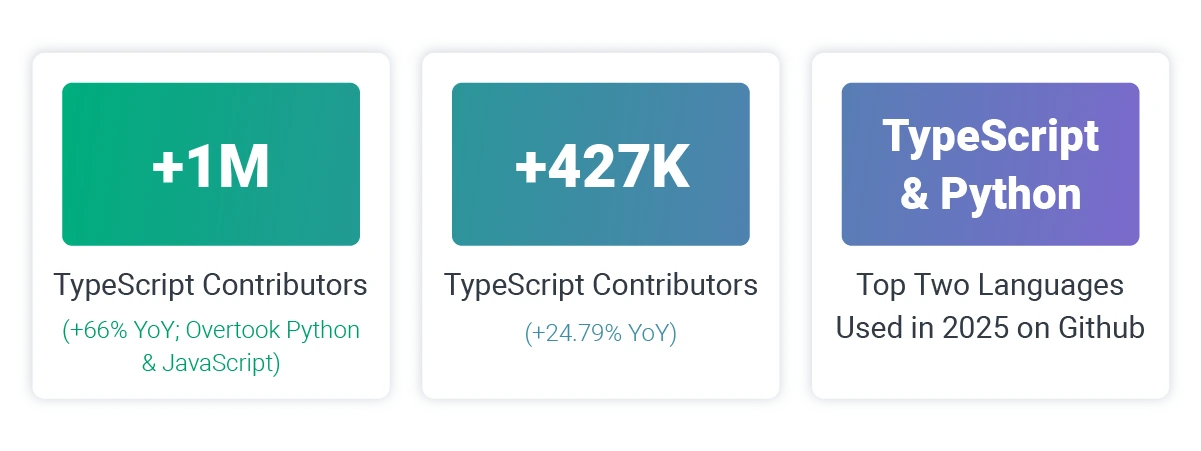
In late 2025, TypeScript surpassed both Python and JavaScript to become the most-used language on GitHub, with 66% year-over-year growth. According to the 2025 State of JavaScript survey, 40% of developers now write exclusively in TypeScript, up from 28% just three years earlier. For anyone still treating TypeScript as a "nice to have" or an optional layer on top of JavaScript, those numbers should be a wake-up call.
TypeScript is a superset of JavaScript that adds static typing, meaning developers declare what kind of data a variable, function, or component expects. When something doesn't match, the code fails at build time rather than in production. For large applications with multiple developers touching the same codebase, this catches entire categories of bugs before they reach users.
What's changed in 2026 is that the last remaining friction around using TypeScript has largely disappeared. Node.js can now run TypeScript files directly, without any separate compilation step. The TypeScript compiler itself is being rewritten from scratch in Go (a faster systems language), with version 7.0 expected mid-2026 and early benchmarks showing roughly 10x speed improvements in large projects. Every major JavaScript framework now ships with TypeScript as the default configuration.
In practical terms, writing plain JavaScript for a professional project in 2026 is increasingly treated as a legacy approach, much like how manual spreadsheet reporting feels in a company that's already adopted BI dashboards. It still works, and nobody will stop you – but it signals that a team or codebase hasn't kept pace.
These are the business implications:
- Hiring: TypeScript proficiency is now a baseline expectation, not a bonus line on a resume. If your job descriptions still list it as a "nice to have," they're out of step with where the talent market has moved. Candidates who don't have TypeScript experience in 2026 likely haven't worked on a modern production codebase recently.
- Code quality and maintenance costs: Static typing reduces a specific, expensive category of production bugs: the kind where one part of the application sends data in a format that another part doesn't expect. On large teams or long-lived products, those bugs are among the most time-consuming to diagnose because the root cause and the visible symptom can be far apart. TypeScript makes them structurally less likely.
- Vendor and partner evaluation: If a development partner delivers JavaScript without TypeScript in 2026, ask why. There are occasionally valid reasons (very small scripts, prototypes, specific runtime constraints), but for any substantial application, it should raise questions about the team's standards and how current their practices are.
- AI-assisted development: TypeScript and AI code generation tools are a strong pairing. Type annotations give AI models more context about what code is supposed to do, which means the generated output is more accurate and easier to verify. Teams using TypeScript get more value from tools like GitHub Copilot than teams working in untyped JavaScript. As one widely cited developer put it: when AI generates code, you need the compiler to verify it actually works. JavaScript gives you nothing; TypeScript gives you a safety net.
3. AI Is Changing JavaScript (And the Role of the Developer With It)
The popular narrative around AI and JavaScript goes something like this: AI writes the code now, developers just review it, and soon we won't need as many engineers. The reality in 2026 is more nuanced and, for technical leaders, more interesting.
AI tools have genuinely changed daily development workflows. GitHub Copilot, Cursor, and similar code assistants are now standard equipment on most JavaScript teams, and surveys suggest that over 90% of developers use AI in some form during their workday.
For boilerplate code, test scaffolding, and documentation, these tools save meaningful time. More recently, AI agents have moved beyond code completion into full feature scaffolding, generating entire components from a natural language prompt or a Figma design file.
Interestingly, JavaScript is also increasingly being used to run AI models directly in the browser. Libraries like TensorFlow.js allow developers to train and execute machine learning models on the client side, with no server round-trip required.
For applications where data privacy matters (healthcare, financial services, anything governed by strict data residency rules), this is a significant capability: user data never has to leave the device.
But the bigger story for technical leaders isn't the tooling itself. It's how AI is changing what developers actually do all day. The most effective JavaScript developers in 2026 spend less time on syntax and implementation, and more time on system design, code review, and deciding how pieces fit together.
"The traditional software engineering role is changing. Developers are transitioning from writing code to acting as managers who direct and validate AI." — Viktor Prutyla, Senior Engineer, Softjourn
In practice, the role is starting to look more like a technical project manager who can also read and evaluate code than a pure coder working heads-down on a single feature.
What this means for your organization:
- Rethink how you hire. Raw coding speed and syntax knowledge are becoming less predictive of developer performance. System-level thinking, the ability to evaluate architectural tradeoffs, critical review of AI-generated output, and clear communication of technical decisions all carry more weight now. Interview processes that still rely heavily on timed coding challenges may be filtering for the wrong skills.
- Invest in seniority, not just headcount. AI tools are most dangerous in the hands of junior developers who can't yet distinguish between code that works and code that's well-designed. A senior developer can use AI to move faster without introducing structural problems. A junior developer using the same tools might produce working features that create expensive maintenance debt down the line. The value of experienced engineers on your team is increasing, not decreasing.
- Reassess team size and composition. If each developer produces more output with AI assistance, you might need fewer people, or a team of the same size can take on more ambitious scope. More often, what works best is a smaller, more senior team replacing a larger, less experienced one. The math depends on your product's complexity and how much of the work requires judgment that AI can't provide.
- Keep an eye on browser-side AI. Running ML models client-side is still early, but for products in regulated industries or with strong privacy requirements, it could become a meaningful competitive advantage. Ask your technical team whether they've explored on-device inference and whether your product roadmap has use cases for it.
4. The Backend Is Just a Folder Now
For most of the history of web development, frontend and backend were separate worlds. Different codebases, different teams, different deployment processes.
The frontend team built what users see and interact with. The backend team built the servers, databases, and APIs that power everything behind the scenes. Communication between the two was a constant coordination challenge, and misalignment between frontend and backend was one of the most common sources of project delays.
Today, that separation is dissolving. With the stabilization of features like Server Actions and serverless functions across major JavaScript frameworks, many web application backends are now literally a folder inside the frontend repository.
Frontend developers can write server-side logic (processing a form submission, querying a database, handling authentication) right alongside their UI code, and deploy both as a single unit. The server-side work runs on cloud infrastructure or edge runtimes rather than on a dedicated backend that someone has to maintain separately.
This isn't a niche experiment. It's becoming the default architecture for new JavaScript projects built with frameworks like Next.js, Nuxt, and Remix, which together account for a large share of new production applications.

Why this matters beyond the engineering team:
- Project timelines compress: When a feature no longer requires coordination between two separate teams with two separate codebases, it ships faster. A single developer or small team can build both the user-facing interface and the server logic behind it, reducing the handoffs and miscommunication that slow projects down.
- The talent market is shifting: The clean line between "frontend developer" and "backend developer" is fading. Many of the strongest JavaScript developers in 2026 work across the full stack as a natural part of their framework, not because they deliberately learned two disciplines. If your job descriptions and team structures still split these roles rigidly, you may be creating artificial bottlenecks or filtering out capable candidates who don't fit neatly into one category.
- Infrastructure gets simpler (and cheaper): When server-side logic runs on managed cloud functions or edge runtimes instead of dedicated backend servers, teams spend less time managing infrastructure and less money keeping it running. The tradeoff is vendor dependency: you're relying on platforms like Vercel, AWS, or Cloudflare to handle the hosting layer. For many products, that tradeoff makes sense. For others (particularly in regulated industries with strict data residency requirements), it needs careful evaluation.
One caveat: this architecture works well for many web applications, but it's not universal. Products with heavy data processing, complex business logic, or strict performance requirements may still benefit from a dedicated backend. The point isn't that backends are dead. It's that for a growing share of JavaScript projects, the backend as a separate team and separate codebase is becoming unnecessary overhead.
5. The Framework Wars Are Quietly Ending
For years, choosing a JavaScript framework felt like picking a side. React teams and Angular teams spoke different languages. Vue developers built communities around shared philosophy. Svelte fans made performance arguments that were hard to ignore.
Conference talks, blog posts, and hiring decisions all revolved around which framework you'd committed to, and switching carried real cost. However, in 2026, the lines are blurring.
The major frameworks are converging on a shared set of architectural ideas. Server-side rendering, which used to be a React and Next.js specialty, is now standard across Vue (via Nuxt), Svelte (via SvelteKit), and Angular.
A reactivity model called Signals – which makes UI updates more efficient by targeting only the specific elements that changed – has been adopted by Angular, Vue, Solid, and Svelte, with a proposal underway to add it to the JavaScript language specification itself. Hybrid rendering (where some pages are generated at build time, some on the server, and some in the browser) is available in nearly every major framework.
The practical result is that frameworks are becoming less like ideological camps and more like different interfaces to the same underlying capabilities. A team that knows React well can pick up the concepts behind Nuxt or SvelteKit faster than they could have three years ago, because the architecture underneath is increasingly similar.

What this means for decision-makers:
- "What framework do you use?" is the wrong question. When evaluating a development team or vendor, the framework they prefer matters less than their reasoning. A better question: "How do you evaluate and choose a framework for a given project?" Teams that can articulate the tradeoffs between options and match them to specific project requirements are more valuable than teams that are simply loyal to one tool.
- Framework lock-in is decreasing: As frameworks converge, the cost of switching between them goes down. This doesn't mean migration is free (it never is), but it does mean that choosing React today doesn't trap you the way choosing AngularJS did in 2014. For long-term product planning, that can be reassuring, as your technology choices are less likely to become dead ends.
- Hiring gets more flexible: If the architectural patterns are shared across frameworks, a strong developer who knows Vue deeply can ramp up on a React project faster than before. Teams that hire for architectural understanding rather than framework-specific experience will have access to a larger talent pool and more adaptable engineers.
- Focus on the ecosystem, not just the framework: In 2026, the build tools, deployment platforms, and testing infrastructure around a framework often matter as much as the framework itself. When evaluating technology choices, look at the full picture: how does the team build, test, deploy, and monitor their code? The framework is just one piece of that.
Making Smarter JavaScript Decisions in 2026
None of these five shifts require you to overhaul your technology strategy overnight. But together, they point in a clear direction: the JavaScript ecosystem is maturing, and the organizations that benefit most will be the ones that update their hiring practices, vendor evaluations, and technical expectations to match.
A few questions worth bringing to your next conversation with your engineering leadership:
- Are we actively reducing our dependency count, or still adding packages by default?
- Do our job descriptions and interview processes reflect what strong JavaScript developers actually do in 2026?
- Is TypeScript the standard on our projects? If not, what's the reason?
- How is our team using AI tools, and do they understand the limitations as well as the benefits?
- Are our frontend and backend team structures still reflecting a separation that the technology no longer requires?
You don't need to have perfect answers to all of these. But if most of them draw a blank, it's probably time for a closer look.
Softjourn works with technical leaders navigating exactly these kinds of decisions, from JavaScript architecture and team structure to full-scale platform builds. If your team is evaluating its JavaScript strategy and could use a partner who's already working through these shifts, get in touch to start the conversation.