-3-1920x1080.webp?v=1787249426810)
What Does a Fractional CTO Do? A Clear Breakdown
The term gets used constantly and defined rarely, so here's a clear breakdown of what a fractional CTO's responsibilities actually cover and where they stop.

One of the most straightforward descriptions of fractional CTO is that it's a technical advisor who checks in for a few hours a month. Since the phrase has become common faster than a shared definition of it has, that gap between how often the term gets used and how clearly it's understood is the actual problem.
A role this loosely defined is hard to evaluate, hard to budget for, and easy to either underuse or overpay for. This piece exists to close that gap: what a fractional CTO's responsibilities actually cover, what the role deliberately leaves out, and how to tell if it fits a specific company's situation before anyone signs anything.
What a Fractional CTO Does
The responsibilities of a fractional CTO tend to center on four things: strategy, architecture, credibility, and oversight. None of them require a full-time seat to do well, which is the entire premise of the role.
- Sets technical strategy and the roadmap. Decides where engineering effort goes over the next two to four quarters, whether that means a new feature push or a legacy system modernization, and ties those decisions back to actual business goals, rather than letting the roadmap become a running list of whatever product asked for last.
- Makes architecture and vendor or tooling decisions. These are the calls that are expensive to reverse later: which cloud provider, which framework, whether to build or buy a given piece of the stack, and how much technical debt is acceptable in the short term to hit a real deadline.
- Represents technical credibility to investors or the board. Sits in the room during due diligence, fundraising conversations, or board updates and answers the technical questions a non-technical founder can't credibly answer alone, without needing to be introduced as a full-time hire to be taken seriously.
- Mentors and oversees the existing engineering staff. Doesn't necessarily write the code, but reviews the decisions of the people who do, coaches a senior engineer stepping into a lead role for the first time, and catches architectural mistakes while they're still cheap to fix.

Put together, that's a role built around judgment and direction, not output. A fractional CTO's value shows up in the decisions that get made the first time correctly, not in a line of commits.
What a Fractional CTO Doesn't Do
The boundaries matter as much as the responsibilities, and they're the part that tends to get glossed over in a sales pitch.
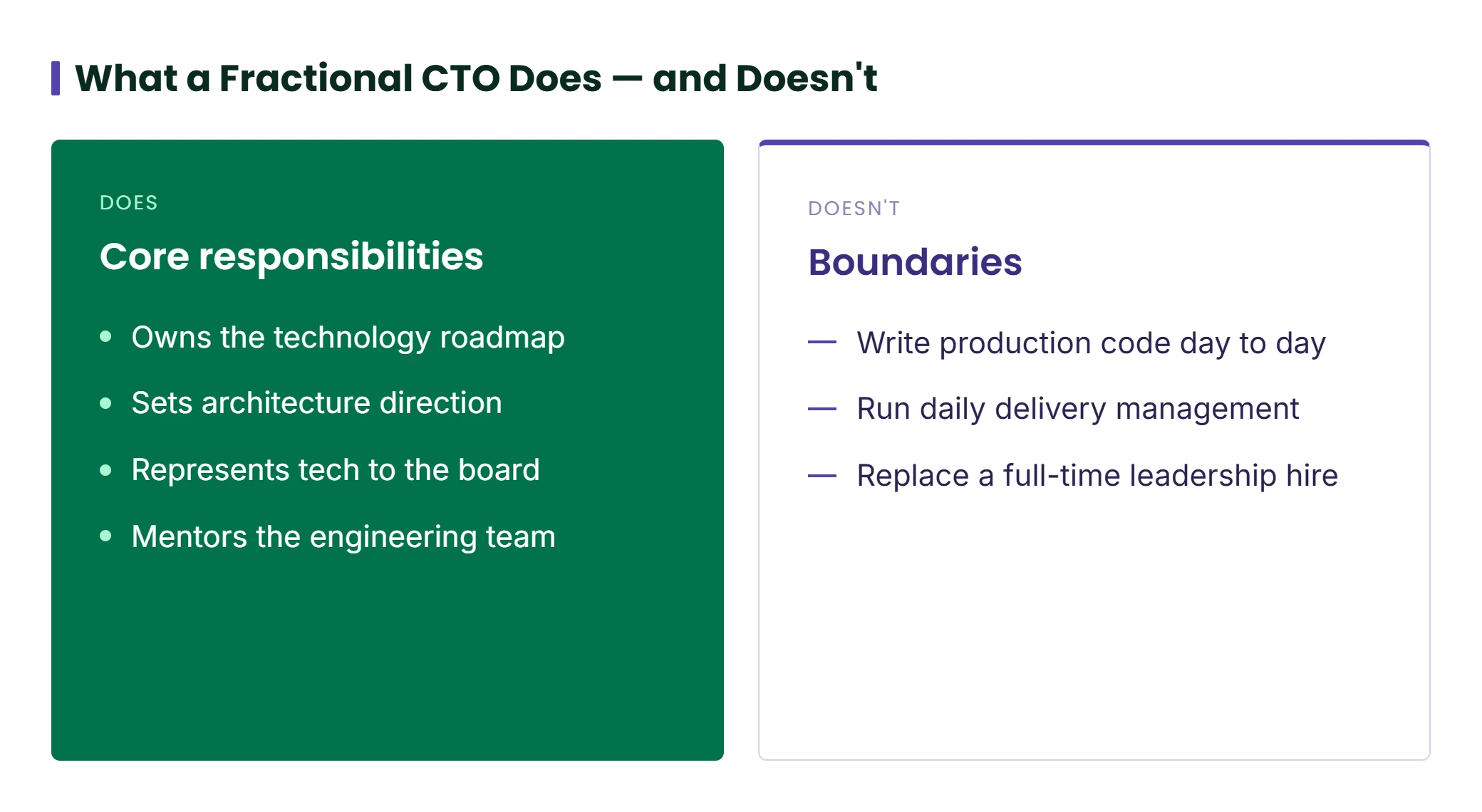
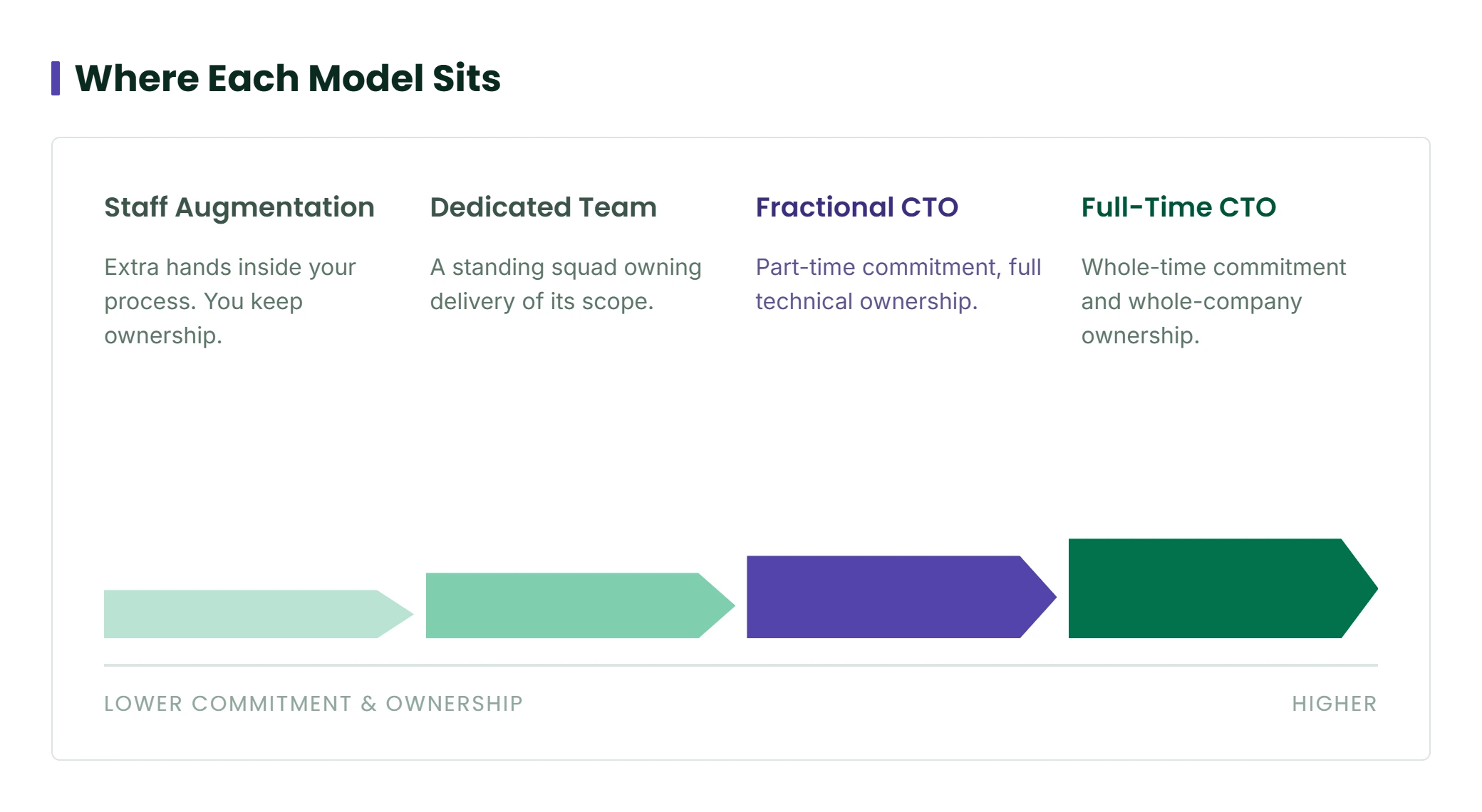
A fractional CTO doesn't replace hands-on engineering headcount. Someone still needs to write the code, run the tests, and ship the feature, and that's not the arrangement here. This also isn't a full-time embedded employee.
A fractional CTO typically works a set number of hours a week or month across multiple clients, which means immediate availability for every fire drill isn't part of the deal, and it shouldn't be sold as if it is. Most importantly, it's not a substitute for a dedicated team executing the day-to-day work.
A fractional CTO can set the direction for a migration; the team of engineers who spend six weeks actually doing the migration is a separate resourcing question entirely.
Companies that expect a fractional CTO to function as a part-time version of a full engineering department tend to come away disappointed, not because the arrangement failed, but because it was never built to do that job in the first place.
It's also worth separating this from a related but different model: a fractional development team, where engineers split their working hours across multiple clients to handle actual build work. That's a staffing and execution question, not a strategy and ownership one. If the real gap is hands-on capacity rather than technical direction, that's a different conversation.
Read our fractional development teams decision framework →
Trusting an Outside Partner With Technical Decisions Isn't New
The idea of handing real technical ownership to someone outside the company can feel like a leap, especially for a founder who's used to keeping every decision in-house. It helps to remember this isn't a new bet. Companies have trusted external partners with meaningful technical decisions for years, often with no in-house team of their own to fall back on.
Myers-Briggs, the company behind the well-known personality assessment, is a useful example of that trust in practice. Softjourn built and validated the company's VitaNavis career and education platform without Myers-Briggs maintaining an internal development team of its own, and the partnership has continued for nine years. To be clear, that engagement wasn't a fractional CTO arrangement; it was a dedicated development partnership. What it demonstrates is the broader point: handing meaningful technical ownership to an outside partner is a proven way of working, not a leap of faith, when the partner earns that trust over time.
A second example makes a related point about credibility with outside stakeholders specifically. When BrainTek, a fintech startup, needed to take a payments concept called MOJA from idea to something investors could evaluate, Softjourn didn't just write code. The team walked BrainTek's founders through the full technical blueprint and produced documentation the founders could put in front of potential investors and mobile carrier partners directly. That's the same instinct behind a fractional CTO representing a company's technical credibility in a board meeting: someone with real technical authority, standing behind the work, in a room the founder couldn't credibly stand in alone.
That same pattern shows up again in Softjourn's work with ticketing and fintech clients, usually through the person carrying the title Solutions Architect rather than CTO. The role is narrower than a fractional CTO's (a Solutions Architect typically owns a single engagement rather than a company's full technical strategy), but the trust involved is the same kind: a client hands a consequential technical call to someone outside the building, and the call ends up mattering.
A few examples where that call proved decisive:
- Superstar, a ticketing platform, asked Softjourn for help adding features to its commission portal. After a code review, Softjourn's Solutions Architect recommended holding off on new features until the framework was modernized, then steered the client toward Laravel PHP specifically because it kept the team's existing PHP knowledge intact rather than forcing a language switch. The client hadn't come in looking for a rewrite; the recommendation reshaped the project and set the platform up to scale without one. Read the full case study →
- Spektrix, a UK ticketing and CRM platform, needed a way for non-technical clients to run their own booking pages without building custom integrations themselves. Softjourn's Solutions Architect designed a serverless architecture on Microsoft Azure rather than a conventional server-based build, a call that kept ongoing infrastructure maintenance low and helped Spektrix onboard more than 200 new clients over the following two years. Richard Bates, Spektrix's Director of Product, put it plainly: "If we'd had to hire a team to build and maintain this project, it would have been much more time-consuming and costly." Read the full case study →
- Project Admission needed a custom access control app before an event that was days away. Rather than building a full native app, Softjourn's Solutions Architect recommended a Progressive Web App, a smaller-scope option that could still be built quickly without cutting the features the client actually needed. The app shipped in two weeks. "All of our requirements were met, no code changes were needed, and the app worked extremely well from the start," said JD Hartley, Project Admission's CTO. Read the full case study →
None of these were fractional CTO engagements either, and the point isn't to blur that line. It's that the specific judgment a fractional CTO brings, weighing the options in front of a client and picking the one that fits the actual constraints rather than the one that looks best on paper, is a muscle Softjourn's technical staff exercises on real projects regularly. It isn't a new skill being tried out for the first time.
Signs the Fractional Model Fits Your Company
Not every company at every stage needs this. A few situations where it tends to be the right call:
- The company has a technical roadmap and real architecture decisions to make, but not yet the scale or budget to justify a full-time CTO salary.
- A fundraising conversation, board meeting, or technical due diligence process is coming up, and there's no one who can credibly own the technical narrative.
- The engineering team has grown past the point where it can set its own direction without a more senior voice, but adding a permanent executive isn't the right next hire yet.
- Recent or recurring technical decisions (a stack choice, a vendor contract, a build-versus-buy call) have been made without anyone who's done it before weighing in.
If more than one of those sounds familiar, it's worth a conversation rather than a guess.
Where to Go From Here
The term "fractional CTO" will keep showing up in more pitch decks and more hiring conversations before it settles into a shared definition on its own. Until then, the clearest way to evaluate the option is by scope: which strategy and architecture decisions actually need a senior technical voice right now, and whether that voice needs to sit in the building full-time to do the job.
Contact Softjourn to learn more about fractional CTO services and whether the model fits where your company is right now.