-1920x1080.webp?v=1787044622519)
How to Keep Shipping During a Hiring Freeze
A hiring freeze stops new full-time offers, not the roadmap, the deadlines, or the client expectations still sitting on your desk, so here's what engineering leaders can actually do about it right now.

That gap, between what the business still expects and what the team is now allowed to do about it, is the actual problem. Not the freeze itself. Freezes are a normal, sometimes necessary budget tool. The problem shows up when a freeze gets treated as a full stop on capacity, instead of what it actually is: a stop on one specific way of adding capacity.
The roadmap doesn't know a freeze happened. The Q3 release date is still the Q3 release date. The client who was promised a new integration by year-end is still expecting it, and the board still wants to hear that the product is moving forward, not that it's on hold until finance lifts a hiring restriction. Everything on the plan stays exactly where it was. The only thing that changed is the ability to hire the two backend engineers that the plan assumed would be in seats by now.
That's the tension worth naming up front, because most of the stress in a freeze comes from treating it as bigger than it actually is. A freeze restricts one lever: adding new full-time headcount. It doesn't restrict the roadmap, the deadlines, or the ways a team can still bring in the right skills to hit them. What follows is a matter of knowing which levers are still available, and using them before the gap between expectation and capacity turns into a missed deadline.
What a Hiring Freeze Actually Blocks (and What It Doesn't)
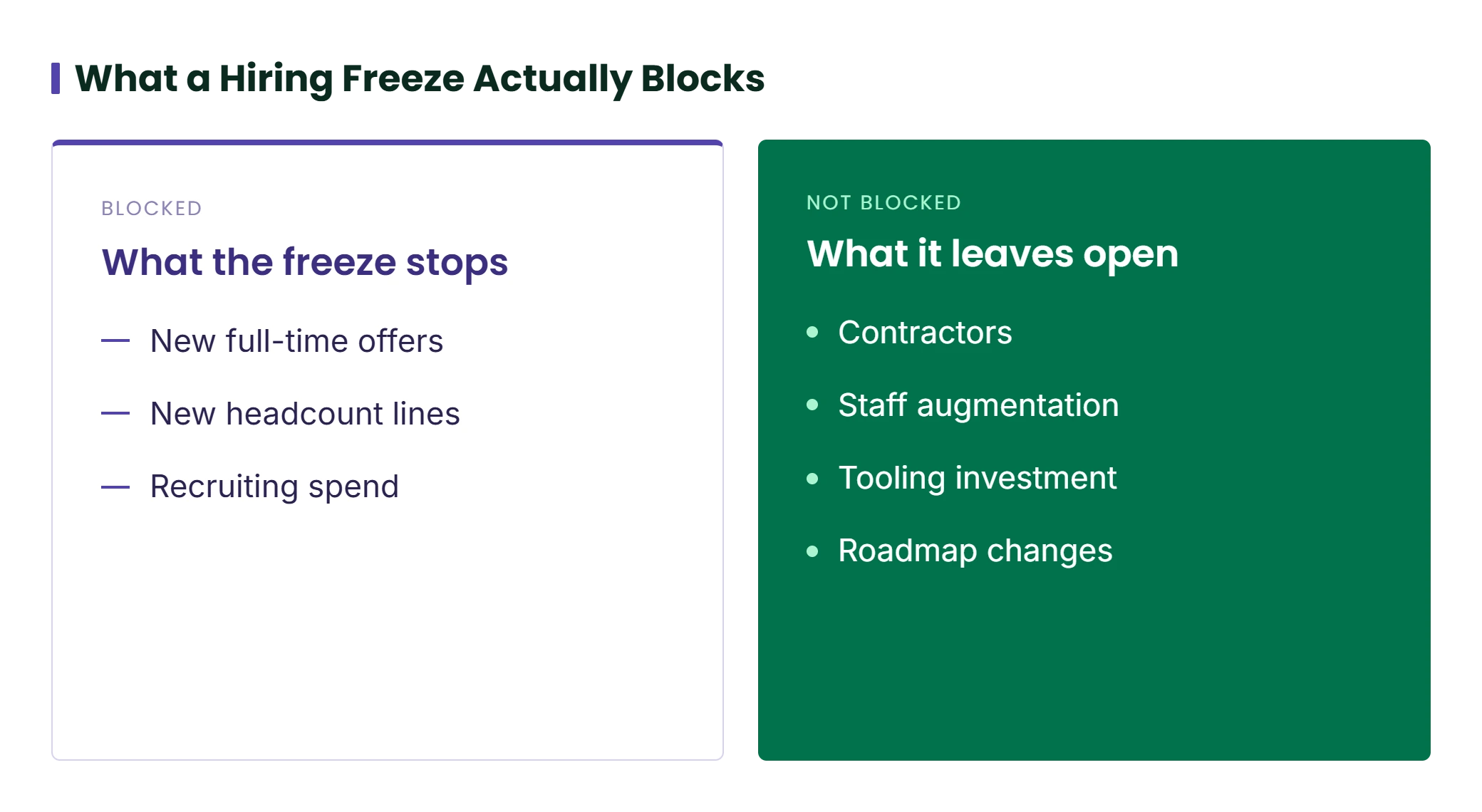
Most hiring freezes are narrower than they sound. Finance is typically blocking new full-time offers, new headcount lines, and the recruiting spend that goes with them. That's a real constraint, and it's usually the right one given whatever finance is looking at.
What a freeze typically does not touch:
- Existing contractor or vendor relationships already in place
- New engagements with staff augmentation or dedicated team partners, since that spend usually sits in a services or project budget rather than payroll
- Investment in tooling or workflow that makes current engineers more productive
- The roadmap itself, which means reprioritizing what actually needs to ship this quarter is still fully on the table
This is the detail that gets missed in the scramble after a freeze announcement: the constraint is on a specific mechanism, hiring a full-time employee, not on capacity in general. A team that reads the freeze as "we can't add people, period" tends to end up more stuck than the situation actually requires.
Three Ways Teams Keep Shipping Anyway
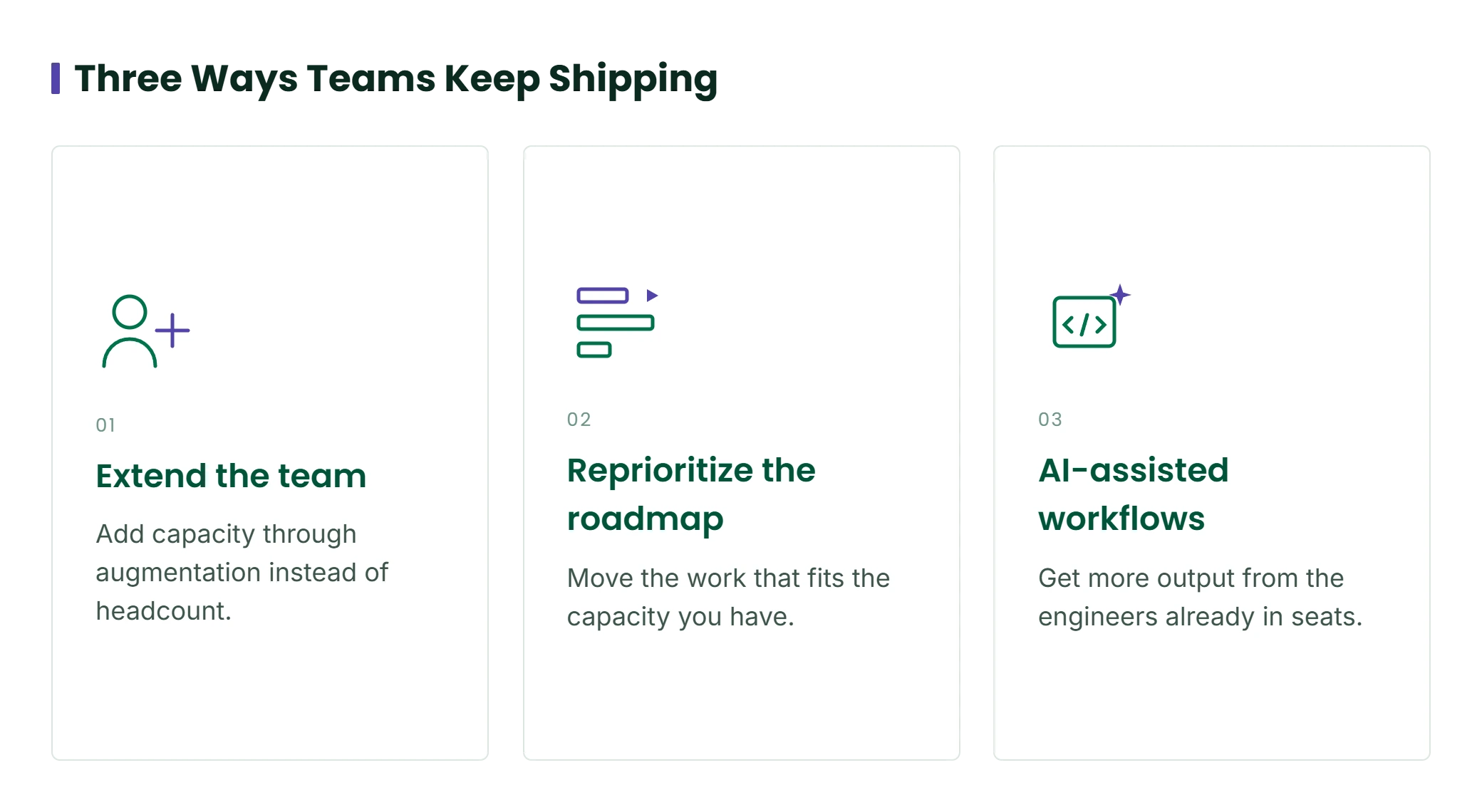
1. Extend the team without touching headcount.
Staff augmentation adds vetted specialists (a senior backend engineer, a QA automation lead, a mobile developer) directly into an existing team's workflow, without going through the full-time hiring process a freeze is blocking.
The spend typically comes from a services or project budget rather than payroll, which is often exactly the line finance is trying to protect. A team stuck at its current headcount can still bring in the specific skill it's missing for the specific stretch of work in front of it.
2. Reprioritize the roadmap around what the current team can actually own.
Not every freeze needs a workaround. Sometimes the more honest move is revisiting the roadmap and being clear with stakeholders about what a team of this size can realistically deliver this quarter, then pushing the rest. This isn't a failure to plan. A roadmap built assuming headcount that never arrived was never a realistic roadmap to begin with, and surfacing that early causes far fewer problems than discovering it in a missed deadline.
3. Get more out of the engineers already in seats.
Softjourn's R&D team has spent the past year testing AI-assisted development workflows against real project work, and the gains are large enough to change what a team's current size can actually cover.
In one case study, a supervised AI debugging workflow produced up to 30x faster resolution on specific debugging tasks and 10 to 20x gains on automated test generation, with a human reviewing every step rather than handing anything off autonomously (Softjourn AI Debugging Case Study).
A separate project applying the BMAD method to QA and business analyst work cut documentation finalization time by 25% to 44% depending on the task (Softjourn BMAD AI Case Study). None of this replaces a missing engineer outright, but it changes how long the existing team can hold the line before that gap turns into a missed deadline.
When Staff Augmentation Makes Sense vs. When It Doesn't
Staff augmentation isn't the answer to every freeze, and it's worth being direct about where it helps and where it falls short.
It tends to work well when:
- The gap is tied to a defined project or scope, like a migration, an integration, or a feature with a clear finish line.
- The team is missing a specific skill it doesn't need permanently, such as niche compliance experience or a legacy technology specialist.
- The work can plug into an existing process without needing to redefine team culture or long-term ownership.
It tends to work less well when:
- The role being backfilled is one of ownership: an engineering lead, an architect setting long-term technical direction, someone whose job is partly about being the institutional memory of the team.
- The company is treating augmented staff as a permanent substitute for a full-time hire it isn't allowed to make right now, without ever planning to revisit that decision.
- There's no clear scope to the work, which usually means the real problem is the roadmap, not the headcount.
The honest version of this: staff augmentation is built for capacity and skill gaps, not as a stand-in for the people who are supposed to set a team's direction long-term. Companies that try to use it that way tend to end up disappointed, not because the augmented engineers did poor work, but because the role they were asked to fill was never really about writing code in the first place.
What This Looks Like in Practice
Softjourn's work with Myers-Briggs is a useful example of this in practice over a longer stretch, not just a single freeze.
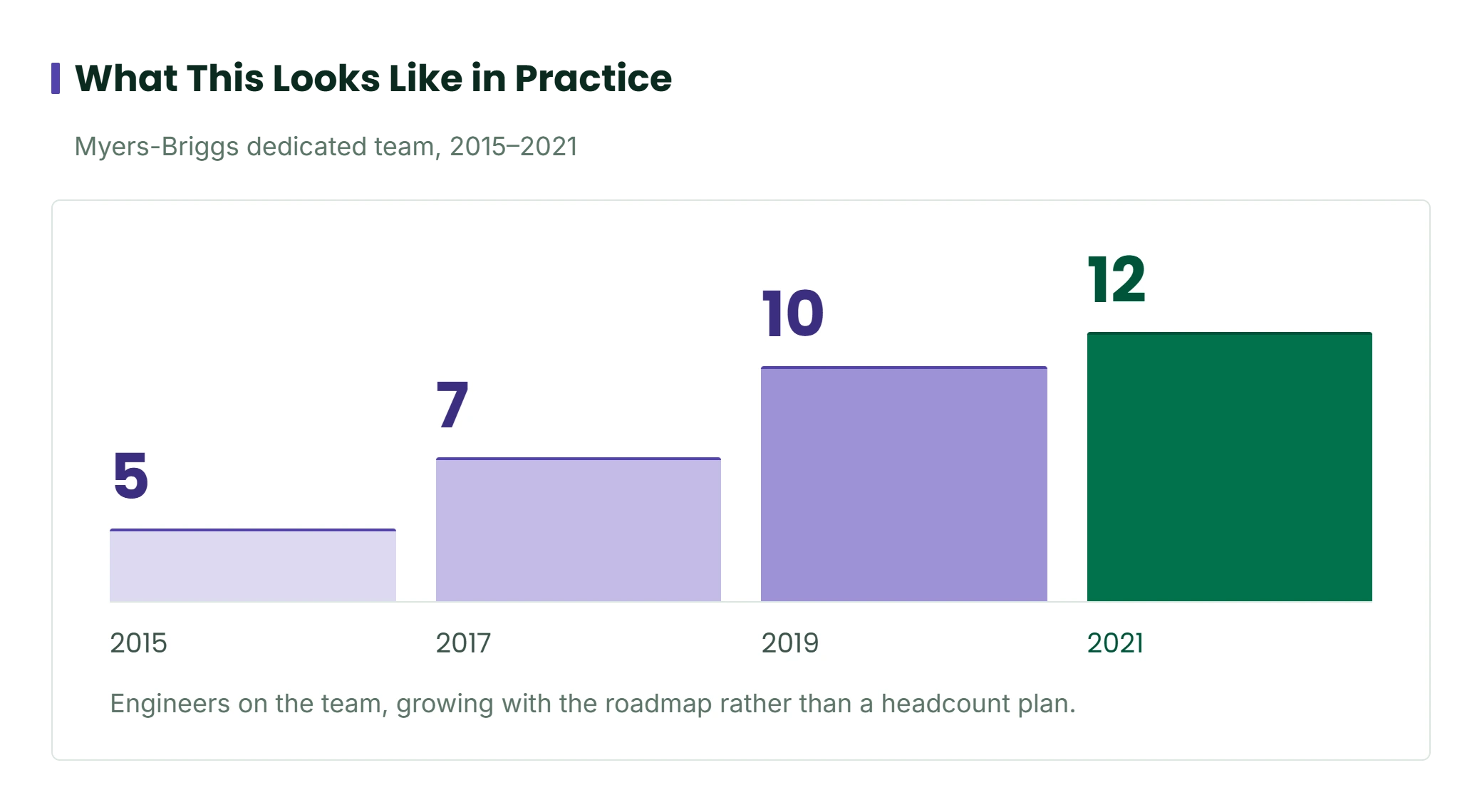
The dedicated team supporting Myers-Briggs' VitaNavis career and education platform grew from five people in 2015 to twelve developers by 2021, expanding and contracting to match what the platform actually needed at each stage, without Myers-Briggs adding those roles to its own permanent payroll. Nine years later, the partnership is still active (Softjourn and Myers-Briggs Case Study).
Getting Through the Freeze
A hiring freeze is a constraint on one specific hiring mechanism, not a constraint on what a team is capable of getting done. If the gap in front of your team traces back to a defined project or a skill your current engineers don't have, staff augmentation is built for exactly that situation, and it doesn't require finance to lift the freeze first.
Contact Softjourn to get started on extending your team without touching headcount: explore IT Staff Augmentation Services →