-1920x1080.webp?v=1786957745778)
Staff Augmentation vs. Layoffs: What CTOs Are Choosing in 2026
As economic pressure forces a choice between cutting headcount and finding another way to control costs, more engineering leaders are weighing staff augmentation against layoffs before making a call they can't easily undo.

Somewhere in this year's budget review, a familiar sentence keeps coming up: a specific number has to come out of engineering, and it's not negotiable.
What happens next tends to get framed as a binary choice. Cut headcount, or find another way to hit the number. Both options are real, but both carry a cost that rarely shows up on the slide where the decision actually gets made.
Layoffs offer something layoffs are genuinely good at: certainty. A smaller headcount line, visible on next quarter's budget, decided in a single meeting. Staff augmentation offers something different: the ability to add or remove capacity without the sunk cost of a hiring cycle followed, six or twelve months later, by a firing cycle. Neither path is automatically the right one, and treating the decision as obvious is usually how a company ends up quietly rehiring the people it just let go.
For a growing number of CTOs and VPs of Engineering, the real comparison isn't staff augmentation vs. outsourcing in the abstract, or even staff augmentation vs. layoffs in isolation.
It's a question of which lever actually matches the problem: is this a temporary capacity gap, or a permanent one? Getting that answer wrong is expensive in both directions. That's why we have decided to tackle this topic and ensure you make the right decision.
Why Layoffs Look Like the Obvious Answer (and Why They Often Backfire)
Layoffs solve a real problem in a way that's easy to explain to a board: fewer people, lower burn, done by Friday. The number goes into the model, the model balances, and the decision feels final.
What's harder to model is what happens next. Replacing an employee, according to research cited by the Society for Human Resource Management, can cost between 50% and 200% of that employee's annual salary once recruiting, onboarding, and lost productivity are factored in (SHRM). That's the cost of getting a role back to where it started, not the cost of growing past it.
That math is playing out publicly right now. A wave of companies that cut staff in the name of AI efficiency over the past year are already reversing course: nearly a third of hiring managers who eliminated roles for AI automation have quietly rehired people for those same positions, and more than half of employers say they now regret the layoffs they made. The workers coming back aren't cheap either. Many are negotiating from a position of strength, which tends to erase whatever the original headcount cut was supposed to save.
The costs that are easiest to overlook show up in the people who stay.
A November 2025 report on the hidden costs of layoffs found that 21% of employees say they're unlikely to remain with an employer after living through a layoff, and 40% of HR leaders report that layoffs at their organization led to increased voluntary turnover among the people who weren't cut (Careerminds, 2025).
The remaining team absorbs the departed team's workload while quietly updating their resumes, and the institutional knowledge that lives in a senior engineer's head, the kind that never made it into a wiki page, leaves the building with them.
None of this means layoffs are the right call. A genuine, permanent reduction in scope calls for a genuine, permanent reduction in team size. The problem is when layoffs get used to solve a temporary capacity problem, and the company ends up paying twice: once to cut the team, and again to rebuild it.
What Staff Augmentation Solves That Layoffs Don't
Staff augmentation and full-scale outsourcing get discussed as if they're the same decision, but they solve different problems.
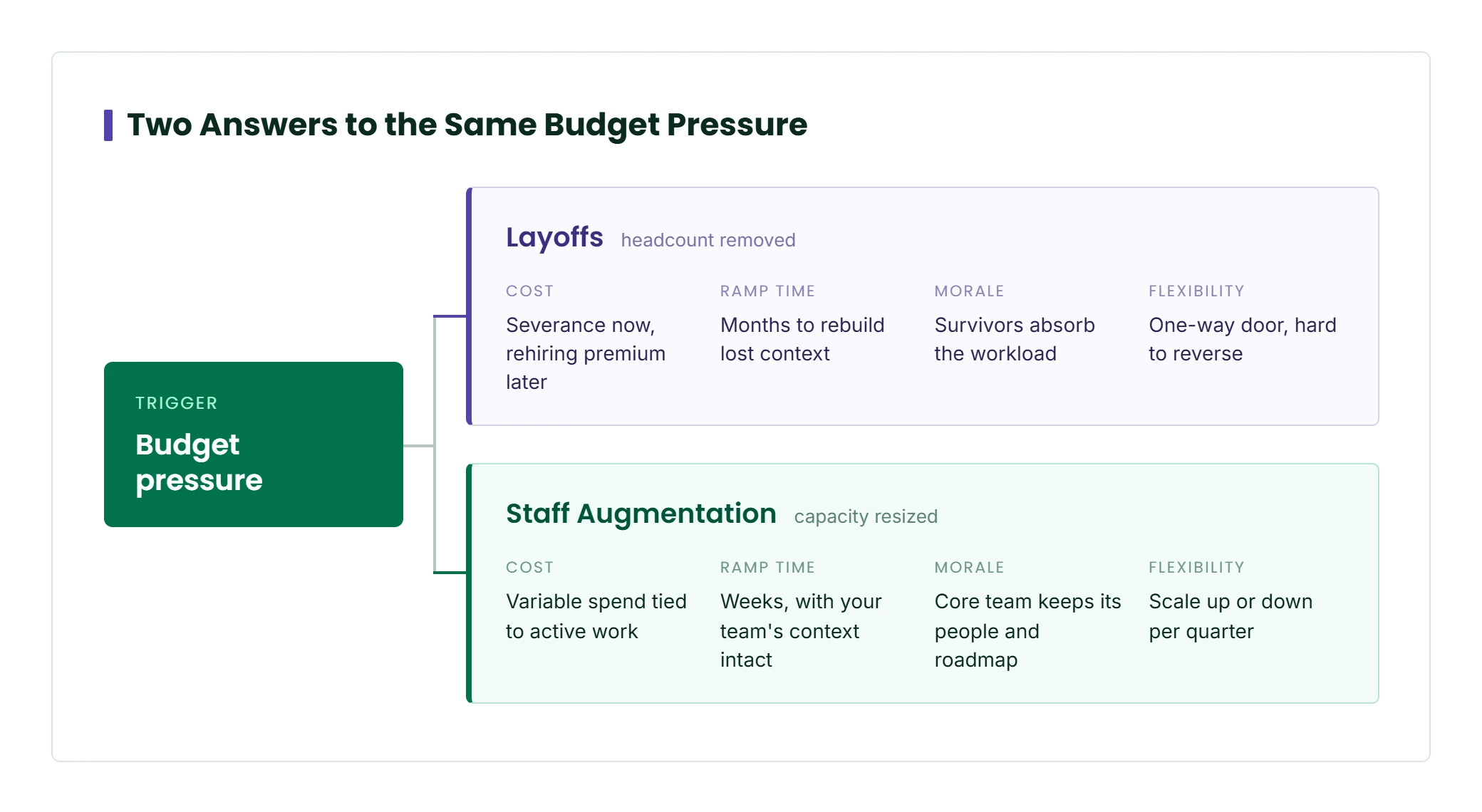
Outsourcing hands an entire function or project to an external team that owns delivery end to end. Staff augmentation adds specific people (developers, QA engineers, DevOps specialists) directly into an existing team and process, reporting to existing managers, working the existing sprint cycle, without becoming a permanent line item on headcount.
That distinction matters most under budget pressure, because it changes what happens once the pressure lifts. A company that laid off 10 engineers has to rebuild its hiring pipeline from scratch to get back to 10. A company that scaled an augmented team down from ten to six can scale back up to ten with a phone call, because the vetting, the working relationship, and the institutional context with the partner never went away.
Vanco, a payment processing company that has worked with Softjourn across several project phases, used a dedicated augmented team for exactly this kind of control. As the engagement grew from architecture review into ongoing development, Vanco decided how many people it needed at each stage, and Softjourn adjusted the team to match, without disrupting the client's in-house staff or forcing a hiring decision on either side.
Vanco's Flexible Dedicated Team
Vanco needed development support for a payment processing platform without pulling focus from its in-house team. Softjourn provided a dedicated team that scaled to match each project phase, from architecture review through active development, giving Vanco control over exactly how many people it needed and when. Read the full case study →
The other advantage that layoffs can't touch is access to specialized skills. A company rarely needs a full-time blockchain engineer or a senior automation QA lead forever, but it might need one for the next four months. Staff augmentation turns that into a staffing decision instead of a hiring decision, which is a meaningfully lighter commitment on both sides.
The Math CTOs Are Actually Running
The staff augmentation conversation in 2026 doesn't stop at headcount flexibility. It's increasingly paired with a second question: how much more capacity can an existing team generate before adding a single person?
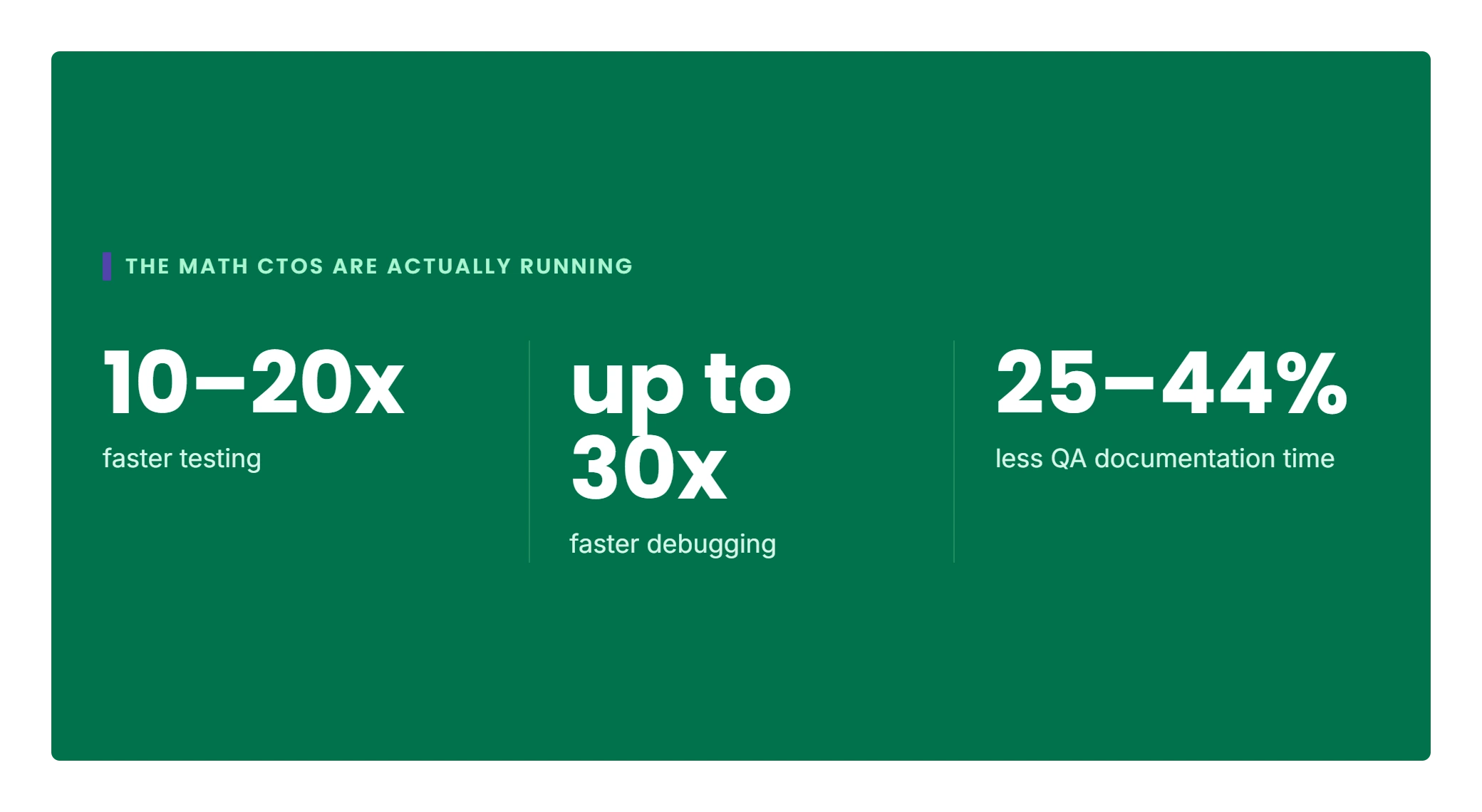
Softjourn's R&D team has spent the past year testing AI-assisted development workflows against real project work, not benchmarks, and the results are changing how "do more with less" gets calculated. In a use case where we tested AI as a supervised debugging and testing partner, the team measured up to 30x faster resolution on specific debugging tasks and 10 to 20x gains on automated test generation, with human review built into every step rather than autonomous handoffs.
A separate R&D project applied the BMAD method, a structured framework for AI-assisted QA and business analyst work, on behalf of an entertainment technology client with lean QA capacity. Documentation finalization time dropped 25% to 30% overall, with specific tasks like integration test documentation seeing a 44% reduction and complex feature scenarios dropping 40%.
What AI Actually Saved (and Didn't)
Softjourn's QA and business analyst teams tested AI-assisted documentation on real client work under a strict monthly hour budget. Structured tasks like test plans and integration testing saw time reductions of 25% to 44%, while more judgment-heavy work like PRD creation needed enough rework that the savings mostly disappeared. The honest finding: AI didn't just make the team faster, it gave a lean team the room to go deeper than their budget would otherwise allow. Read the full case study →
Put those two pieces together and the calculation shifts. A CTO isn't only choosing between a smaller permanent team and a flexible augmented one. Increasingly, they're choosing between a smaller permanent team and an augmented team that, paired with the right AI-assisted workflow, may close the capacity gap without adding a single full-time line to payroll.
A Framework for Deciding
Not every capacity problem is the same, and the right fix depends on which one is actually in front of you. Before defaulting to layoffs or staff augmentation, it's worth answering a short set of questions honestly.
This is likely a temporary capacity gap, where staff augmentation is the better fit, if:
- The workload is tied to a specific project, migration, or seasonal spike with a visible end date.
- The team needs a skill set it doesn't have and won't need permanently (a compliance specialist, a legacy language expert, a short-term QA push).
- Rehiring for the same roles in six to twelve months is a realistic scenario, not a worst case.
- The budget pressure is about controlling burn rate, not a permanent shift in product scope.
This points toward a genuine structural change, where reducing headcount may be the more honest answer, if:
- The product line, market, or business unit itself is shrinking or being discontinued.
- The work that team was doing isn't coming back in any form, augmented or otherwise.
- Leadership is confident this isn't a decision it will need to reverse within a year.
- The cost pressure reflects a genuine change in company strategy, not one difficult quarter.
Most companies feeling budget pressure in 2026 are living in the first category more often than the second, even when the instinct is to reach for the second option first.
Getting the Decision Right the First Time
The decision in front of most engineering leaders right now isn't really staff augmentation vs. outsourcing in the abstract, or even staff augmentation vs. layoffs as a clean binary. It's a question of matching the fix to the actual problem. A temporary gap deserves a flexible answer. A permanent one deserves an honest one. Getting that distinction right the first time is considerably cheaper than getting it wrong twice.
Contact Softjourn to get started on building a staff augmentation plan that flexes with your budget instead of working against it.