-2-1920x1080.webp?v=1787169836062)
Agentic Engineering vs. Vibe Coding: The Cost Nobody's Budgeting For
A look at why the cheapest way to write code with AI quietly becomes the most expensive way to run it, and what disciplined engineering teams do instead.

A four-hour job. That's what it cost Softjourn's own QA team to manually update a single section of a 170-page internal product document after a platform migration. A full refresh of the whole thing took four to five months, and the moment it was finished, the next release cycle started eroding it again.
The debt didn't accumulate because someone made a bad call. It accumulated because there was no system in place to stop it from accumulating. The team was simply running documentation the way most engineering teams run it: by hand, on top of everything else, with AI tools available but not built into the workflow in any structured way.
Most of what gets written about AI in software development focuses on the dramatic failure mode of a poorly "vibe coded" app. But the more common cost isn't a catastrophic outage. It's a running tab, paid in hours, that most engineering budgets aren't tracking anywhere.
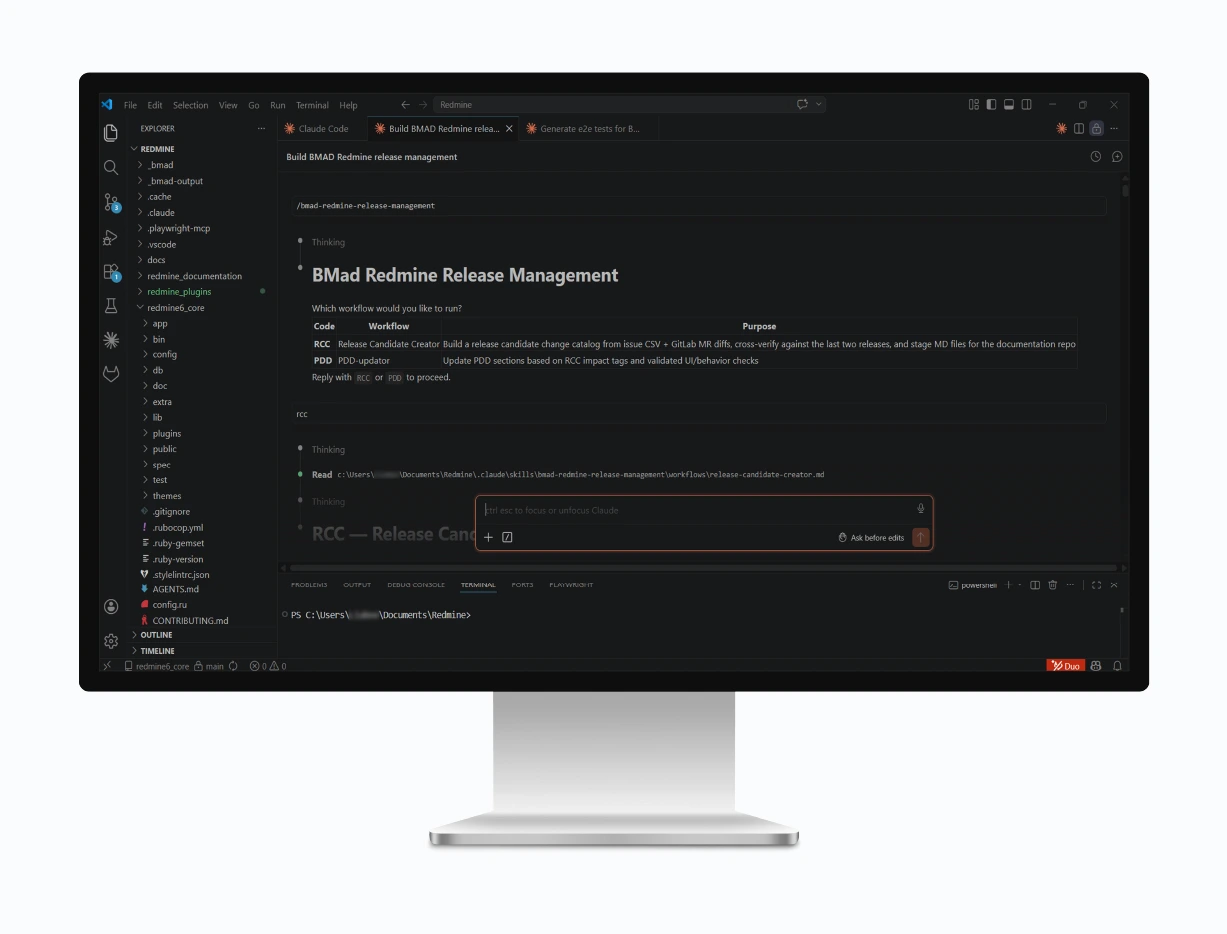
Softjourn's R&D team eventually rebuilt that workflow around two linked AI skills instead of manual updates, and the six-month backlog cleared in a single automated run. The AI was never the missing piece; the system around it was. Vibe coding versus agentic engineering isn't merely a style preference but the line item that shows up on a budget.
What Vibe Coding Actually Costs
The whole appeal of vibe coding is how cheap and easy it is to get started: open a chat window, describe what you want, accept what comes back. No architecture document, no test suite, no setup cost beyond a subscription. For a prototype or a weekend project, that's a reasonable trade.
The bill shows up later, and it shows up in three places.

The Token Bill
Every prompt costs something, and vibe coding tends to produce the expensive kind of prompt. Without a defined structure to work from, a developer ends up pasting large, messy chunks of context into the chat, then repeating the process when the first attempt breaks. Each round trip burns tokens on output that gets thrown away, and none of this shows up as a single alarming charge so much as a monthly API bill that's quietly larger than it should be.
The Maintenance Tax
This is the part that's easiest to miss, since it doesn't cost anything today so much as six months from now.
GitClear has tracked this shift directly, analyzing 211 million lines of changed code between 2020 and 2024. Refactored code, the kind that signals a codebase being actively cleaned up and reused, fell from about a quarter of all changes in 2021 to under 10% by 2024. Copy-pasted code moved the opposite direction, and 2024 was the first year on record where it outpaced refactoring entirely. Code churn, meaning code that gets rewritten or reverted within two weeks of being written, roughly doubled over the same stretch [GitClear, 2025].
That's not a story about AI writing bad code line by line, but about what happens when a lot of code gets written fast and nobody goes back to clean it up. Vibe coding produces exactly that pattern: quick output, minimal reuse, and a growing pile of near-duplicate logic that someone eventually has to untangle by hand.
The Security Bill
The same lack of structure that produces duplication also produces gaps, since without an automated way to check what shipped, vulnerabilities get generated at the same pace as everything else. Catching one in production costs far more than catching it before merge, and that gap tends to be invisible right up until it isn't.
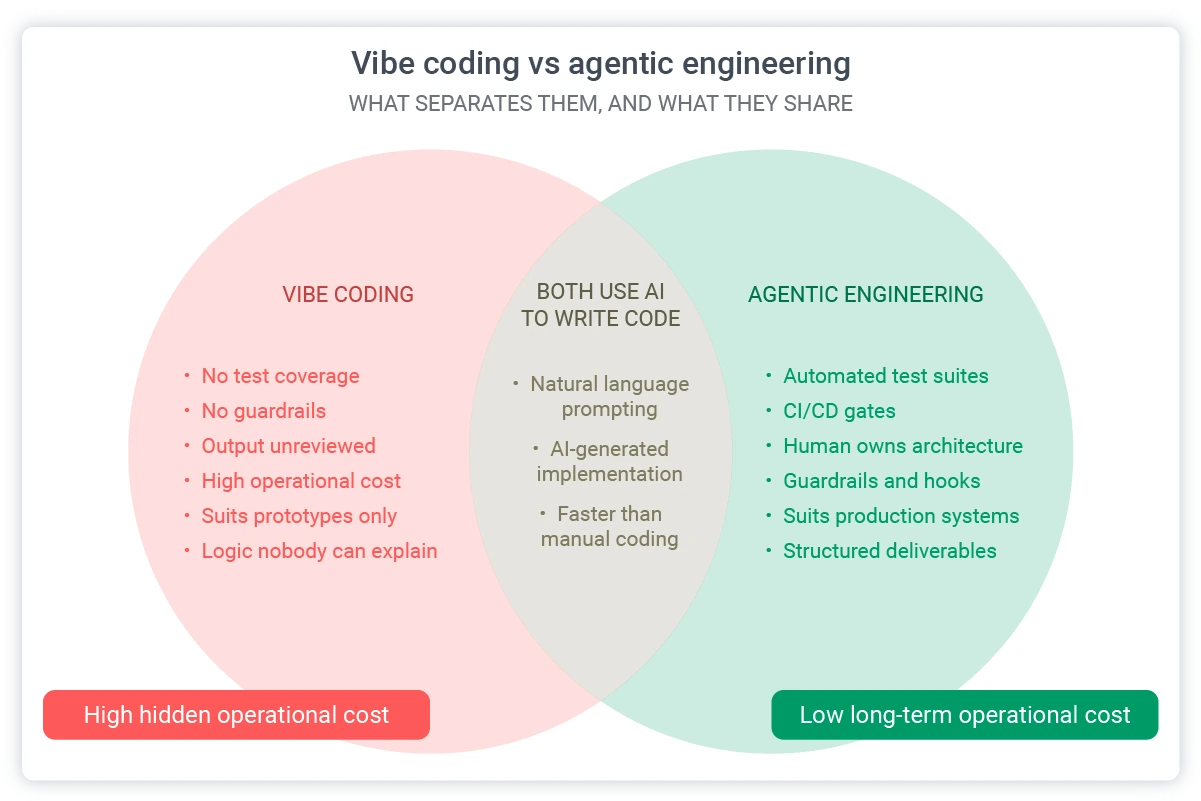
None of this means AI-generated code is inherently worse, only that unverified code is, and vibe coding is, by definition, code that skips verification. These costs can be avoidable if you go in with a well-planned, systematic approach.
The Other End of the Spectrum: Agentic Engineering
Agentic engineering is what vibe coding looks like once you add the parts that were missing: structure, verification, and a plan for how the AI's output actually gets checked before anyone trusts it.
The clearest way to see the difference is in how each approach handles verification. In vibe coding, verification is optional, and a developer runs the code and decides whether it looks right. In agentic engineering, two mechanisms do that work automatically. Tests check the deterministic parts of the system, confirming that a given input produces the expected output every time. Evaluations, or evals, check the parts that aren't deterministic, such as whether an AI agent chose the right tools, followed a sensible sequence of steps, and produced a final result that actually meets the bar. Tests get verified by code, and evals get verified by labeled datasets and scoring rubrics. Skip both, and it's still vibe coding, no matter how sophisticated the prompts sound.
What makes this possible is the harness; a raw AI model isn't an agent on its own, since it becomes one only once it's given memory, tool access, feedback loops, and rules it can't break. Everything surrounding the model, meaning the instructions, the guardrails, the sandboxing, and the observability that shows whether an agent is doing well or quietly drifting, is the harness. It's the difference between an engine and a car. The model provides the power, but the harness is what actually gets anyone anywhere.
This matters because most failures blamed on “the AI” are really failures in the harness. A missing tool, a vague instruction, an absent guardrail, or a context window stuffed with irrelevant noise will produce bad output regardless of which model sits underneath. Public benchmarks make this concrete: one team moved a coding agent from outside the top 30 to the top 5 on a standard coding benchmark by changing only the harness, with no change to the model at all [Google, 2026]. The model is one input; the harness is everything that determines whether that input turns into something usable.
This doesn't mean your projects will move slower; it just means that the verification would be built in rather than bolted on after something breaks in production.

What This Looks Like Running on a Real Client Engagement
Softjourn's own R&D team ran a version of this exact experiment on a live client project: a large, active codebase with a steady stream of well-defined tickets covering UI changes, bug fixes, and minor feature work. The question wasn't whether AI could write code faster. It was whether a fully autonomous loop, prompt in, reviewed pull request out, could hold up under real delivery pressure without cutting corners.
The Setup
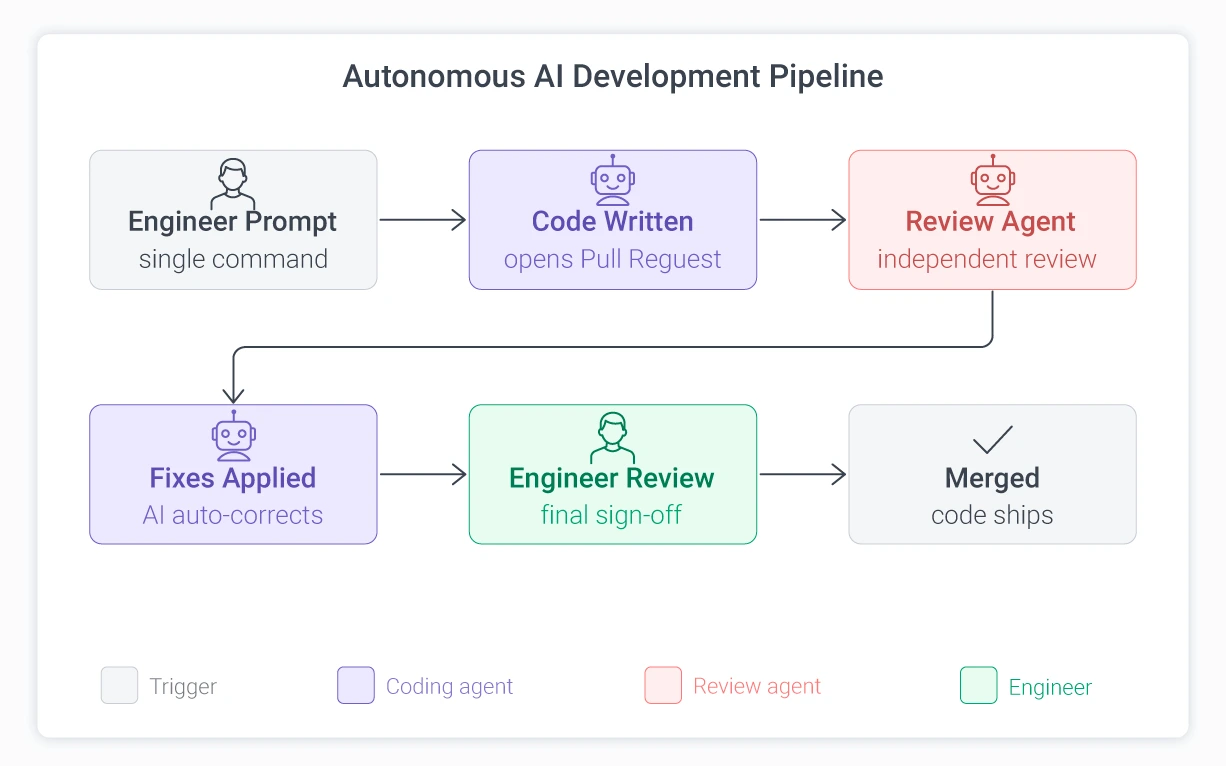
Two AI agents worked in sequence. The first reads a ticket, inspects the UI, writes the code, tests it locally, and opens a pull request. The second reviews that pull request independently, leaves comments, and the first agent reads those comments and applies the fixes. Two agents checking each other's work before a human ever looks at it, with one hard constraint from day one: no deployment access to production. Everything stayed sandboxed and reviewable.
What Made It Reliable
What made the loop reliable wasn't the agents themselves so much as what they carried between sessions. Rather than re-explaining the platform's architecture and API patterns every time, the team encoded that knowledge into Markdown-based skill files, compact instruction documents that load automatically for each task type. That's the harness at work: institutional memory the agent doesn't have to relearn, shareable across the whole team rather than locked to whoever set it up.

The Results
The results held up over several months, not just in a demo. Tasks that used to take one to two days were done in one to two hours, a five to ten times speed increase on well-scoped work. Delivery throughput on the client side rose 125%. The ongoing cost of running the whole workflow came to around $120 a month in compute.
"My role has fundamentally changed. I am no longer a developer writing code. I am a manager who monitors, directs, and validates AI output." — Senior Engineer, Softjourn
The Tradeoff Worth Naming
This approach can introduce more bugs than manual coding does, which means local testing before merge matters more, not less. The team's own read on it is candid, and QA involvement stayed essential throughout. That tradeoff is the whole point. Agentic engineering doesn't promise fewer things to check. It promises that what needs checking gets checked systematically, by design, instead of by luck.
Beyond the Pipeline
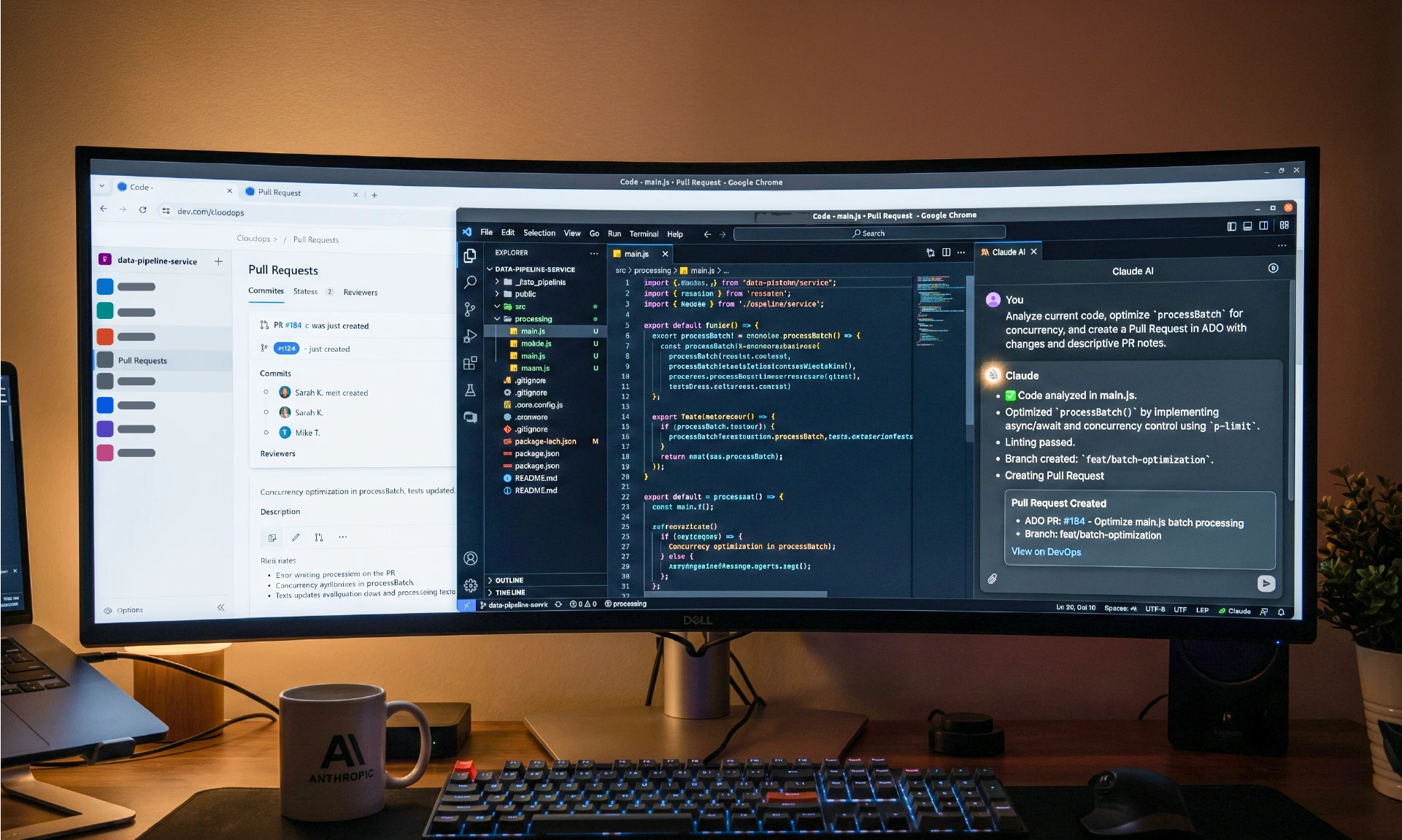
The same discipline showed up elsewhere in Softjourn's R&D work. A separate debugging workflow, built around structured, supervised AI use rather than open-ended prompting, cut resolution time on certain bugs by up to 30 times and sped up automated test generation by 10 to 20 times. And the documentation workflow from earlier in this article, the one that used to take four to five months to refresh, now runs through two linked AI skills that pull live context directly from the codebase instead of requiring anyone to re-explain it by hand.
None of these examples involve a more powerful AI model than what's available to anyone with a subscription. What's different is the system built around it.
Where Most Teams Actually Are
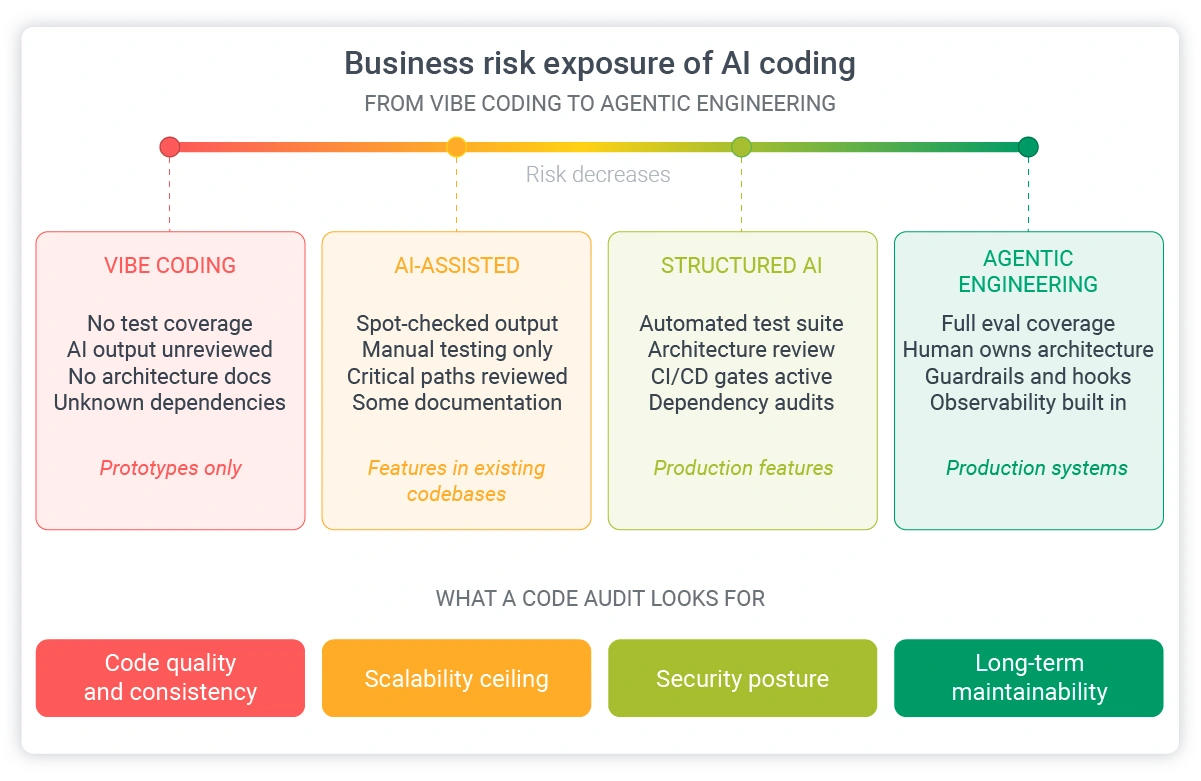
Vibe coding and agentic engineering aren't two separate camps so much as opposite ends of the same spectrum, and most real work happens somewhere in the middle. A weekend prototype earns the speed of vibe coding. A payment processing system demands the discipline of agentic engineering. Most engineering teams are building something in between, and the skill worth developing isn't picking a side once. It's knowing which mode a given task calls for.
A few questions tend to sort this out quickly:
- Is this disposable or does it need to last? A one-off script or an internal proof of concept can tolerate a vibe-coded approach, since the cost of throwing it away is low. Anything that ships to customers, touches sensitive data, or becomes part of the codebase other people build on top of needs the verification layer.
- Who's checking the output, and how? If the answer is “a developer glances at it, and it seems fine,” that's vibe coding regardless of how the prompt was written. If the answer involves an automated test suite, an eval with a defined rubric, or a second reviewer, that's agentic engineering, even if the workflow still moves fast.
- What does a mistake actually cost? A broken internal dashboard is an inconvenience, while a vulnerability in a fintech API or a bug in a live event-ticketing system is a different category of problem entirely. The stakes should set the level of structure, not the other way around.
Most teams don't consciously choose a spot on this spectrum. They default to whatever the deadline allows, which usually means sliding toward vibe coding under pressure and only adding structure after something breaks. The stronger position is deciding in advance, project by project, which mode a piece of work actually warrants, and building the harness for it before the first line of code gets written rather than after the first incident.
Making the Shift: What It Actually Takes
Moving from vibe coding to agentic engineering doesn't require a new toolset. Most teams already have access to the AI models they need. What's missing is usually the structure around them, and that structure comes down to a handful of concrete practices.

Write the Tests and Evals First
A well-written test and eval suite communicates intent more precisely than any prompt does, since it tells the AI exactly what “correct” looks like and gives everyone an automated way to check it. Writing these before generating code, rather than after something breaks, is what actually separates agentic engineering from vibe coding with extra steps.
Treat Context as a Deliverable
The quality of AI-generated output depends less on clever prompting and more on the quality of the context behind it: the architecture, the conventions, the intent. Documenting that once, in a rule file the AI loads automatically, means never having to re-explain it, and it means every person on the team is working from the same set of ground truths instead of whatever they happened to type into a chat that day.
Build the Harness as Shared Infrastructure
Reusable rule files, skill libraries, and evaluation suites compound in value across projects the same way any other piece of infrastructure does. Treating them as one-off prompts that live in someone's chat history means starting from zero on the next project. Treating them as documented, versioned, team-owned assets means the next project starts from wherever the last one left off.
Match the Review to the Risk
AI-generated code deserves the same scrutiny as human-written code, with a few specific things worth watching for: hallucinated dependencies, thin error handling, and logic that looks correct at a glance but doesn't hold up under an edge case. None of this means slowing everything down equally. It means calibrating review depth to what's actually at stake, the same way any team already does with human-written code.
All of these best practices aren't so different from what good engineering has always required. The only difference is a new kind of collaborator.
Closing Thoughts
The gap between vibe coding and agentic engineering was never really about which AI model a team uses. It's about whether anyone decided, on purpose, how that model's output gets checked before it ships. That decision is cheap to make early and expensive to skip, and the cost of skipping it doesn't show up as a single dramatic failure so much as a slow accumulation of hours, dollars, and risk that most budgets never line-item.
The upside is that the fix doesn't require throwing out what's already working. It requires building the harness, the tests, the evals, the shared context, around the tools already in use, so that speed and reliability stop being a tradeoff and start being the same thing.
Figuring out where a given team or project actually sits on that spectrum, and what it would take to move toward the disciplined end of it, is exactly what an AI readiness assessment is built to answer. Contact Softjourn to get started on assessing where your team's AI workflows stand today.