
Why Enterprise MVP Development Requires a Different Playbook Than Startup MVPs
The startup MVP playbook doesn't work for enterprises. Here's what does.

Innovation in an enterprise moves differently than in a startup. While a scrappy two-person team can pivot on a dime and rebuild their entire product over a couple of weekends, enterprises operate within established systems, compliance frameworks, and organizational structures that can't be ignored.
Yet the pressure to innovate has never been higher. Digital transformation isn't a buzzword anymore; it's a survival imperative in most industries.
The question now isn't whether to build new digital products, but how to do it without disrupting core operations, violating compliance standards, or burning through budgets on unvalidated ideas.
This is where strategic MVP development for enterprises becomes critical. But here's what most articles won't tell you: the MVP approach that works for startups often fails spectacularly in enterprise environments.
The stakes are different, the constraints are different, and the definition of "minimum" changes entirely when you're dealing with enterprise security requirements, legacy system integration, and regulatory compliance.

The Enterprise Innovation Paradox
Large organizations face a unique challenge. They have the resources to build almost anything, yet they struggle to validate new ideas quickly. Internal teams are stretched thin across existing products and infrastructure.
The same rigorous approval processes designed to protect million-dollar investments end up creating months of delay for $50,000 validation experiments. Meanwhile, concerns about disrupting existing revenue streams or cannibalizing successful products can freeze decision-making at the executive level.
Example: Consider a financial services company exploring a new customer onboarding flow. They can't just ship a basic prototype and iterate. They need to consider PCI compliance, integration with existing identity management systems, and alignment with enterprise security protocols from day one. The "minimum" in their minimum viable product includes elements that a startup would consider advanced features.
This is why enterprises need a fundamentally different approach to MVP development, and why outsourcing to partners who understand these nuances can be the difference between successful innovation and expensive false starts.
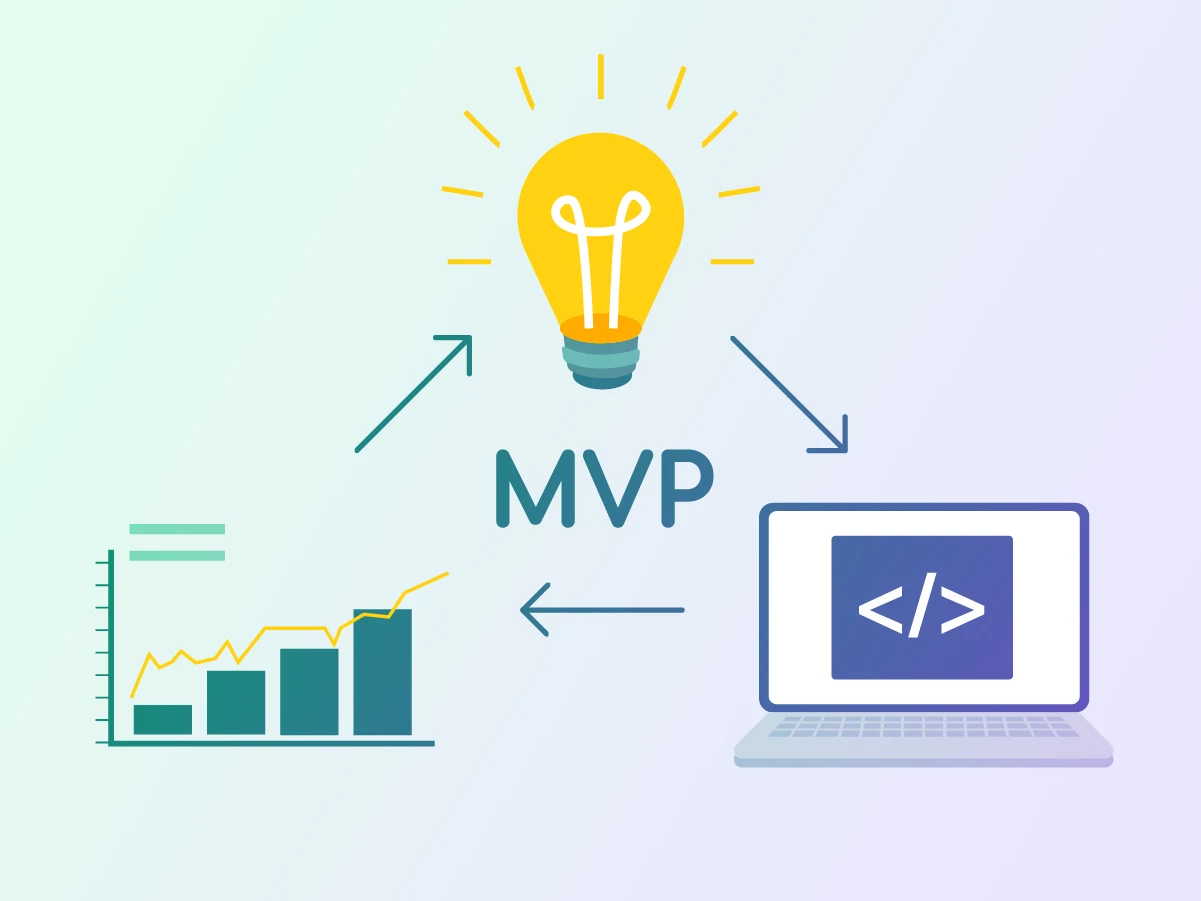
Strategic Advantages of MVP Development for Enterprises Through Outsourcing
Preserving Internal Capacity for Strategic Initiatives
Your internal development teams are already the guardians of mission-critical systems. Every hour they spend on exploratory MVP work is an hour not spent optimizing core products, addressing technical debt, or maintaining the infrastructure that generates revenue today.
Outsourcing MVP development isn't about lacking capability. It's about strategic resource allocation.
By partnering with experienced external teams, you maintain internal focus on systems that require institutional knowledge while exploring new opportunities in parallel. This dual-track approach accelerates innovation without compromising operational excellence.
Example: A major ticketing platform needed to explore a new B2B2C model without pulling engineers from their core booking engine. By outsourcing the MVP to a specialized team with ticketing industry experience, they validated the concept in weeks while their internal team continued optimizing the platform that processed millions of transactions daily.
Compressing the Innovation Timeline Without Sacrificing Quality
In enterprise contexts, speed isn't just about coding faster. It's about navigating complexity efficiently. The right outsourcing partner has already solved many of the problems you're about to encounter: integrating with enterprise identity providers, handling high-volume data processing, building for regulatory compliance, designing for enterprise-grade security.
Where an internal team might spend weeks researching best practices for PCI compliance or HIPAA requirements, experienced partners implement known solutions immediately. This isn't cutting corners; it's leveraging long-tested approaches that have worked across multiple enterprise implementations.
The timeline compression is substantial. What might take 6-9 months with a newly formed internal team can often be accomplished in 10-16 weeks with a specialized outsourcing partner. Not because they necessarily code faster, but because they navigate the complexity more efficiently.
Creating Flexible Capacity That Scales With Validation
Enterprise innovation isn't linear. Some experiments fail quickly and should. Others show promise and need rapid scaling. Internal teams create a fixed capacity that's hard to scale up or down based on validation outcomes.
Outsourcing creates elastic capacity that aligns with your validation journey:
Early-stage exploration (Weeks 1-8): Small, focused team validates core assumptions with minimal features
Validation phase (Weeks 8-16): If promising, expand team to build out additional features and handle increased user testing
Scale decision (Week 16+): Either wind down the initiative without stranded resources, transition to internal teams, or scale the partnership based on market response
This flexibility is particularly valuable for enterprises exploring multiple opportunities simultaneously. You can run three MVP experiments in parallel, scale the winners, and wind down the others. All without the fixed cost and organizational complexity of three dedicated internal teams.

Industry-Specific Considerations for Enterprise MVP Development
Building an MVP in financial services isn't the same as building one in healthcare or event management. Each industry has its own regulatory landscape, user expectations, technical requirements, and competitive dynamics.
We recommend finding partners with long-term experience and deep expertise in industry-specific projects who can bring their accumulated wisdom to your project from day one.
This matters more than you might think. When you're developing an MVP for expense management, for instance, working with a team that already understands corporate card integration, multi-currency handling, and approval workflow patterns means you're not paying them to learn what they should already know. You're leveraging their existing expertise to compress your learning curve.
Beyond development skills, industry-specialized partners can:
- Anticipate regulatory requirements before they become blockers
- Recommend proven architectural patterns for your specific use case
- Identify which "minimum" features actually matter in your market
- Connect you with relevant technology ecosystems and partnerships

Generic MVP advice fails in specialized industries. Here's what actually matters when you're building enterprise MVPs in complex domains:
Financial Services and Fintech
Beyond PCI compliance, enterprise fintech MVPs must navigate API authentication with banking partners, handle reconciliation at scale, and design for auditability from the start. The "minimum" in a fintech MVP includes transaction logging, security controls, and error handling that other industries might defer to later phases.
Partners with fintech expertise understand that your MVP needs to prove not just user value, but operational reliability and regulatory compliance simultaneously. Robust API development services become essential when integrating with banking systems, payment processors, and financial data providers where security and reliability cannot be compromised even in early validation stages.
Ticketing and Event Management
High-volume transaction processing, seat inventory management, and real-time availability synchronization aren't features you add later. They're core to validation. An MVP that can't handle concurrent purchases or doesn't integrate with existing venue systems won't validate anything useful. Industry-specialized partners know how to build lean while preserving the technical foundations that matter in this space.
Enterprise Expense Management
Multi-entity accounting, approval workflows, integration with ERP systems, and corporate card reconciliation create complexity that can't be ignored even in an MVP. The key is knowing which integration points are essential for validation and which can be simulated initially. This judgment comes from experience, not generic Agile methodology.
EdTech and eLearning
Enterprise learning platforms face unique MVP requirements around LMS integration, SCORM compliance, and learner data privacy regulations like FERPA. The MVP must handle proper course progression tracking, assessment delivery, and grade synchronization even in early validation.
Content delivery must be reliable and scalable from day one because disrupted learning experiences damage credibility with both administrators and learners.
Partners with EdTech experience understand that your MVP isn't just testing if people will use the platform, but whether it can operate within the complex technical and regulatory environment of enterprise learning ecosystems.
E-commerce and Retail
Enterprise e-commerce MVPs face unique challenges around inventory synchronization across channels, real-time pricing engines, and integration with existing order management systems. The MVP must handle peak load scenarios even in testing. A validation that works fine with 50 concurrent users tells you nothing when Black Friday brings 50,000. Partners with e-commerce depth understand how to architect for scale while building minimal features, ensuring your MVP tests what actually matters: can the core commerce flow handle real-world transaction volumes and integrate with your existing fulfillment infrastructure?
Healthcare
HIPAA compliance isn't optional, even for MVPs. Enterprise healthcare solutions must implement proper consent management, audit logging, and data encryption from day one. Beyond regulatory requirements, healthcare MVPs often need to integrate with EHR systems, handle complex clinical workflows, and support multiple user roles with different access privileges.
The "minimum" viable product in healthcare includes security and compliance features that would be future considerations in other industries. Partners experienced in healthcare understand these non-negotiable requirements and build them into the foundation rather than treating them as add-ons.
SaaS and Enterprise Software
Multi-tenancy architecture, role-based access control, and enterprise SSO integration define the baseline for B2B SaaS MVPs. Even in validation phases, enterprise buyers expect proper user management, basic admin controls, and integration capabilities with their existing tools. The challenge is determining which enterprise features are must-haves for validation versus nice-to-haves for scale. Industry-specialized partners can distinguish between features that prove product-market fit and those that can wait until commercial launch.

Risk Mitigation and Governance in Enterprise MVP Development
Enterprises can't afford the "move fast and break things" mentality. Your MVP experiments must operate within governance frameworks that protect customers, comply with regulations, and maintain brand reputation.
Here's how outsourcing actually strengthens risk management:
- Contractual risk transfer: Well-structured engagements include clear liability provisions, IP protection, and performance guarantees that internalized teams can't provide. You're not just buying development capacity; you're purchasing risk management expertise.
- Compliance as a core competency: Partners specializing in regulated industries maintain compliance certifications and audit readiness as part of their operational baseline. They've already invested in SOC 2, ISO 27001, or industry-specific certifications that would take internal teams months to achieve.
- Security architecture from inception: Enterprise MVPs need production-grade security even if they're not yet production-scale. Experienced partners implement proper authentication, authorization, data encryption, and security monitoring from week one. Not as afterthoughts, but as foundational elements.
- Documented decision-making: External partners bring structured documentation practices that create the audit trails enterprises require. Every architectural decision, security consideration, and compliance measure is documented not just for current validation, but for future scaling and regulatory review.
Evaluating MVP Development Partners: What Actually Matters
Most partner selection criteria focus on surface-level factors: team size, hourly rates, technology stack. Here's what enterprise leaders should actually evaluate:
Demonstrated Industry Depth
Ask for specific examples of regulatory challenges they've navigated in your industry. Request to speak with references who faced similar compliance requirements. Review their case studies for both successful outcomes and for evidence of industry-specific problem-solving.
Architectural Maturity Beyond MVP
Your MVP might start small, but it needs to be built on foundations that can scale. Evaluate partners' ability to design for future complexity while delivering current simplicity.
Ask: How do you approach database design for an MVP that might need to handle 100x current volume? How do you structure code for features that aren't in the MVP but are on the roadmap? How do you balance quick delivery with technical debt management?
Integration and Transition Planning
The best MVP partnerships include clear paths for knowledge transfer, code handoff, or continued scaling. Evaluate their approach to documentation, their willingness to work alongside internal teams, and their track record of successful transitions.
Red flag: Partners who want to own your MVP indefinitely without transparent transition options.
Green flag: Partners who proactively discuss how to set up internal teams for success post-MVP.

Beyond the MVP: Strategic Planning for Validation and Scale
Validation Metrics That Drive Real Decisions
Your MVP isn't successful just because it launches. It's successful when it generates actionable insight. Before development begins, establish clear decision criteria:
- What usage patterns would justify scaling investment?
- Which user segments need to validate the value proposition?
- What operational metrics (cost per transaction, support burden, performance characteristics) inform the business case?
- How will you measure MVP success differently from how you'd measure a mature product?
The Scale-or-Sunset Decision Framework
Some MVPs should not become full products. The goal is learning, not launching. Create explicit decision points:
Week 12-16: Initial validation checkpoint. Do core assumptions hold? Is user engagement meeting thresholds? Should we continue, pivot, or stop?
Week 20-24: Scale decision. If validated, what's the path to productization? Expand the outsourcing partnership? Transition to internal teams? Rebuild with a different architecture for scale?
The best outsourcing partners help you make these decisions objectively, even when it means recommending against continued engagement. Their long-term value comes from helping you invest wisely, not from maximizing project duration.

Building Institutional Knowledge From External Development
A common fear: if we outsource, we don't build internal capability. The reality: strategic outsourcing can accelerate internal learning when done thoughtfully. We recommend you to:
- Embed internal team members in the outsourced project as product owners and technical reviewers. They gain hands-on experience with the new domain without bearing the full development burden.
- Structure knowledge transfer explicitly: Regular architecture reviews, documented decision rationale, and code walkthroughs ensure your team understands what was built and why.
- Use MVPs as training grounds: Bring internal developers into the project for specific modules, letting them work alongside experienced external teams to build both the product and their own skills.

When Outsourcing Enterprise MVP Development Doesn't Make Sense
Honest assessment: outsourcing isn't always the answer. Here are scenarios where internal development might be more appropriate:
- When the MVP requires deep integration with proprietary internal systems that external partners can't access for security or competitive reasons. If 80% of the value comes from leveraging unique internal data or infrastructure, the coordination overhead of external development might outweigh the benefits.
- When internal teams have specific expertise that's rare in the market and central to the MVP's differentiation. If your competitive advantage comes from specialized algorithms or domain knowledge that's hard to transfer, keeping development internal preserves that advantage.
- When organizational learning is more valuable than speed. Sometimes the goal isn't just to validate a product idea but to build internal capability in a new domain. If developing institutional expertise is the primary objective, internal development (even if slower) might be the strategic choice.
- When the political or cultural situation requires visible internal innovation. Enterprise politics are real. If your organization needs to demonstrate internal innovation capacity to stakeholders, outsourcing (even if more efficient) might not serve that goal.
The key is honest assessment of what you're actually trying to achieve: rapid validation, capability building, stakeholder management, or some combination of these objectives.

Making the Strategic Decision to Outsource Your Enterprise MVP Development
Enterprise MVP outsourcing isn't about sacrificing speed, quality, or cost but about using internal teams where they add the most value and validating new ideas quickly. Strategic partners help you test products fast without overloading internal capacity.
The best innovators don't ask "can we build this?" but "is this the best use of our teams' time?" For most MVPs, the answer is no. Outsourcing provides proven expertise, faster validation, and an innovation engine that scales winners while keeping core operations focused.

Ready to Validate Your Next Enterprise Innovation?
Enterprise MVP development requires partners who understand more than just code. They need to understand your industry's regulatory landscape, integration complexity, and the organizational dynamics of enterprise innovation.
With 20+ years of specialized experience in fintech, expense management, ticketing & events, EdTech, and other complex enterprise domains, we've helped organizations validate new products without disrupting core operations or compromising on security and compliance.
Let's discuss your MVP initiative. We'll help you determine if outsourcing makes strategic sense for your specific situation, what validation approach will generate the most valuable insight, and how to structure an engagement that aligns with your governance requirements and business objectives.
Frequently Asked Questions on MVP Development
How long does enterprise MVP development typically take when outsourcing?
Enterprise MVP development can vary greatly depending on the scope, but generally we've seen them take 12-20 weeks with experienced partners, compared to 6-12 months with newly formed internal teams. The timeline varies based on complexity, regulatory requirements, and integration needs.
How do you protect intellectual property when outsourcing MVP development?
Strong IP protection starts with contractual provisions that clearly assign all work product to your organization. Beyond contracts, work with partners who maintain proper development practices: clean-room development environments, limited access controls, and documented processes for handling proprietary information. Partners with enterprise clients, such as Softjourn, typically have existing frameworks for IP protection, including assignment agreements with their developers and secure development infrastructure. Request to review their IP protection processes during partner evaluation.
Should startups use the same approach to MVP outsourcing as enterprises?
No. Startups face fundamentally different constraints and opportunities. Startups often prioritize speed above all else and can accept more technical debt in exchange for faster validation. They typically have fewer compliance requirements, simpler integration needs, and more tolerance for architectural pivots. Enterprises need to balance speed with governance, consider existing system integration from day one, and build on foundations that can scale within their architectural standards. The right partner for a startup MVP might lack the enterprise depth needed for regulated industry development.
How do you transition from outsourced MVP to internal ownership if the product succeeds?
Successful transitions require planning from the start. Establish clear documentation practices, involve internal technical leaders in architectural decisions throughout development, and structure the engagement with explicit knowledge transfer milestones. Best practice: bring internal developers into the project during final phases to work alongside outsourced teams, building understanding of the codebase and technical decisions. Some enterprises maintain hybrid models, keeping specialized external partners for complex modules while transitioning standard functionality to internal teams. The key is defining the transition strategy before MVP development begins, not after validation succeeds.
What is MVP development for enterprises?
MVP development for enterprises is the process of building a minimum viable product within the constraints and requirements of large organizations. Unlike startup MVPs that can sacrifice security or scalability for speed, enterprise MVPs must include production-grade security, compliance measures, and integration capabilities from day one. The goal is still to validate assumptions with minimal features, but the definition of "minimum" includes enterprise-grade reliability, data protection, and architectural foundations that can scale. Enterprise MVP development typically involves specialized partners who understand industry regulations, existing system integration, and the governance requirements that enterprise innovation must satisfy.
What should be included in an enterprise MVP?
An enterprise MVP should include core features that validate your business hypothesis plus the non-negotiable enterprise requirements: security authentication and authorization, data encryption, audit logging, and basic compliance measures for your industry. Integration points with existing enterprise systems (SSO, identity management, ERP connections) often must be included even in the MVP phase. The key is distinguishing between features that test your value proposition and infrastructure requirements that enterprises cannot compromise on.
What's the difference between building an MVP and full product development?
MVP development focuses on validating core assumptions with minimal features before committing to full-scale product investment. Full product development builds comprehensive feature sets for market launch. The MVP includes only features necessary to test your hypothesis with real users, while full products include complete functionality, extensive integrations, advanced features, and polish. For enterprises, the key difference is scope and commitment, not quality standards. Enterprise MVPs still require production-grade security, compliance measures, and architectural foundations, but with fewer features. The MVP validates whether the product concept solves a real problem before investing in the full feature roadmap. Think of it as proving the concept with 20% of planned features rather than building a lower-quality version of 100% of features.
When should enterprises consider outsourcing MVP development?
Enterprises should consider outsourcing MVP development when internal teams are fully allocated to core products, when specialized expertise is needed for new technology domains, when speed to validation is critical for competitive advantage, or when the initiative requires industry-specific knowledge that internal teams lack. Outsourcing makes sense for exploratory projects where building permanent internal capacity isn't justified yet, for initiatives requiring compliance expertise in new regulatory domains, and when you need elastic team capacity that scales with validation outcomes.