
Outsourcing Java: A Guide for Business Leaders
A practical look at when outsourcing Java development makes sense, what it costs, and how to choose a partner who won't leave you with technical debt.

Somewhere right now, a CTO is looking at a backlog that hasn't moved in weeks and a job requisition for a senior Java engineer that's been open since spring. It's not that Java talent is scarce; the broader developer market has actually loosened considerably over the past two years.
What's scarce is the specific kind of expertise a Java engineer in this role needs: someone who can own a Spring Boot migration or modernize a decade-old banking system, not just write code to a spec.
The gap between "plenty of candidates" and "the right candidate" is what's pushing companies toward outsourcing Java development, and it deserves to be taken seriously rather than treated as a last resort.

That CTO may have already ruled out outsourcing in the past because of a picture that's stuck in their head: a discount team that never quite integrates with the workflow, a vendor who ships code nobody in-house wants to maintain, or engineers fluent in code but not in English, with no real grasp of the industry they're building for.
That picture is out of date, and the gap between it and what outsourcing Java development actually looks like today is exactly what this guide is for.
Why This Decision Still Matters for Java
Business leaders sometimes assume a language built in 1995 must be running on borrowed time, propped up by legacy systems nobody wants to touch, but Java still ranks among the top five most-used languages on the TIOBE Index, and GitHub's Octoverse report places it fourth by contributor count, behind only TypeScript, Python, and JavaScript.
It remains the backbone of enterprise banking systems, Android infrastructure, and the high-throughput backend work that fintech, e-commerce, SaaS, and ticketing platforms depend on daily. The language isn't the risk here; finding and managing the right team is.
The demand side backs this up. In the most recent Stack Overflow Developer Survey, roughly 30% of respondents reported extensively using Java in their work, and recruiter demand has held up alongside it: recent data puts Java as the third most sought-after language among recruiters, behind only Python and JavaScript.
That combination, a mature, well-supported language with steady enterprise demand, is exactly why Java outsourcing has become its own distinct hiring decision rather than a subset of general developer outsourcing.
When to Outsource Java Development, and When Not To
The mistake most companies make with this decision is treating it as binary: either you outsource everything, or you build everything in-house. In practice, the better question is which parts of the work benefit from outside expertise and which parts need to stay close to the business. A few signals tend to point clearly in one direction or the other.
Outsourcing tends to make sense when:
- The work is well-scoped and technical rather than strategic, such as a Spring Boot microservices build, an Elasticsearch upgrade, or a legacy modernization project with a defined endpoint.
- Speed matters more than building permanent headcount, particularly when a project has a natural start and finish rather than an indefinite lifespan.
- The expertise needed is narrow and hard to justify hiring for full-time, like a one-time cloud migration or a compliance-driven overhaul that won't recur every quarter.
- Internal engineering capacity is already stretched thin on the product's core differentiators, and adding more scope in-house would mean slowing down the work that actually sets the company apart.
Building in-house still wins when:
- The system in question is the product itself, not supporting infrastructure around it. If Java is running the core logic that makes your platform different from a competitor's, that context is expensive to hand off and expensive to hand back. [Note: the one exception is a genuine long-term relationship with an outside team, where the same engineers stay on the project for years and build the same institutional knowledge an in-house hire would. That arrangement can work well, but it depends on structuring the contract so long-term continuity is actually possible, not assumed.]
- The team needs to make fast, informal decisions daily rather than working from a defined scope. Iteration speed matters more than initial build speed once a product is past its early stages.
- Long-term institutional knowledge is the point. A team that's owned a system for five years understands why certain decisions were made in ways a new outside team, however skilled, will need time to absorb.
Most companies that get real value from outsourcing don't pick one side permanently. They keep product strategy and the systems that define competitive advantage in-house, and bring in outside Java expertise for the execution work: the migrations, the integrations, the modernization projects, and the capacity that doesn't need to exist year-round. The ratio shifts as the company matures, but the split itself tends to hold.
What It Costs to Outsource Java and How the Engagement Models Differ
Outsourcing has moved well past its old reputation as a discount option. Global spending on software development outsourcing reached an estimated $564.2 billion in 2025 and is projected to grow to $977.0 billion by 2031, a compound annual rate of 9.6% [Mordor Intelligence, 2025]. That growth is a reasonable proxy for how mainstream the decision has become; the capability gap discussed earlier, senior expertise in a saturated general market, is exactly the kind of specialized need companies increasingly turn outside for, not just the cost.
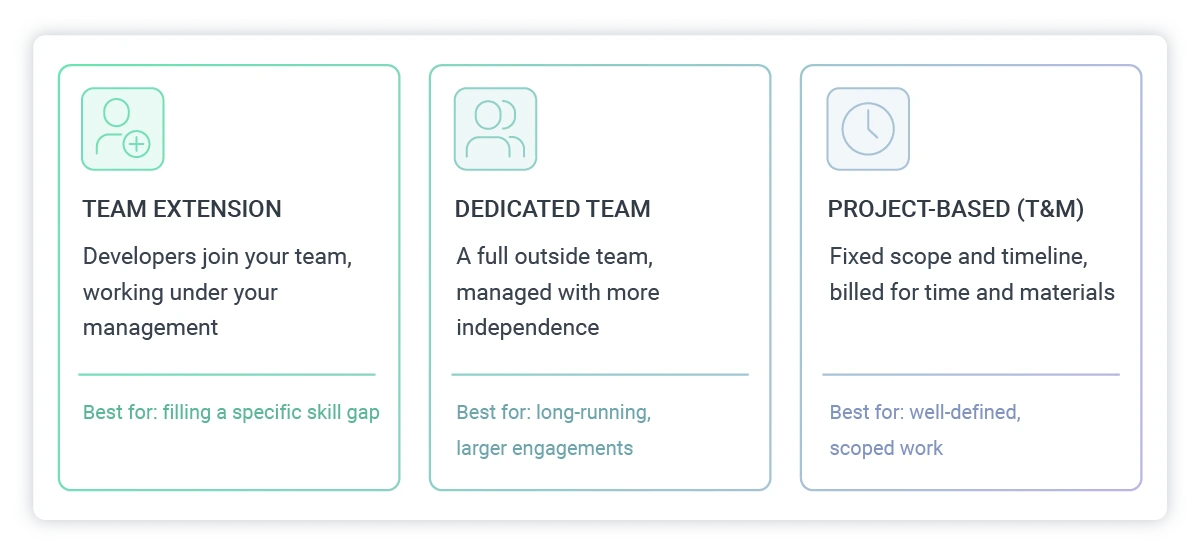
The engagement model you choose shapes both the cost and the working relationship more than location does. The three most common structures for Java work:
- Team extension: outsourced Java developers join your existing team and work under your processes and management. This model fits companies that already have a strong engineering culture and just need more hands, or specific expertise like Kafka or cloud-native Java that the current team doesn't have.
- Dedicated team: a full outsourced team, often including a project lead and QA, works exclusively on your project but is managed with more independence than team extension. This tends to fit larger, longer-running engagements like a full modernization project or an ongoing product line.
- Project-based: a fixed scope, timeline, and (usually) budget, handed to an outside team to deliver end-to-end. This fits well-defined work with a clear endpoint, like a single system migration, but carries more risk if the scope shifts partway through.
Rates vary considerably by region, engagement model, and how the number is measured, so treat any single figure as a starting point for a conversation rather than a firm quote. In North America, vetted senior Java engineers and specialized consultants typically run $90 to $115 or more per hour, reaching up to $150/hr for high-scale fintech or cloud architecture work.
Rates drop meaningfully outside North America, though the relationship between price and quality isn't linear. Ukraine and Poland in particular have built a reputation over the past decade for a strong ratio between cost and technical depth, a mature developer ecosystem shaped by decades of engineering-focused higher education, not just a cheaper hourly rate.
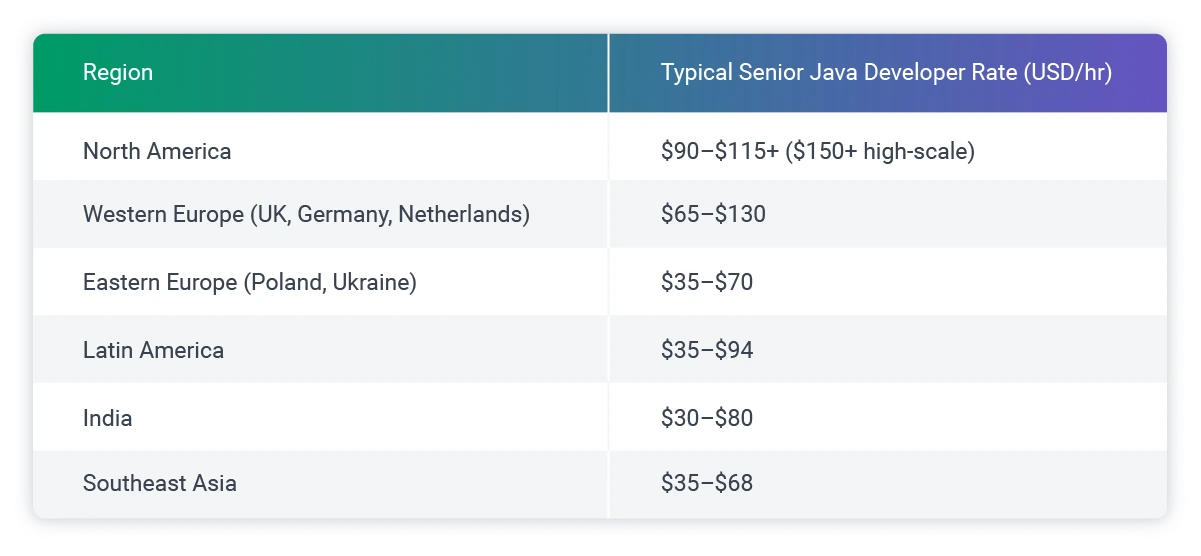
Latin America has become a popular choice specifically for its nearshore advantages: overlapping working hours with US teams, minimal cultural distance, and the ability to join a live standup instead of working entirely asynchronously.
India remains one of the largest and most established outsourcing markets in the world, and rates there are often the lowest on this list. Still, quality varies more widely than in the other regions. The standard working day has little to no overlap with US business hours, which puts more weight on documentation and asynchronous communication than a nearshore engagement would.
Softjourn's own development hubs sit in exactly this Eastern Europe and Latin America band, in Ukraine, Poland, and Brazil, which is part of why these regions come up so often in outsourcing conversations rather than as an abstract comparison.
Whatever the model, the sticker price rarely tells the whole story. In-house hiring carries costs that don't show up in a base salary line: recruitment fees, benefits and payroll tax loading, onboarding time before a new hire is fully productive, and the ongoing cost of replacing people who leave. Outsourcing shifts most of that overhead onto the partner, which is part of why the cost comparison tends to favor outsourcing more than a simple hourly-rate comparison suggests, but it's worth asking any partner directly what's actually included in their rate before comparing numbers.
The Concerns Worth Taking Seriously When Outsourcing Java
The three most common objections to outsourcing often come from a place of truth, but they're also frequently exaggerated or dependent entirely on which outsourcing company you choose. Here are the concerns worth taking seriously:
Code quality and technical debt: This is the most legitimate worry on the list, and the one that determines whether an outsourcing decision pays off two years later. A team that ships working code under deadline pressure but skips documentation, tests, or architectural discipline hands you a system that costs more to maintain than it would have cost to build in-house. The fix isn't avoiding outsourcing; it's vetting for engineering discipline specifically. Ask a prospective partner how they handle code review, what their testing standards look like, and whether they'll walk you through a codebase they've maintained for a year or more, not just one they built and handed off.
Case Study Snapshot: Long-Term Java Maintenance for UPC
After completing UPC's initial banking platform work, Softjourn stayed on to maintain and enhance UPC's Java systems over several years rather than handing off and walking away. That kind of sustained engagement only works when documentation, testing, and communication are built in from the start rather than patched in later. Read More→
IP protection: Contract quality determines almost everything here. A solid agreement should specify who owns the code, what happens to access and credentials when the engagement ends, and how confidential information is handled throughout. Getting counsel involved early is worth the time it takes, since terms are far easier to negotiate before work begins than after a problem surfaces.
Time zone and communication: This concern is real but easy to overstate, and it depends heavily on region. A nearshore team in Latin America or a team in Eastern Europe with a partial overlap window can join live standups and answer questions the same day. A fully offshore team usually can't, which shifts more weight onto documentation and async updates. Neither approach is wrong, but mismatching your team's working style to the region you choose is a more common failure point than language ability or technical skill.
How to Actually Vet an Outsourcing Company’s Java Depth
Most vetting conversations focus on the wrong things: portfolio size, client logos, years in business. Those numbers matter less than whether a team can answer specific, technical questions about how they actually work. A few questions tend to separate a partner worth hiring from one that just talks well:
- Long-term maintenance: ask to see a codebase they've maintained over time, not just one they built. Anyone can demo a clean greenfield project. The harder, more revealing question is how they've handled a system after the initial build, through version upgrades, changing requirements, and the inevitable accumulation of edge cases.
- A migration that went wrong: ask how they've handled one. Every experienced team has a story here, and the answer reveals more about their process than a list of successes ever will.
- QA and code review, in specifics: "we follow best practices" is not an answer. A real one names tools, review cadence, and who signs off before code ships.
- Industry experience, not just Java experience: a team that's built fintech or ticketing systems before understands compliance requirements, transaction integrity, and the edge cases that only show up at scale, the kind of domain knowledge that's harder to outsource than the code itself.
- Responsible AI use in development: AI-assisted coding is now the norm rather than the exception; in Deloitte's 2024 Global Outsourcing Survey, 83% of executives reported their outsourced services already involve AI in some form. Ask how a prospective partner uses AI in their workflow, and just as importantly, how they review and validate AI-assisted code before it ships. A team with no answer here is likely behind. A team with no review process for it is a bigger concern than a team not using AI at all.
Softjourn's work with an expense management client shows what this looks like in practice. The team built a custom Java comparison tool to validate an Elasticsearch upgrade from version 2.3.4 to 7.9, processing more than 500,000 search queries with a 0.02% error margin before the client would sign off on the launch. That kind of rigor, verifying the work before asking a client to trust it, is exactly what a vetting conversation should be trying to surface before a contract is signed, not after.

Final Word: To Outsource or Not?
The decision to outsource Java development doesn't have to be all or nothing, and it doesn't have to be permanent. The companies that get the most value from it are usually the ones that treat it as a tool for specific work, execution, migrations, specialized capacity, rather than a wholesale replacement for an internal team.
Java isn't going anywhere, and neither is the gap between generalist availability and specialized expertise that started this conversation. The question worth answering isn't whether outsourcing works. It's whether the partner you choose has the technical discipline, industry context, and communication habits to make it work for your specific system.
Softjourn has spent more than two decades building and maintaining Java systems for fintech and ticketing platforms, the same kind of high-stakes, long-lived systems this guide has been talking about throughout. Our senior Java engineers bring dozens of projects' worth of hands-on experience to every engagement, backed by mid-level and junior developers, QA, and specialists across other languages when a project calls for it. Contact Softjourn to talk through your specific Java project and see whether outsourcing, done the right way, makes sense for your team.