
TypeScript in 2026: Why It's No Longer Optional for Serious Projects
TypeScript's dominance isn't a passing preference or a developer fad; it's a structural shift, and the window for treating it as optional is closing.

In August 2025, TypeScript surpassed both Python and JavaScript to become the most-used language on GitHub, with 66% year-over-year growth.
It now ranks as the 5th most admired programming language on Stack Overflow's 2025 developer survey, the 3rd most popular language on GitHub’s The State of the Octoverse Survey, and the 3rd most popular language for AI projects. On modern job postings, TypeScript is increasingly listed as a required skill rather than a nice-to-have.
Those numbers would be notable on their own. What makes them worth paying attention to is what's happening underneath: the JavaScript ecosystem has structurally committed to TypeScript. Frameworks default to it, runtimes now execute it natively, the compiler is being rewritten for 10x performance, and the one thing that could have made TypeScript unnecessary (native static typing in JavaScript itself) isn't coming.
This article makes a specific argument: TypeScript's position in 2026 isn't a trend. It's permanent. And if your team, your hiring practices, or your vendor requirements haven't caught up, the gap is growing.
For a broader view of the JavaScript ecosystem in 2026, including where TypeScript fits alongside other major shifts, see our companion article: The State of JavaScript in 2026: What's Changed and What It Means for Your Product.
Why This Shift Is Permanent, Not Cyclical
Technology preferences come and go. CoffeeScript was popular once, and so was jQuery. A reasonable person could look at TypeScript's growth and ask: is this just another cycle?
We believe it's not, and the reason is structural.
The most requested feature in the annual State of JavaScript survey, year after year, is native static typing in JavaScript itself. If that ever shipped, it would significantly reduce the case for TypeScript. But it hasn't shipped, and it almost certainly won't anytime soon.
Native type annotations are not part of the ECMAScript 2026 specification. The TC39 committee (the body that governs JavaScript's development) has shown no indication of moving a static typing proposal to an advanced stage. Given the committee's track record on major language changes, most observers don't expect native typing before 2028 at the earliest, if ever.
That matters because it means TypeScript isn't a temporary bridge until JavaScript catches up. Because it's unlikely JavaScript will ever catch up. TypeScript is the solution the industry has settled on, and the ecosystem is building around that assumption.
Consider how deeply frameworks have committed:
- Next.js, Angular, Nuxt, and SvelteKit all generate TypeScript configurations by default when you start a new project
- Node.js can now execute TypeScript files directly without a compilation step, thanks to native type stripping (stable as of Node 22.18)
- The TypeScript compiler itself is being rewritten in Go (Project Corsa), with version 7.0 expected mid-2026 and early benchmarks showing roughly 10x speed improvements
- Every major JavaScript framework now ships with first-class TypeScript support, not as an afterthought but as the assumed default
When the runtimes, the frameworks, the build tools, and the package ecosystem all orient around a single direction, the window for that direction to reverse effectively closes.
TypeScript vs. JavaScript in 2026: Why the Debate Is Already Over
The "TypeScript vs. JavaScript" comparison still generates plenty of search traffic, but the framing itself is starting to feel outdated. In 2026, choosing plain JavaScript for a new professional project is increasingly treated as a legacy decision, similar to how manual spreadsheet reporting feels in a company that's already adopted BI dashboards. It still works, and nobody will stop you. But it signals that a team or codebase hasn't kept pace.
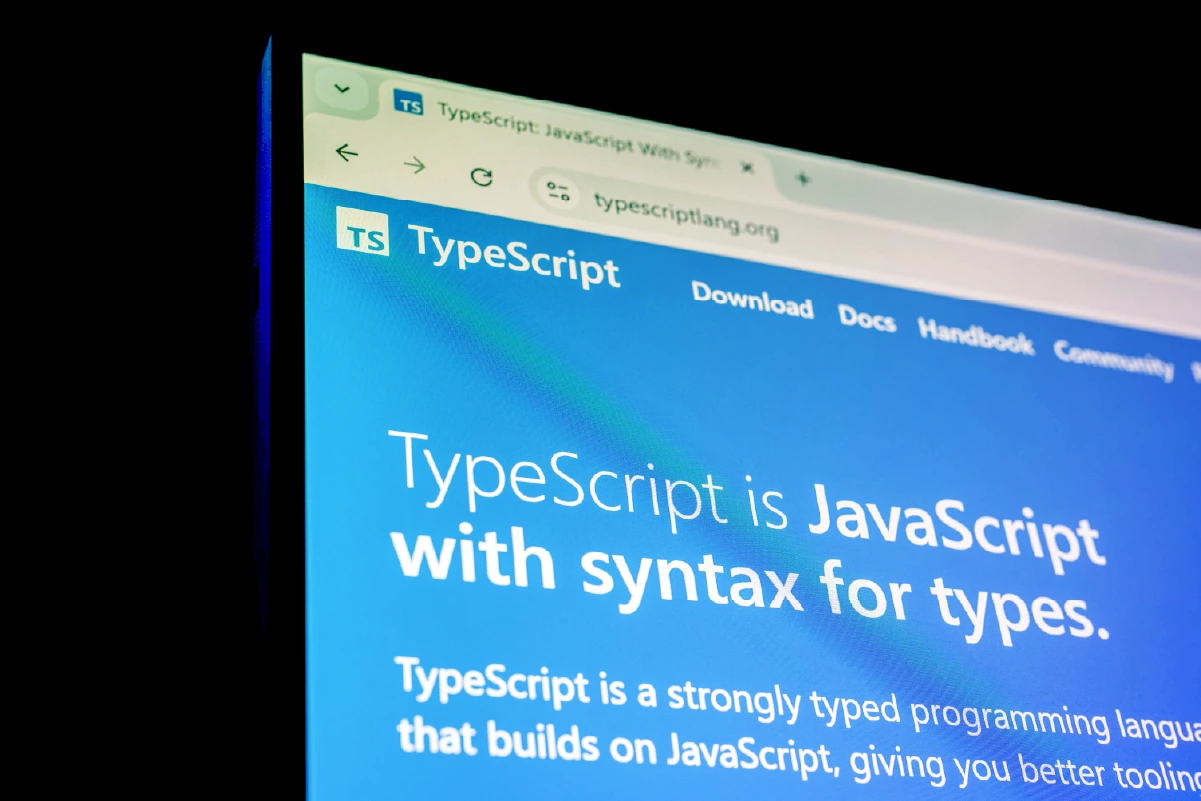
That said, this isn't about JavaScript being "bad." TypeScript is a superset of JavaScript: every TypeScript program compiles down to JavaScript, and the browser still executes JavaScript at runtime.
The question was never "TypeScript or JavaScript." It was whether you want type safety checking your work before your code reaches production, or whether you're comfortable catching those errors later (usually at higher cost, usually at a worse time).
In 2026, the industry answered that question decisively. Daniel Roe, leader of the Nuxt framework's development team, summed it up after the latest State of JavaScript survey results: "TypeScript has won. Not as a bundler, but as a language."
What This Means for Your Product and Team
If you're a technical leader evaluating how TypeScript fits into your organization, the practical implications are worth spelling out:
- Update your hiring criteria: TypeScript proficiency is a baseline expectation in 2026, not a bonus line on a resume. If your job descriptions still list it as a "nice to have," they're out of step with the talent market. Candidates without TypeScript experience likely haven't worked on a modern production codebase recently.
- Think about codebase longevity: Static typing reduces a specific, expensive category of production bugs: the kind where one part of the application sends data in a format another part doesn't expect. On large teams or long-lived products, those bugs are among the most time-consuming to diagnose because the root cause and the visible symptom can be far apart. Over a product's lifetime, TypeScript pays for itself in lower maintenance costs and fewer surprise debugging sessions.
- Evaluate your vendors and partners: If a development partner delivers JavaScript without TypeScript in 2026, ask why. There are occasionally valid reasons (very small scripts, rapid prototypes, specific runtime constraints), but for any substantial application, it should raise questions about how current the team's practices are. Softjourn's engineering teams have worked with TypeScript across fintech, ticketing, and enterprise platforms, and it's a standard part of how we build and evaluate codebases.
- Factor in AI-assisted development: TypeScript and AI code generation tools are a strong pairing. Type annotations give AI models more context about what code is supposed to do, which means generated output is more accurate and easier to verify. Teams using TypeScript get more value from tools like GitHub Copilot than teams working in untyped JavaScript. When AI generates code, you need something to verify it actually works. TypeScript gives you that verification layer.

The Honest Tradeoffs (And Why They're Shrinking)
TypeScript is not without costs, and pretending otherwise would undermine the argument. The real tradeoffs are worth acknowledging:
There's a learning curve: Developers coming from plain JavaScript need time to get comfortable with type annotations, generics, and the occasional type error message that reads like a riddle. For most developers, this takes one to two months of regular use to feel natural.
Complex type patterns can get unwieldy: Advanced generics and utility types can produce code that's harder to read than the JavaScript equivalent. The best teams treat this as a code review concern: if a type definition is harder to understand than the bug it prevents, simplify it.
There's historically been a build step: TypeScript required compilation to JavaScript before it could run. This added friction and configuration overhead, particularly for small scripts and quick prototypes.
Here's why these costs matter less in 2026 than they did even two years ago:
Node.js now runs TypeScript files directly, eliminating the build step for server-side code. The upcoming Go-based compiler (TypeScript 7.0) will make type-checking roughly 10x faster on large projects, removing the "slow compiler" complaint for good.
Modern IDE support (VS Code in particular) handles most type inference automatically, so developers write fewer explicit type annotations than they used to. And AI coding assistants are surprisingly good at writing TypeScript, which flattens the learning curve for developers who are new to it.
The cost-to-benefit ratio has shifted decisively. The tradeoffs are real but well-understood, and the tooling has matured to the point where they're manageable for virtually any team.
The Bottom Line
The question for technical leaders in 2026 isn't "should we adopt TypeScript?" It's "can we justify not using it?"
For most professional projects, the answer is no. The ecosystem has committed, the talent pool has moved, and the tooling has matured. Plus, the one thing that could have changed the equation (native typing in JavaScript) isn't on the horizon.
If your team is building or maintaining JavaScript-based products and TypeScript isn't yet the standard, now may be the time to make the transition. And if you're evaluating development partners, TypeScript fluency is one of the clearest signals of a team that's keeping pace with where the industry actually is, not where it was three years ago.
Softjourn's engineering teams build with TypeScript across fintech platforms, ticketing systems, and enterprise applications. If your organization is navigating this transition or evaluating its JavaScript strategy, contact Softjourn to start the conversation.