-1920x1080.webp?v=1787580716468)
7 Questions to Ask Development Team Vendors
Finding the right development team model has less to do with a vendor's pitch deck and far more to do with asking the right questions before you sign.

Finding the right development team model has less to do with a vendor's pitch deck and far more to do with asking the right questions before you sign.
The question most buyers wish they'd spent more time on isn't "can you build this."
It's "what happens to this relationship once the contract is signed." Staff augmentation, a dedicated development team, and project-based outsourcing can all be described in nearly the same language during a sales call, right up until something goes wrong, and the difference in the contract becomes the difference in who is responsible for fixing it.
The fix isn't a longer RFP. It's a shorter list of sharper questions, asked before signing rather than after the first sprint goes sideways.
This article builds on topics from our Guide to Hiring Dedicated Development Teams, which covers how to compare development team models against your project's timeline, what to look for when vetting a longer-term partner, and how to structure the contract once you've made a decision.
What Development Team Models Actually Change
Before the questions matter, the terms need to mean something specific. Vendors use "dedicated team," "staff augmentation," and "outsourcing" almost interchangeably in early conversations, but each one changes who directs the work, who owns the outcome, and what happens when the engagement winds down.
- Staff augmentation: individual specialists join your existing team and report into your existing management structure. Your project managers direct the work day to day, and the vendor is mainly responsible for sourcing and retaining the people.
- Dedicated development team: a vendor assembles a group that works exclusively on your project, typically with its own project manager or team lead, who combines your product direction with the vendor's delivery process and technical oversight.
- Project-based outsourcing: the vendor owns delivery of a defined scope from start to finish, and you evaluate the output rather than manage the process that produced it.
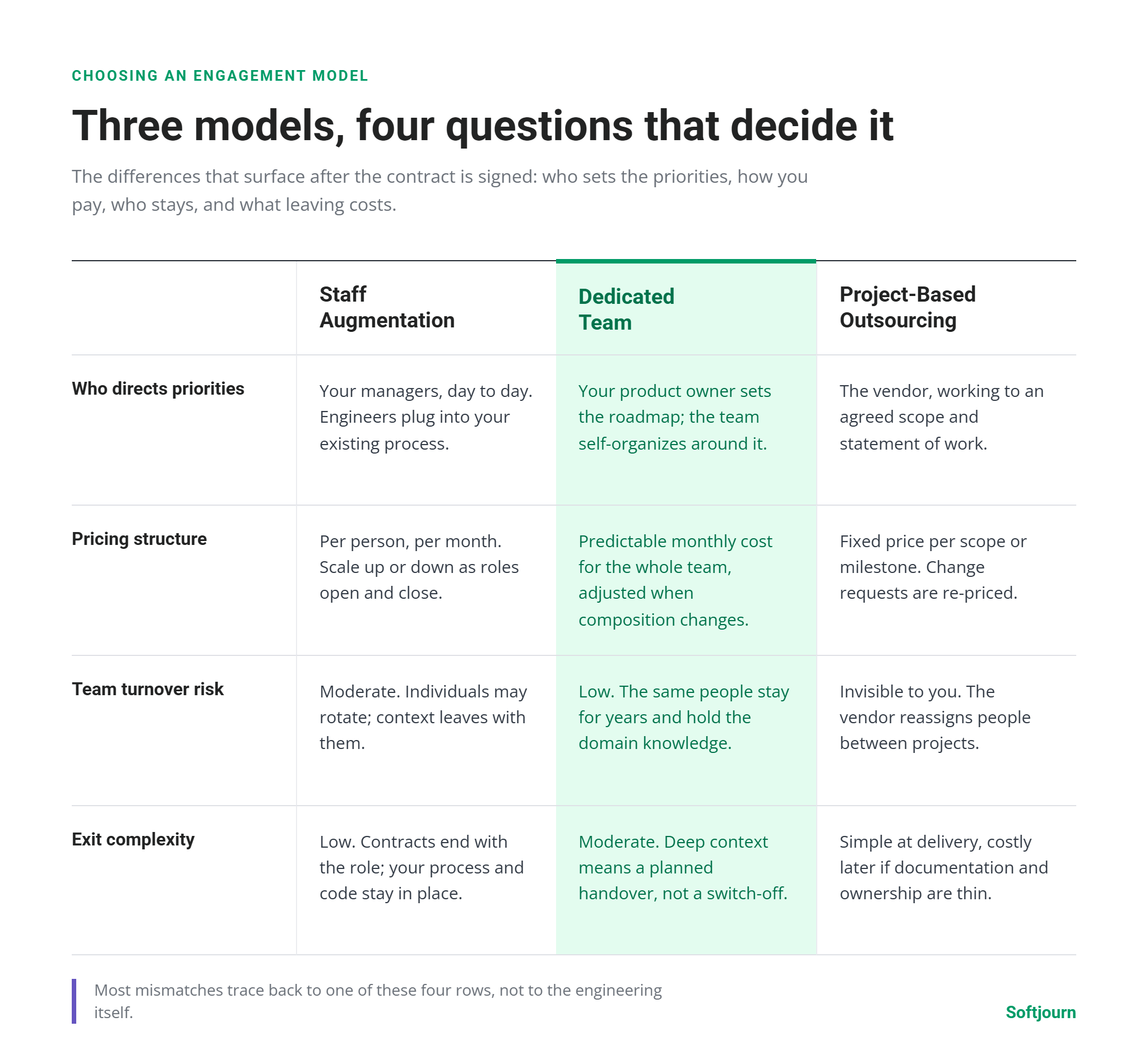
None of those definitions survive a first sales call fully intact, which is exactly why the seven questions below matter more than the label on the proposal.
Question 1: Who Sets the Daily Priorities?
This is the fastest way to tell staff augmentation apart from a dedicated team, and vendors answer it less directly than you'd expect. In staff augmentation, your own project manager should be running standups and assigning tickets.
In a dedicated team model, that role usually sits with someone on the vendor's side, working from a roadmap you set but managing sprint mechanics independently.
Neither answer is wrong. What's wrong is not knowing which one you're getting until three months in, when you discover you're paying dedicated-team rates for people who still need daily direction from your own managers, or paying for staff augmentation flexibility while the vendor quietly runs the whole process without your input.
Follow-up questions to ask:
- "Who runs our daily standup, your side or ours?"
- "If our product manager and your team lead disagree on priority, whose call is it?"
Question 2: How is Pricing Structured, and What Changes It?
Staff augmentation is usually priced per person, per hour or per month, which makes cost scale in a straight line with headcount.
A dedicated team is often priced as a team rate that includes a project manager, QA, and sometimes an architect, which means the sticker price looks higher even when the effective cost per output is lower. Project-based outsourcing is typically fixed-bid, which shifts the risk of underestimating the work onto the vendor rather than you.
Follow-up questions to ask:
- "What specifically causes this price to change: added headcount, added scope, or a rate review at renewal?"
- "Is there a minimum commitment period, and what does early exit cost?"
A Note on Pricing Conversations
A vendor that can explain what moves the price in one sentence has a pricing model simple enough to manage. A vendor whose answer requires a follow-up call, or shifts to talking about "value" instead of mechanics, has a pricing model that will surprise you later. This is worth pressing on even when the number itself looks reasonable, since the structure behind the number is what determines whether costs stay predictable.
Question 3: What Happens When the Scope Shifts Halfway Through?
Scope rarely stays fixed for the life of an engagement, and how a vendor handles that tells you more about the actual model than the contract's cover page does.
Follow-up questions to ask:
- "Is a scope change handled through a change order, a rate adjustment, or absorbed into the existing team's capacity?"
- "Who has the authority to approve a scope change, on our side and on yours?"
- "How long does it typically take between requesting a change and seeing it reflected in the sprint plan?"
A project-based outsourcing vendor should have a formal, fairly rigid change order process, because that rigidity is what makes the fixed price possible in the first place. A dedicated team vendor should be able to absorb moderate scope shifts without a formal change order at all, since flexibility is part of what you're paying for.
Question 4: How Is the Team Assembled, and Can We Meet Them First?
For a dedicated team engagement especially, this question separates vendors who are staffing your project from vendors who are staffing their bench. Ask whether the people proposed are already identified individuals or a description of a role that will be filled after signing.
Case Study: A Team That Grew With the Client, Not Around Them Tacit, a food ordering platform, started with a small Softjourn team of three developers in 2013. Over a decade of continuous partnership, that dedicated team grew to twenty people across server, mobile, web, and QA, expanding in step with what Tacit's platform actually needed at each stage. "They are my team," said Brenda Crainic, Tacit's CTO and co-founder, "and I count on them as if we were all working in the same office." Read the full case study →
Follow-up questions to ask:
- "Can we interview the actual engineers before we sign, not just review resumes?"
- "If we're not satisfied with someone proposed, how quickly can that change?"
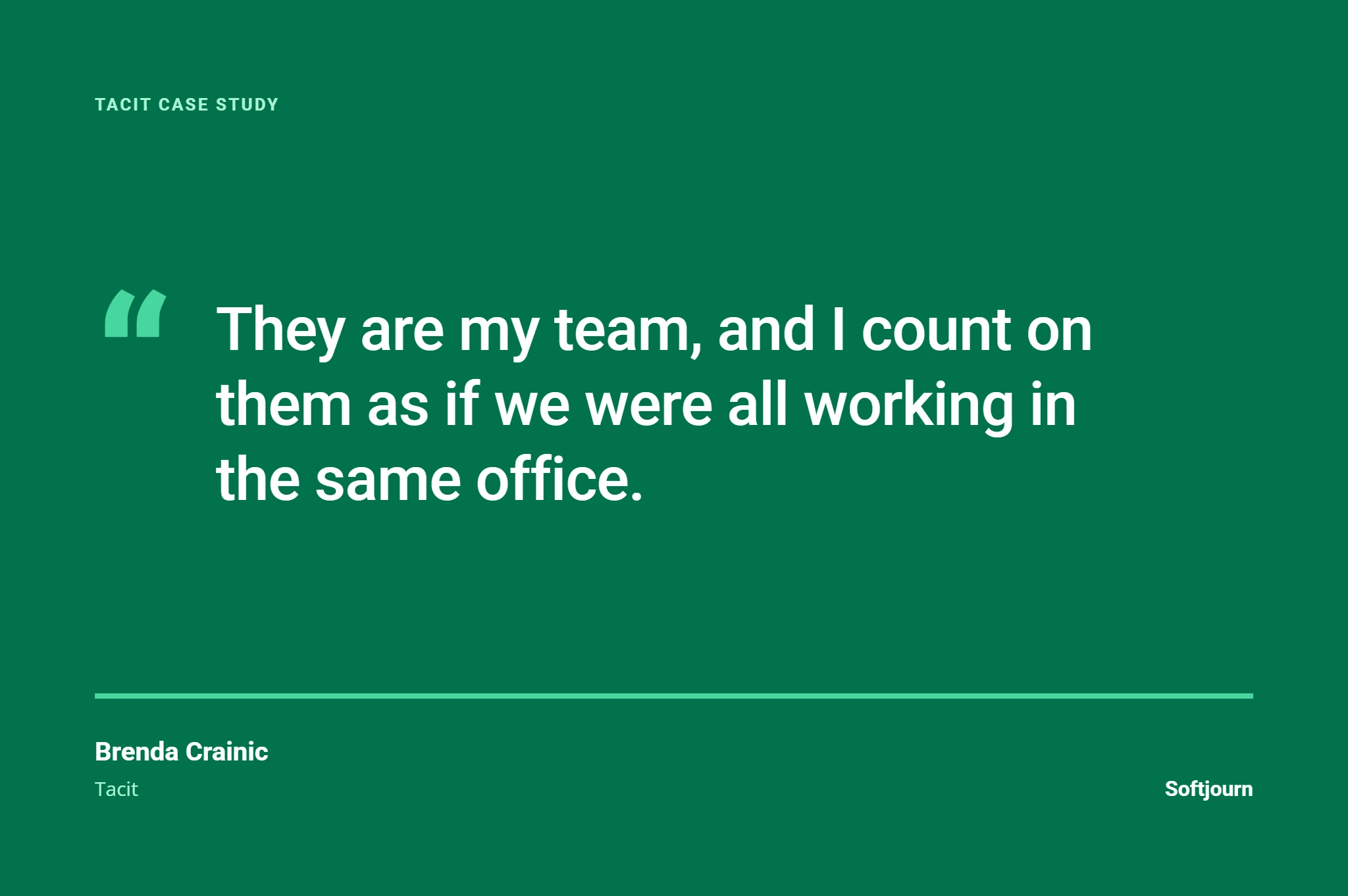
That kind of continuity doesn't happen by accident. It happens because the vendor treated team assembly as a long-term staffing decision from the start, rather than a placeholder to fill once the contract was signed.
Question 5: What Happens When Someone on the Team Leaves?
Every engagement eventually loses a team member to attrition, and the honest vendors have a specific answer ready rather than a general reassurance.
Follow-up questions to ask:
- "What's the average tenure on your similar long-term engagements?"
- "How much notice will we get before a transition, and what does the handoff include?"
A vague answer here, something like "we handle that internally, don't worry about it," is worth pressing on directly, regardless of which model you're evaluating.
Question 6: What Does Ramp-Up Actually Look Like?
Staff augmentation specialists often need to learn your codebase and internal tools before they're fully productive, since they're joining your existing process rather than bringing one with them. A dedicated team, especially one with an established internal process, may ramp faster on process but slower on domain knowledge specific to your business.
Follow-up questions to ask:
- "Based on engagements of similar complexity, what week does this team typically reach full velocity?"
- "What do you need from us in the first two weeks to make that timeline realistic?"
Vendors with real delivery history can usually answer both with a range grounded in past projects. A vendor who answers "day one" to either question is selling a pitch, not a plan.
Question 7: What Does the Exit or Transition Look Like?
This question gets skipped more often than any other, mostly because nobody wants to plan for the end of a relationship before it's begun. It matters most.
For staff augmentation, exit is usually straightforward: individuals roll off, and knowledge transfer is limited to whatever they personally built. For a dedicated team, exit is more consequential, because the team may hold a meaningful share of your product's institutional knowledge.
Follow-up questions to ask:
- "What notice period applies if either of us wants to end this engagement?"
- "Is documentation maintained continuously, or only pulled together at offboarding?"
- "Would you support a transition to our internal team or a different partner if that became necessary?"
Which Development Team Model Should You Choose?
None of these seven questions has a universally correct answer. What matters is whether the vendor's answers are specific and consistent with each other. A vendor that describes flexible, informal scope changes but also insists on a rigid change-order process for pricing is describing two different models at once, and that inconsistency is worth raising directly.
Certain answer patterns tend to cluster together:
- Answers pointing to your own team directing daily work, per-person pricing, and a light exit process usually describe staff augmentation.
- Answers pointing to vendor-led sprint management, team-based pricing, and a more involved transition plan usually describe a dedicated development team.
- Answers pointing to a fixed price, a formal change-order process, and delivery of a finished output usually describe project-based outsourcing.
When the second pattern shows up, especially alongside a project expected to run a year or longer with an evolving roadmap rather than a fixed spec, that combination is a reasonable signal that a dedicated team model fits better than the alternatives.
Our full guide to hiring a dedicated development team walks through that decision in more depth, including how to size the team by project stage and what a healthy long-term partnership looks like once it's underway.
Comparing a vendor's answers against these three patterns, rather than against their marketing language, is what actually resolves the staff augmentation vs. dedicated team question in practice.
Ready to Choose the Right Development Team Model?
The questions in this article aren't a formality to get through before the real conversation starts. They are the real conversation. A vendor's answers, and how specific those answers are, tell you more about which development team model you're actually being offered than any label in the proposal.
Contact Softjourn to get started on a vendor conversation that gives you real answers to these questions from the first call - explore our dedicated development team services.
If you're looking for more guidance, explore our Complete Guide to Hiring Dedicated Development Teams.