
Is .NET Still Relevant in 2026? A Strategic Analysis for Business Leaders
A business leader's guide to evaluating .NET for enterprise applications in 2026

While technology trends come and go, some platforms quietly power the world's most critical systems, and .NET is one of them. But as a business leader evaluating your technology stack, you're right to question whether a framework that's been around since 2002 still makes strategic sense for your organization's future.
The answer might surprise you. While many startups chase the newest frameworks, Fortune 500 companies and enterprises are doubling down on .NET.
Not because it's trendy, but because it delivers measurable business value: lower costs, faster development, enterprise-grade security, and seamless AI integration.
Let's cut through the hype and trends to examine what actually matters when selecting your tech stack: costs, security, scalability, AI readiness, and how .NET compares to the alternatives.
The Evolution of .NET: From Windows-Only to Enterprise Standard
When Microsoft introduced .NET in 2002, it was primarily a Windows-centric framework. Today's .NET is fundamentally different. The platform has transformed into an open-source, cross-platform powerhouse that runs on Windows, macOS, Linux, and mobile devices. This evolution isn't just technical. It represents a strategic shift that aligns with how modern businesses operate.
The results speak for themselves: 34.2% of all websites and web applications run on the .NET framework, making it one of the most preferred and utilized development platforms among Fortune 500 companies.
Why Business Leaders Should Care About .NET in 2026
1. Total Cost of Ownership and Resource Efficiency
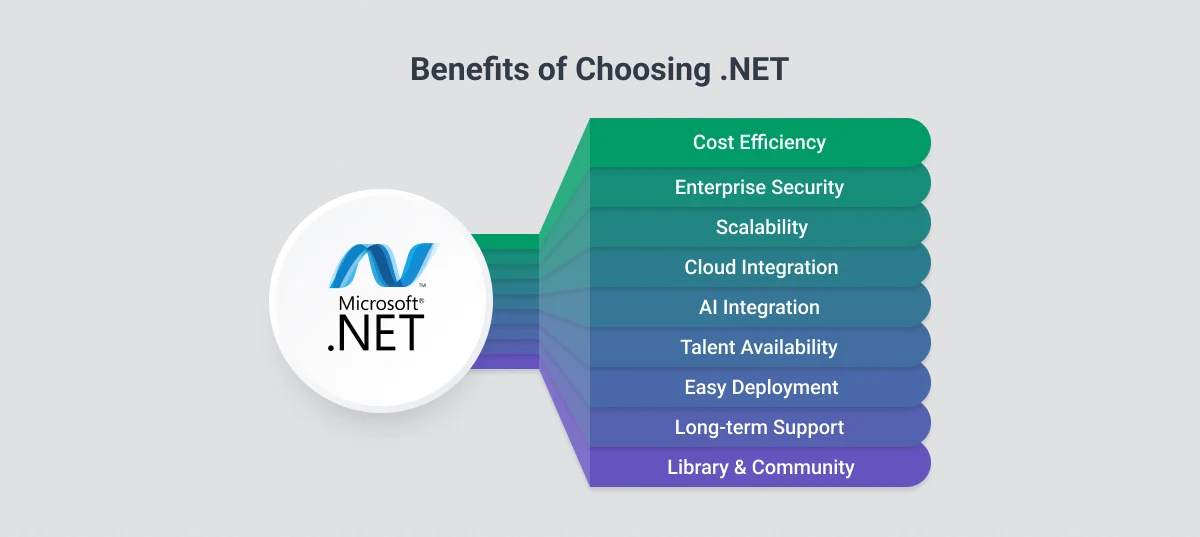
Budget optimization remains a top priority for every organization. .NET delivers compelling cost advantages that directly impact your bottom line:
Development efficiency: Cross-platform capabilities mean your team writes code once and deploys everywhere: Windows, macOS, Linux, web, and mobile. This dramatically reduces development time and costs compared to maintaining separate codebases for each platform.
Talent utilization: Your existing development teams can build modern applications using familiar tools and languages. There's no need to hire specialized teams for different platforms, reducing both recruitment costs and knowledge silos.
Infrastructure optimization: .NET's cloud-native design and container support enable efficient resource utilization, directly lowering operational expenses.
Long-term maintenance: The unified framework simplifies maintenance, updates, and technical debt management. These factors often consume the majority of IT budgets in mature organizations.
2. Enterprise-Grade Security and Compliance
In an era where data breaches cost organizations an average of $4.4 million per incident, security cannot be an afterthought. .NET provides security advantages that matter to board-level discussions:
Built-in security frameworks: Authentication, authorization, data encryption, and secure communication protocols are native to the platform, not afterthoughts requiring third-party solutions.
Compliance support: .NET aligns with major regulatory standards, including SOC 2, ISO 27001, GDPR, and HIPAA. For regulated industries like healthcare, finance, and government, this compliance support reduces audit complexity and risk exposure.
Regular security updates: Microsoft's commitment to the platform ensures continuous security patches and vulnerability management. This is critical for maintaining secure operations without dedicating extensive internal resources.
3. Scalability That Grows With Your Business
Today's successful application may serve thousands of users; tomorrow it might need to handle millions. .NET's architecture supports this growth without requiring complete rewrites:
Horizontal scalability: Applications can scale across multiple servers and cloud instances seamlessly, ensuring performance remains consistent as demand increases.
Microservices architecture: .NET excels at building modular, independently deployable services. This means you can update specific business capabilities without disrupting entire systems. This capability is crucial for maintaining continuous operations while innovating.
Performance under pressure: From e-commerce platforms handling Black Friday traffic to financial systems processing millions of transactions, .NET applications maintain reliability when it matters most.
4. Seamless Cloud Integration and Digital Transformation
Cloud computing isn't the future. It's the present. Organizations that haven't migrated are falling behind competitors who leverage cloud agility:
Native Azure integration: .NET applications deploy effortlessly to Microsoft Azure, but also support AWS, Google Cloud, and hybrid environments. This flexibility prevents cloud vendor lock-in while maintaining operational efficiency.
Reduced migration complexity: For organizations with existing Microsoft investments (Office 365, Active Directory, SQL Server), .NET applications integrate seamlessly, significantly reducing digital transformation complexity and risk.
DevOps and automation: Modern .NET fully supports continuous integration/continuous deployment (CI/CD) pipelines, enabling faster releases, better quality, and reduced time-to-market.
5. AI and Machine Learning Integration: The 2026 Advantage
Artificial intelligence has moved from experimental to essential. It's likely that in 2026, organizations that successfully integrate AI will realize efficiency improvements across operations. .NET can help with this:
Generative AI capabilities: .NET now features native integration with OpenAI and Azure OpenAI APIs. This enables businesses to embed conversational interfaces, intelligent automation, and advanced content generation directly into applications without complex integrations.
ML.NET framework: Your development teams can build and deploy machine learning models without requiring specialized data science teams for every project. This democratization of AI enables faster innovation at lower cost.
Semantic Kernel and AI orchestration: Microsoft's Semantic Kernel connects .NET applications with large language models, memory stores, and vector databases. This allows businesses to create AI agents that reason, plan, and act autonomously.
Practical business applications: From fraud detection and customer churn prediction to intelligent document processing and personalized user experiences, .NET provides the foundation for AI that drives measurable business outcomes.
6. Talent Availability and Market Demand
Technology investments must consider human capital. Can you find qualified professionals? Will this skill remain valuable? For .NET, the outlook seems good:
Strong job market: .NET developers remain in high demand across startups and Fortune 500 companies. This demand indicates the platform's continued business relevance and ensures talent availability for your initiatives.
Established talent pool: Unlike emerging frameworks with scarce expertise, .NET boasts millions of experienced developers globally. This mature talent market provides competitive hiring options and reduces recruitment risk.
Career path stability: Professionals investing in .NET skills see stable, well-compensated career paths. This makes it easier to attract and retain top talent compared to niche or unstable technologies.
7. Microsoft's Continued Investment: A Signal for Decision-Makers
When evaluating technology platforms, examine the vendor's commitment. Microsoft's actions speak clearly:
Consistent innovation cycles: Microsoft releases a new .NET version every November with performance improvements and modern features. Currently supported versions include .NET 8 (supported until November 2026) and .NET 9 (supported until November 2026), with .NET 10 arriving in November 2025, and .NET 11 projected to arrive in November 2026.
Long-term support: Microsoft provides either 2 or 3 years of guaranteed support for each release, giving organizations stable, predictable upgrade paths. Microsoft also provides extended support cycles (3+ years) for LTS (Long-Term Support) versions, giving organizations predictable upgrade paths and investment protection.
AI-first development: Recent releases prioritize seamless integration of generative AI capabilities, positioning .NET at the forefront of the AI transformation businesses are navigating in 2026.
Open-source commitment: The entire .NET platform is open-source, fostering innovation, community contribution, and preventing vendor lock-in. This is rare for enterprise-grade platforms.
.NET vs. Other Enterprise Platforms: A Strategic Comparison
When evaluating .NET against alternative platforms, business leaders need to understand the strategic trade-offs. Here's how .NET compares to other major enterprise development platforms in 2026:
Key Comparisons for .NET:
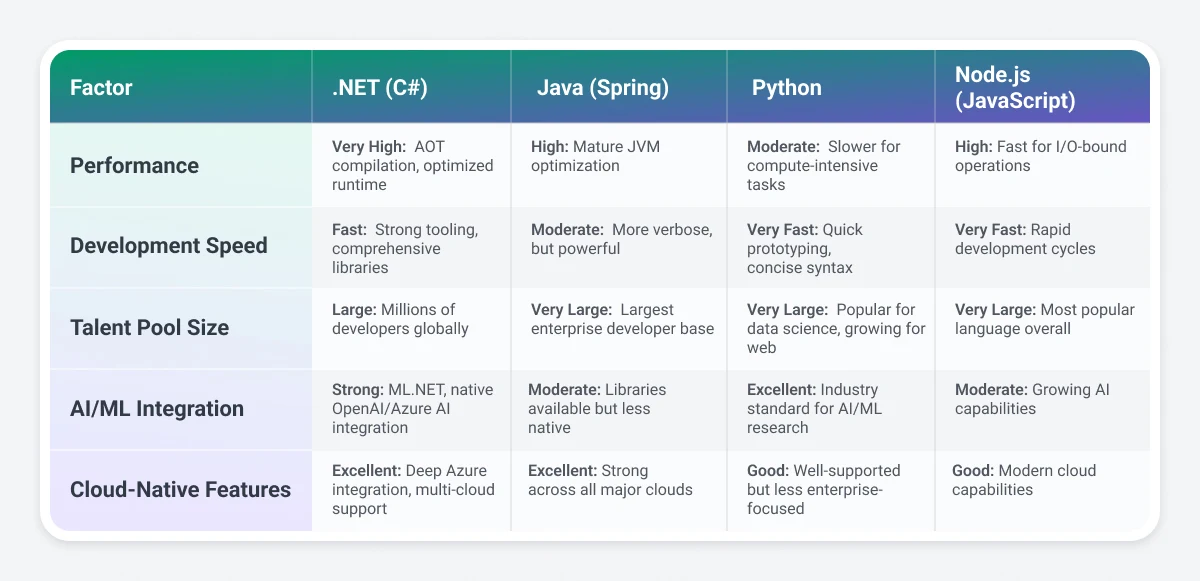
Choose .NET when: You need enterprise-grade security, compliance support, excellent performance, strong AI integration, and seamless Microsoft ecosystem compatibility. It's ideal for organizations building long-term, scalable applications with predictable costs.
Consider Java when: You need maximum platform independence, have existing Java investments, or work in highly regulated industries with decades-old Java systems requiring integration.
Consider Python when: Your primary focus is data science, AI/ML research, or rapid prototyping. Python excels in experimental AI but .NET is superior for productionizing AI solutions.
Consider Node.js when: You're building modern, real-time web applications with JavaScript-heavy frontends and want a unified language across your stack. Less ideal for compute-intensive enterprise systems.
Strategic Considerations: Making the Right Choice for Your Organization
Beyond feature comparisons, successful technology decisions require honest assessment of your specific context:
- What is the condition of your existing technology stack and how much technical debt are you carrying?
- Do you have existing Microsoft investments (Office 365, Azure, SQL Server) that would benefit from tighter integration?
- What is your team's current skill set and capacity for learning new technologies?
- Does .NET support your digital transformation, cloud strategy, and innovation goals?
- What is your 3-5 year cloud strategy, and which providers are you committed to?
- How critical is AI integration to your competitive positioning and does it fit your innovation roadmap?
- What is your total cost of ownership, including development, maintenance, infrastructure, and opportunity costs?
- Can you quantify the business impact of faster time-to-market versus lower development costs?
- Are you in a regulated industry where built-in compliance frameworks provide significant value?
- What are your security requirements and operational reliability expectations?
The Cost of Inaction
Sometimes the right question isn't whether to adopt .NET, but what you risk by not modernizing:
- Competitive disadvantage: Organizations running legacy systems face higher operational costs, slower innovation cycles, and difficulty attracting modern talent.
- Technical debt accumulation: Delaying modernization increases future migration complexity and cost. IBM reports that fixing errors found after product release costs four to five times more than those uncovered during design, and up to 100 times more than those identified in the maintenance phase.
- AI readiness gap: Platforms without robust AI integration capabilities leave organizations unprepared for AI-driven competition that's already reshaping industries in 2026.
- Talent retention challenges: Top developers seek opportunities with modern, relevant technologies. Legacy platforms make recruitment and retention increasingly difficult.
Real-World Business Applications in 2026
.NET powers critical systems across industries, demonstrating proven business value:
- Financial services: Banks and fintech companies rely on .NET for secure, high-performance transaction processing, regulatory compliance, and real-time analytics.
- Healthcare: Electronic health record systems, patient management platforms, and telemedicine solutions leverage .NET's security and HIPAA compliance capabilities.
- E-commerce and retail: Major retailers use .NET for scalable online platforms that handle peak traffic while maintaining performance and security.
- Manufacturing and IoT: Smart factory systems, supply chain management, and IoT device integration utilize .NET's edge computing capabilities and real-time processing.
- Government and public sector: Mission-critical government services depend on .NET's reliability, security, and compliance features.
- Ticketing and events: Event ticketing systems use .NET to handle massive concurrent user loads during high-demand sales, process secure transactions at scale, and manage real-time inventory across multiple channels while preventing fraud.
Looking Ahead: .NET Beyond 2026
Strategic technology decisions require confidence in long-term viability. Here's what you need to know:
Confirmed release schedule:
- .NET 8 and .NET 9 supported through November 2026
- .NET 10 launching November 2025 (supported through 2028)
- .NET 11 planned for November 2026 (supported through 2028)
- Annual releases continue every November
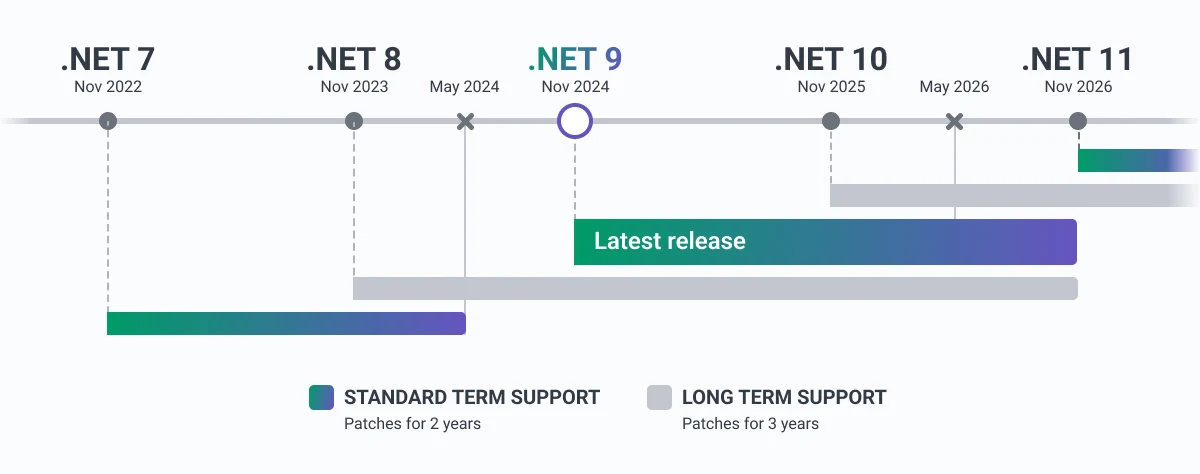
What this means for you: If you invest in .NET today, Microsoft guarantees support through at least 2028, with a clear roadmap extending beyond. No surprise end-of-life announcements or forced migrations.
Two decades of proven commitment: Since 2002, Microsoft has continuously invested in .NET through every technology shift. From Windows-only framework to today's cross-platform, AI-enabled platform, .NET has evolved while maintaining stability. This 20+ year track record is rare in software and provides confidence that investments made in 2026 will remain viable for years to come.
Looking Forward: Microsoft's published roadmap includes continued performance optimization, deeper AI integration, enhanced cloud-native capabilities, and expanded support for emerging computing paradigms.
Industry adoption trends: Major enterprises continue investing in .NET, with growing adoption in AI, IoT, edge computing, and cloud-native scenarios.
Community momentum: An active global community of millions ensures continued innovation, shared knowledge, and available expertise.

.NET: Strategic Relevance Stronger Than Ever
.NET in 2026 is not just relevant. It's strategically positioned as a leader in enterprise software development.
The evidence is clear: Organizations investing in .NET today are building on a stable, innovative, and future-proof foundation that will serve their business objectives well into the next decade. With Microsoft's continued commitment, a thriving ecosystem, and proven enterprise success, .NET stands as one of the most strategic technology choices available to business leaders in 2026.
Ready to explore how .NET can accelerate your digital transformation? Our team of .NET experts specializes in strategic consulting and implementation, helping organizations achieve measurable business value. Contact us to discuss your specific needs and objectives.