The 7 Biggest Challenges Facing Expense Management Platforms in 2026
While new competitors flood the market with AI promises and aggressive pricing, established platforms face different battles: technical debt, integration nightmares, and changing demands from customers.

Your engineering team just spent six months building an AI-powered receipt scanner. Launch day arrives, and three clients ask when you're adding a feature their previous vendor rolled out last quarter. Two more want to know why it doesn't work with their obscure ERP system from 2008.
Welcome to 2026, where table stakes keep rising, and every platform improvement reveals two new problems.
Expense Management Challenges Overview
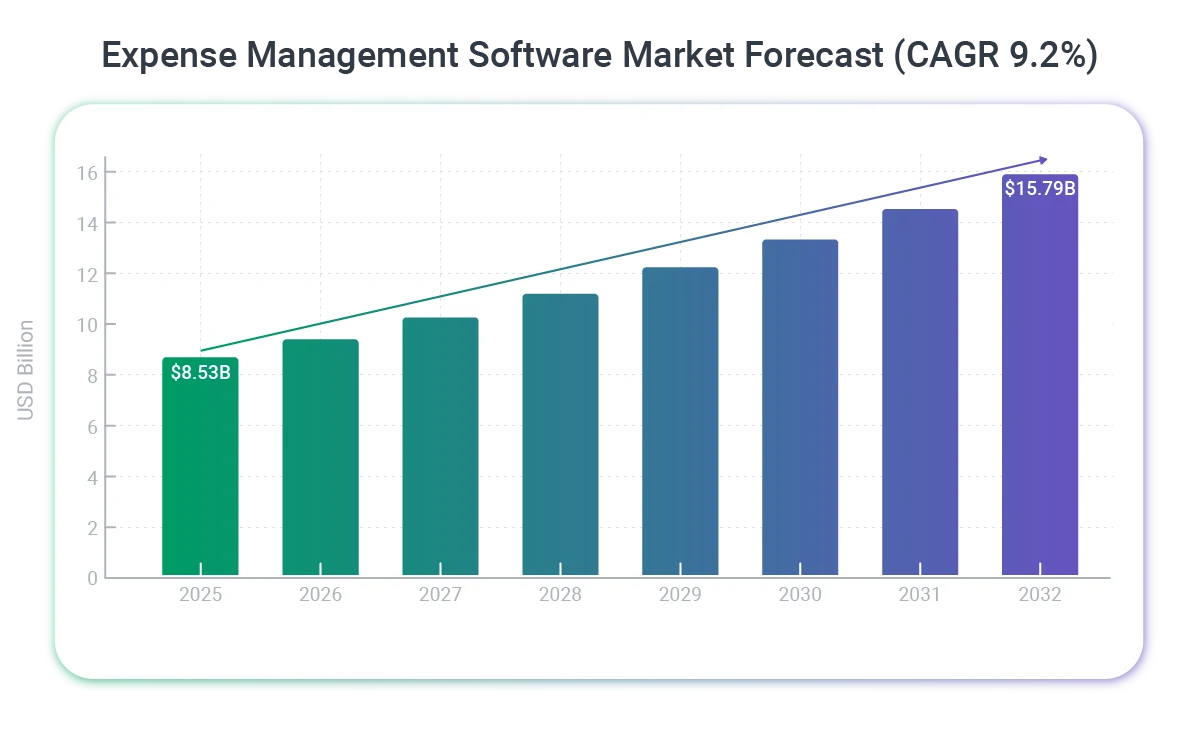
The expense management market is growing faster than ever. According to Research & Markets, the global expense management software market is expected to reach $15.79 billion by 2032, up from $8.53 billion in 2025.1 But this growth brings complexity that would have seemed impossible five years ago.
Platforms now compete against venture-backed startups promising the moon, legacy competitors with decades of enterprise relationships, and clients who want consumer-grade experiences at enterprise-grade security levels.
For product leaders, CTOs, and engineering teams building these platforms, 2026 presents challenges that can't be solved with more developers or faster sprints. These are structural problems that require strategic decisions about where to invest, what to build, and when to partner.
Here are the seven challenges that will define which platforms thrive and which ones struggle to keep up.
1. Technical Debt Isn't Just Old Code Anymore
Most platform leaders understand technical debt. You've got that AngularJS module that everyone's afraid to touch, or the monolithic database that predates your current architecture team. Standard stuff.
The new problem? Technical debt now includes your AI models, your integration architecture, and even your security framework.
Why this matters in 2026:
One major expense management platform we worked with faced end-of-life for both their frontend framework and their Elasticsearch version simultaneously. The migration required coordinating across multiple teams, ensuring zero downtime for thousands of users processing millions of transactions monthly, and maintaining data accuracy throughout the transition.
The solution wasn't just updating code. The platform needed a custom comparison tool to validate search query accuracy across versions, progressive migration strategies to avoid service interruption, and careful coordination with their QA and DevOps teams.

The hidden costs:
- Security vulnerabilities in unmaintained dependencies
- Performance degradation as workarounds pile up
- Developer productivity loss (new engineers spend weeks understanding legacy logic)
- Opportunity cost (engineering time spent on maintenance instead of new features)
Research by Stripe found that engineering teams spend roughly one-third of their time (33%) managing technical debt and maintenance rather than developing new features, representing substantial opportunity costs for platform companies.2
What leading platforms do differently:
They schedule regular modernization cycles instead of waiting for crisis moments. When PEX needed to migrate critical infrastructure, they didn't attempt a big-bang rewrite. Softjourn helped implement progressive migrations and cloud optimizations that maintained service reliability while systematically addressing technical debt.
Set aside 20 to 30% of engineering capacity for continuous modernization. It feels expensive until you compare it to emergency rewrites that halt feature development for quarters at a time.
2. Integration Complexity Has Become an Architectural Problem
Your platform probably integrates with QuickBooks, Xero, and maybe SAP. That's the easy part.
Now your clients want connections to their specific payroll system, their custom-built approval workflow, their specialized travel booking platform, and their procurement software that only twelve companies worldwide use.
The real challenge:
Each integration becomes a long-term maintenance commitment. APIs change, vendors deprecate endpoints, authentication methods evolve, and what you built last year breaks next quarter.
According to the Consortium for IT Software Quality, software failure contributes greatly to revenue loss, amounting to $2.41 trillion in the US.3 For expense platforms, integration failures often look like software failures to clients.

Where platforms get stuck:
Many try to build every integration themselves. This creates three problems:
- Engineering teams become integration specialists instead of platform innovators
- Complex clients require custom connectors that benefit only one customer
- Maintenance burden grows faster than revenue
When one expense management platform wanted to expand beyond their initial accounting integrations, Softjourn helped them build an integration framework that could support both standard connections and client-specific needs. The approach included modular architecture, extensive API documentation, and a partner ecosystem that allowed third parties to build their own connectors.
Strategic options:
- Build an integration marketplace where partners can create connectors
- Invest in API-first architecture that makes integrations easier to maintain
- Partner with specialists for complex or niche systems
- Offer premium integration tiers that justify custom development costs
The platforms winning at integrations aren't those with the longest integration lists. They're the ones where integrations rarely break and new connections don't require six-month projects.
3. AI Implementation: From Novelty to Necessity (Without the Budget to Match)
Every sales deck now mentions AI. The problem? Your clients expect AI to actually work, not just exist.
Receipt scanning with OCR is baseline. Fraud detection is expected. What about context-aware approval routing? Predictive spend analysis? Natural language policy queries?
The expectations gap:
62% of finance leaders surveyed agree that artificial intelligence is an essential tool for managing unexpected expenses and overall expense management.4
AI implementation divides into three categories:
Baseline features (if you don't have these, you're behind):
- Automated receipt data extraction
- Basic duplicate detection
- Policy violation flagging
Competitive features (these differentiate but require investment):
- Context-aware categorization that learns from corrections
- Anomaly detection that understands business patterns
- Intelligent approval routing based on historical decisions
Future features (early movers are testing):
- Conversational interfaces for expense submission
- Predictive budget forecasting
- Automated vendor contract analysis
When Softjourn helped develop automated approval systems for an expense management platform, the goal wasn't just automation but intelligence. The system needed to understand complex approval rules, handle exceptions gracefully, and learn from manager decisions over time.
Where budgets break down:
Building AI features isn't like building standard software. You need:
- Data scientists alongside developers
- Ongoing model training and refinement
- Significantly more testing (AI can fail in subtle ways)
- Explainability features (clients need to understand why AI made decisions)
Practical approach:
Start with one AI feature that solves a painful, measurable problem. Get it working reliably and then expand. Platforms that try to implement five AI features simultaneously often end up with five mediocre experiences instead of one excellent one.
4. Security Expectations vs. Security Budgets
Your platform handles sensitive financial data for thousands of companies. A single breach could destroy client trust you spent years building.
The IBM Cost of a Data Breach Report 2025 found that the global average cost of a data breach decreased to $4.4 million, but 97% of organizations that reported an AI-related security incident lacked proper AI access controls.5
The modern security challenge:
Security isn't just about encryption and firewalls anymore. You need:
- Multi-factor authentication
- Role-based access controls with granular permissions
- Real-time threat monitoring and response
- Regular penetration testing and security audits
- Compliance with multiple frameworks (PCI DSS, SOC 2, GDPR, regional requirements)
- Biometric authentication options
- Zero trust architecture
One expense management platform working with Softjourn discovered vulnerabilities including IDOR (Insecure Direct Object References), during a security assessment. Beyond fixing immediate issues, they implemented advanced SIEM (Security Information and Event Management) systems across their cloud environments, improving both security posture and compliance audit readiness.

Where platforms underinvest:
Many allocate security budget for initial compliance certification but underestimate ongoing costs. Security isn't a project that ends. It's continuous monitoring, regular updates, and constant vigilance as new threats emerge.
Good security should be invisible to clients; they won't praise you for breaches that never happened. But one significant security incident can cost more than a decade of security investment.
Build security into your architecture from the start rather than bolting it on later. The platforms that treat security as a feature cost rather than foundational investment inevitably face expensive retrofits.
5. The Customization Paradox: Everyone Wants It, Nobody Wants to Pay for It
Your largest clients want custom approval workflows, specialized reporting, unique integration requirements, and tailored user experiences. They're willing to pay enterprise prices.
Your mid-market clients want the same customization. They're not willing to pay enterprise prices.
The tension:
According to customer feedback collected by expense platforms, companies choose solutions based on intuitiveness and ease of use. According to Better Cloud, once companies settle on the SaaS solution that meets their criteria, ease of use and integrations are the second and third highest priorities (after security).6 At the same time, these buyers expect the platform to adapt to their specific processes, not the other way around.
Where platforms get trapped:
Some build everything as custom projects, with engineering teams spending time on client-specific features that can't be reused. This means that technical debt accumulates as special cases pile up.
Others refuse all customization. They maintain clean codebases but lose deals to more flexible competitors.
When one major expense management platform needed better configuration capabilities, Softjourn helped build systems that allowed non-technical users to customize rules, create approval workflows, and modify interface elements without developer intervention. This gave clients flexibility without creating maintenance nightmares.
The middle path:
Invest in configurable architecture where customization happens through configuration rather than code changes:
- Rule engines that let clients define approval logic
- Customizable field definitions and reporting structures
- White-label capabilities for branding
- Flexible permission systems
- Modular features that can be enabled per client
This approach costs more upfront but scales better than either extreme. The goal is making common customizations self-service while reserving engineering time for truly unique requirements.
6. Global Operations, Local Compliance Chaos
Your platform works great in the US. Then a client asks about VAT reclaim in the EU, or expense tracking for employees working remotely across five countries, or compliance with local tax laws in markets you've never served.
The compliance web:
Different regions require:
- Different tax calculations and reporting formats
- Varying data residency requirements
- Local payment rails and currency support
- Region-specific privacy regulations (GDPR, CCPA, etc.)
- Industry-specific compliance (PCI DSS everywhere, plus local financial regulations)

The average global expense management platform usually must navigate as many as five different compliance frameworks, not to mention other cross-border compliance challenges.7
The permanent establishment problem:
Some platforms are discovering that employee expense tracking across borders can trigger corporate tax liabilities. Reimbursing coworking space costs or temporary housing in foreign jurisdictions may create permanent establishment issues that require local tax filings.
Most expense platforms weren't architected to track this level of detail or alert finance teams to these risks.
What works:
- Partner with regional specialists rather than building all compliance capabilities internally
- Build flexible tax and compliance frameworks that can adapt to new regulations
- Invest in proper multi-currency support (not just conversion, but proper handling of different payment rails)
- Consider compliance as a feature that commands premium pricing, not just a cost center
The platforms succeeding globally are those that acknowledged they can't be compliance experts in every jurisdiction. They build partnerships and flexible systems instead.
7. The Talent Problem Nobody Talks About
You need developers who understand financial systems, security engineers with fintech experience, DevOps specialists who can maintain uptime during migrations, and product managers who grasp both technical constraints and client needs.
These people are expensive, in high demand, and often get recruited by competitors or venture-backed startups offering equity.
The hidden challenge:
Even when you hire great people, knowledge transfer takes time. Your platform has custom logic, specific integrations, and architectural decisions that aren't documented anywhere except in senior developers' heads.
When team members leave, institutional knowledge walks out the door.

Strategic approaches:
Many successful expense platforms augment internal teams with specialized partners for specific needs:
- Dedicated teams for maintenance while internal teams focus on innovation
- Specialists for complex migrations or upgrades
- Domain experts for new capabilities outside current team expertise
When PEX scaled their operations over a decade of growth, they didn't try to hire experts for every specialized need; instead, they chose a development partner with deep expense management expertise. Softjourn provided dedicated teams for DevOps optimization, mobile app development, analytics implementation, and various technical initiatives, allowing PEX's internal team to focus on strategic direction.
Documentation investment:
Platforms that invest in proper documentation, knowledge bases, and onboarding systems reduce the cost of team changes. It's not glamorous work, but it's valuable insurance.
Consider offshore or nearshore partnerships strategically. The goal isn't just cost reduction but accessing specialized skills that are hard to find or retain locally.
Where This Leaves You
These seven challenges won't disappear in 2027. If anything, they'll intensify as the market matures and client expectations continue rising.
The platforms that will thrive aren't necessarily those with the biggest engineering teams or the most funding. They're the ones making smart strategic choices about:
- Where to build vs. where to partner
- When to standardize vs. when to customize
- Which technical debt to address now vs. later
- How to balance innovation with stability
After working with expense management platforms for over 15 years, we've seen these challenges play out repeatedly. The solutions aren't always obvious, and they're rarely quick. But they're addressable with the right approach and the right partners.
If you're facing any of these challenges and want to discuss specific solutions for your platform, Softjourn brings deep expertise in expense management systems, from complex integrations and cloud migrations to AI implementation and security hardening.
Contact us to explore how we can help your platform navigate these obstacles and stay competitive.